Animal self-medication and wound care
Humans are by no means the only animals known to turn to nature’s pharmacy for relief from injury and illness. However, using substances to treat wounds was, until recently, a behaviour documented in only one other primate: chimpanzees.
A newly published study by an international group of researchers now adds a second species to that select group.
"To the best of our knowledge, this study is the first systematic documentation of the putative active wound treatment with a biologically active plant substance in… non-human species," the researchers write in their paper.
Rakus the Sumatran orangutan uses a medicinal plant
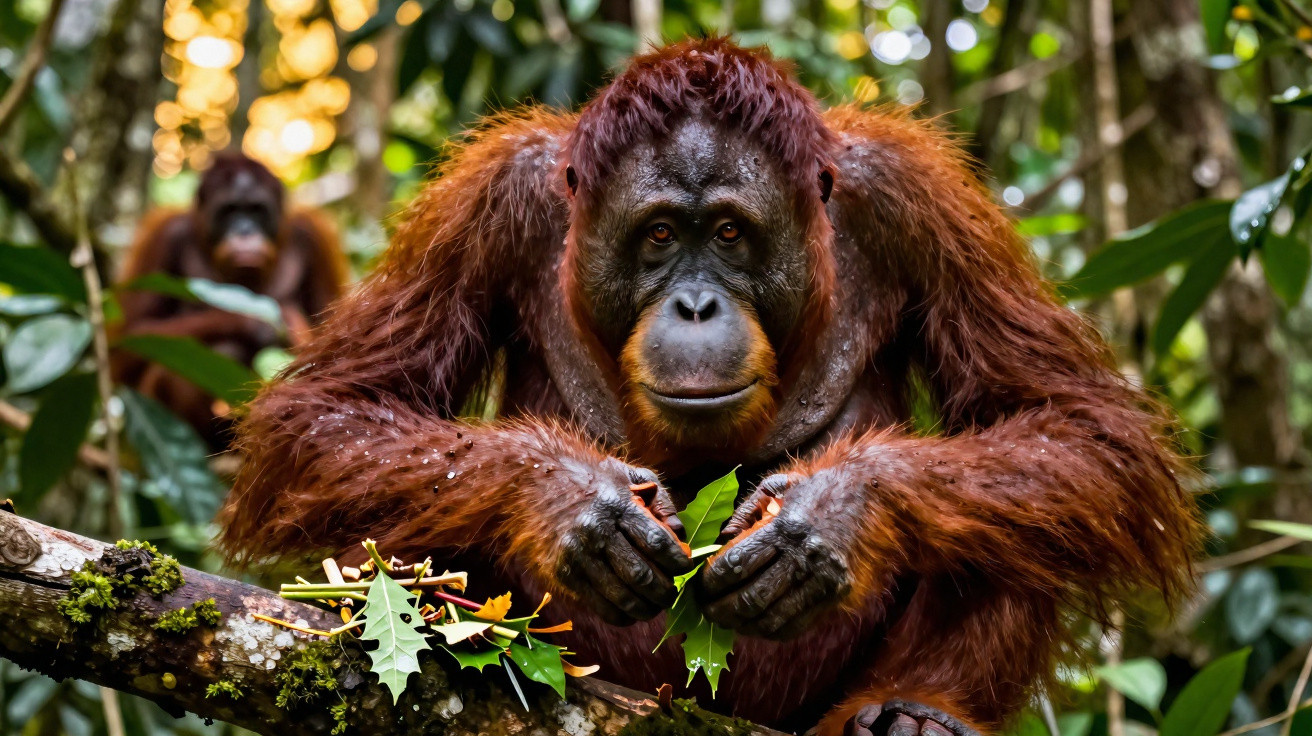
A few years ago, Max Planck Institute primatologist Isabelle Laumer and her colleagues watched a male Sumatran orangutan (Pongo abelii) called Rakus spend more than 30 minutes preparing, eating and repeatedly applying a recognised medicinal plant to an open facial wound.
The adult male, thought to be in his 30s, used his fingers to rub the juices from chewed leaves exclusively onto the wound several times. He then completely covered the injury with leaf pulp. Because Rakus did not apply the material anywhere else on his body, Laumer and her colleagues consider the treatment to have been intentional.
The team recorded the behaviour in Gunung Leuser National Park in Indonesia. On 25 June 2022, three days after they had first noticed the open facial wound, sustained during a confrontation with another male, they saw Rakus deliberately gather leaves from Akar Kuning, a climbing plant also known as Fibraurea tinctoria.
F. tinctoria has a long history in traditional medicine, where it is used to treat wounds as well as conditions including diabetes, dysentery and malaria.
Chemical analysis of the plant has identified antibacterial, anti-inflammatory, antifungal and antioxidant qualities, all of which can support wound healing.
"As F. tinctoria has potent analgesic effects, individuals may feel an immediate pain release, causing them to repeat the behavior several times and subsequently apply solid plant matter possibly to also cover the wound as a protection against flies," the researchers explain.
Recovery after the facial injury
Rakus may have encountered its pain-relieving effects accidentally while feeding on the plant, although the wound-treatment method could also be learned. Researchers had not previously seen the behaviour among local orangutan groups. Yet males leave their groups when they reach maturity, so Rakus may have learnt the useful technique within the population where he was born.
"Rakus had just gone through his secondary sexual development in the year before the incident and… seemed to try to establish himself as the new dominant local male which is reflected in our behavioral data collected during this time," the researchers note. Physical confrontations are a routine aspect of that process.
In the following days, Laumer and her team saw Rakus continue eating F. tinctoria, while the wound showed no indication of infection. By 19 July 2022, it seemed fully healed, leaving only a slight scar.
During his recovery, Rakus also rested for more than half of each day. This was notably different from the periods of rest researchers had recorded before they discovered his wound.
There are numerous reports and anecdotal accounts of self-medication in other primates. These include chimpanzees chewing the bitter pith of Vernonia amygdalina for worm infections and placing insects on wounds, although such actions have been difficult to document systematically.
Should the use of plant ointments for wound treatment turn out to be more widespread among orangutans or other great apes, it could indicate that human medical practices trace back to an era when our common primate ancestors inhabited Earth.
The research was published in Scientific Reports.

















Comments
No comments yet. Be the first to comment!
Leave a Comment