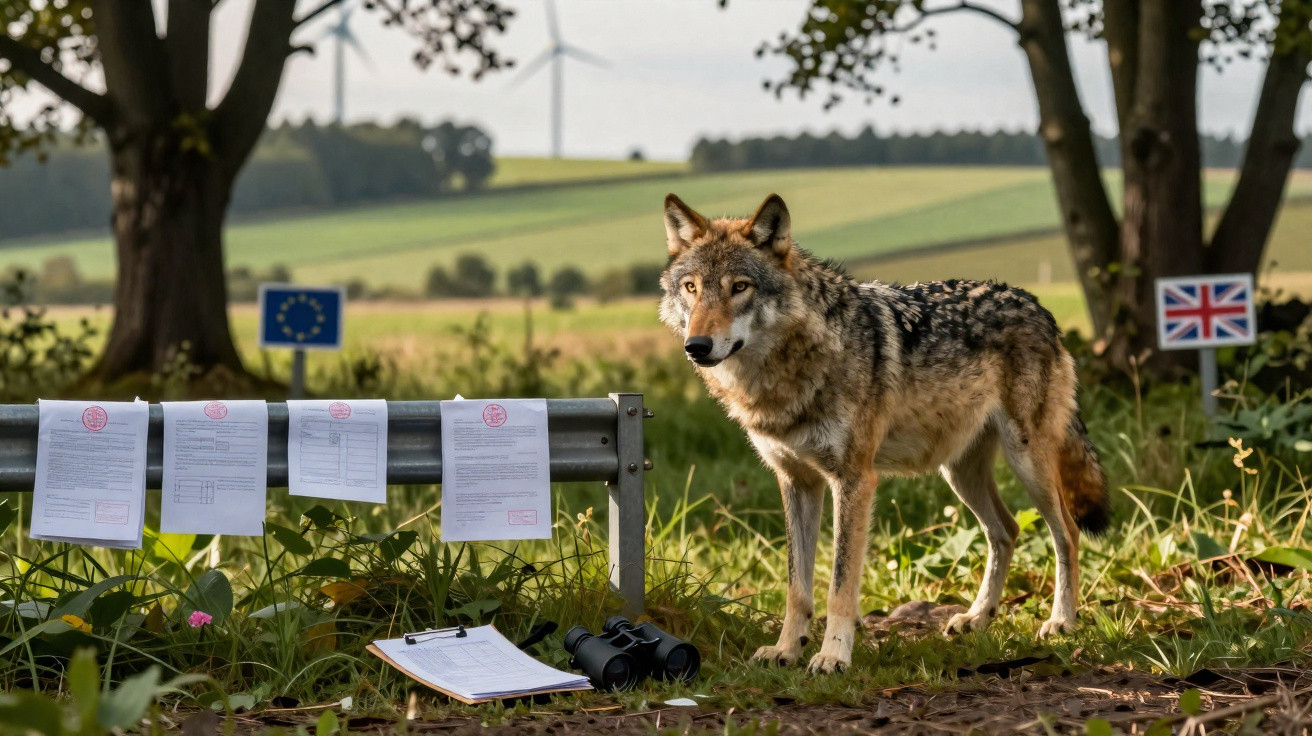
Wildlife legislation in the European Union and the United Kingdom gives animals uneven protection, safeguarding a species when it is scarce or considered useful, then diluting those safeguards as political agendas shift.
Researchers say that neither legal system recognises wild animals as individuals able to suffer.
This is more than a theoretical difference. Where legislation values an animal for its ecological role rather than its own capacity to experience feelings, protection becomes dependent on circumstances – and protections that are conditional can be removed.
According to the authors, recognising animals as sentient would make wildlife law more consistent and extend safeguards to species currently left off legal lists.
Conditional wildlife protection
Dr Caroline Cox, associate professor of wildlife law and policy at the University of Portsmouth, led the research alongside Dr Meganne Natali, a visiting research fellow.
Their paper provides the first comprehensive comparison of EU and UK wildlife legislation since Brexit.
“Our study finds that while both the EU and the UK have developed complex legal structures for wildlife protection, neither system delivers a coherent or fully effective framework,” the authors write.
Rather than providing universal coverage, the EU protects wildlife through listed exceptions.
A species receives protection only if it is included in the annexes – the official schedules – of the Habitats Directive, the bloc’s principal legislation for threatened animals and their habitats.
Nor do listed species necessarily receive enduring safeguards.
Through legal exemptions, called derogations, national, regional and local authorities may suspend those protections in particular situations, leaving them conditional instead of permanent.
Habitats remain in poor condition
Statutory protection has not produced healthy ecosystems.
Just around one in six habitat types covered by EU law is in favourable condition, while a major assessment found that over half of reviewed bird species were struggling.
The annexes determine almost everything. “Species outside the annexes receive little to no protection,” Natali said.
She added that member states may comply with the wording of the legislation even as conservation’s practical scope remains limited.
Britain reveals a comparable flaw in a different way. Its principal legislation is outdated.
The Wildlife and Countryside Act was introduced in 1981, while enforcement remains limited: convictions for wildlife offences are far lower than the conviction rate for crime generally.
The figures are bleak. Almost one in six of more than 10,000 British species assessed faces the risk of extinction, and only roughly one in seven key habitats is in good condition.
Wolves lost some protection
Across much of Europe, wolves were hunted until they were close to vanishing, before staging a notable recovery.
Their numbers have increased by about 60 percent during the last decade, placing them among the EU’s conservation successes.
However, in 2024, the EU reclassified wolves from “strictly protected” to simply “protected”, making population management – including culling in some areas – easier.
The revision was framed as a response to expanding packs and increasing tensions with farmers and hunters.
Support for the decision was limited. The European Commission’s own 2023 assessment did not justify reducing the wolf’s protection status, and concluded that non-lethal approaches protect livestock more effectively than culling.
Wildlife protection under pressure
A study examining large carnivores across Europe found that bears, lynx, wolves and wolverines had recovered where protective laws were paired with practical measures enabling people and predators to occupy the same landscapes.
The process behind the decision attracted criticism comparable to that directed at the result itself. It was affected by a restricted public consultation, limited evidence concerning livestock losses, and lobbying pressure from farming and hunting interests.
There was also disagreement about whether an attack by a wolf on a pony belonging to Commission President Ursula von der Leyen had influenced the outcome.
“The wolf downgrade demonstrates how fragile protection can become under pressure,” the researchers write.
Measuring an animal’s worth
On paper, both the EU and UK acknowledge that animals are capable of feeling. The EU’s founding treaties identify them as sentient beings, while Britain enacted the Animal Welfare (Sentience) Act in 2022.
Yet that acknowledgement has not been incorporated into the legislation that directly regulates wildlife. There remains a divide between scientific understanding of animal sentience and the way statutes address it.
Science has advanced more quickly than legislation. Following a review of evidence about their ability to feel pain, Britain’s 2022 act extended recognition to octopuses, crabs and lobsters – animals overlooked under older rules.
That rationale continues to broaden. One analysis argued that it should also apply to insects such as honeybees, whose behaviour and nervous systems resemble those of animals already protected by law.
The more fundamental issue concerns the reason wildlife is protected in the first place. Ultimately, it is about human interests.
In both systems, an animal’s value is judged according to what it provides for people – perhaps an ecosystem service or an attractive sight – rather than according to its own experiences.
The authors call this an anthropocentric, or human-centred, model. In their view, it is embedded in the foundations of both legal frameworks, so amending individual laws cannot resolve the deeper issue.
Toward stronger wildlife law
Cox and Natali set out three reforms they consider capable of reinforcing wildlife law. One would restrict derogations so that sweeping claims of “overriding public interest” could no longer be used to erode protections.
They also say enforcement must improve, management should favour coexistence over confrontation, and co-operation between countries needs to be stronger.
They caution that rules achieve little without implementation.
“Legal ambition without monitoring and prosecutorial follow-through produces symbolic protection,” the team writes.
In their analysis, inadequate enforcement reduces even far-reaching statutes to empty gestures.
Biodiversity law is still incomplete
The earlier paper concluded that protection appearing robust in legislation can prove empty in reality.
The study under discussion proposes a straightforward test for wildlife law: does it safeguard an animal only when that animal is convenient, or does it protect the animal regardless?
The authors argue that incorporating sentience into biodiversity rules would block the loopholes through which protection can disappear as priorities change.
They are currently considering how this could be achieved without converting conservation into welfare law alone.
“Without that integration, biodiversity law remains ethically incomplete and politically unstable,” the researchers conclude.
In their view, environmental law should be judged not just by whether it prevents species from disappearing, but also by whether it regulates shared landscapes with any real consistency.

















Comments
No comments yet. Be the first to comment!
Leave a Comment