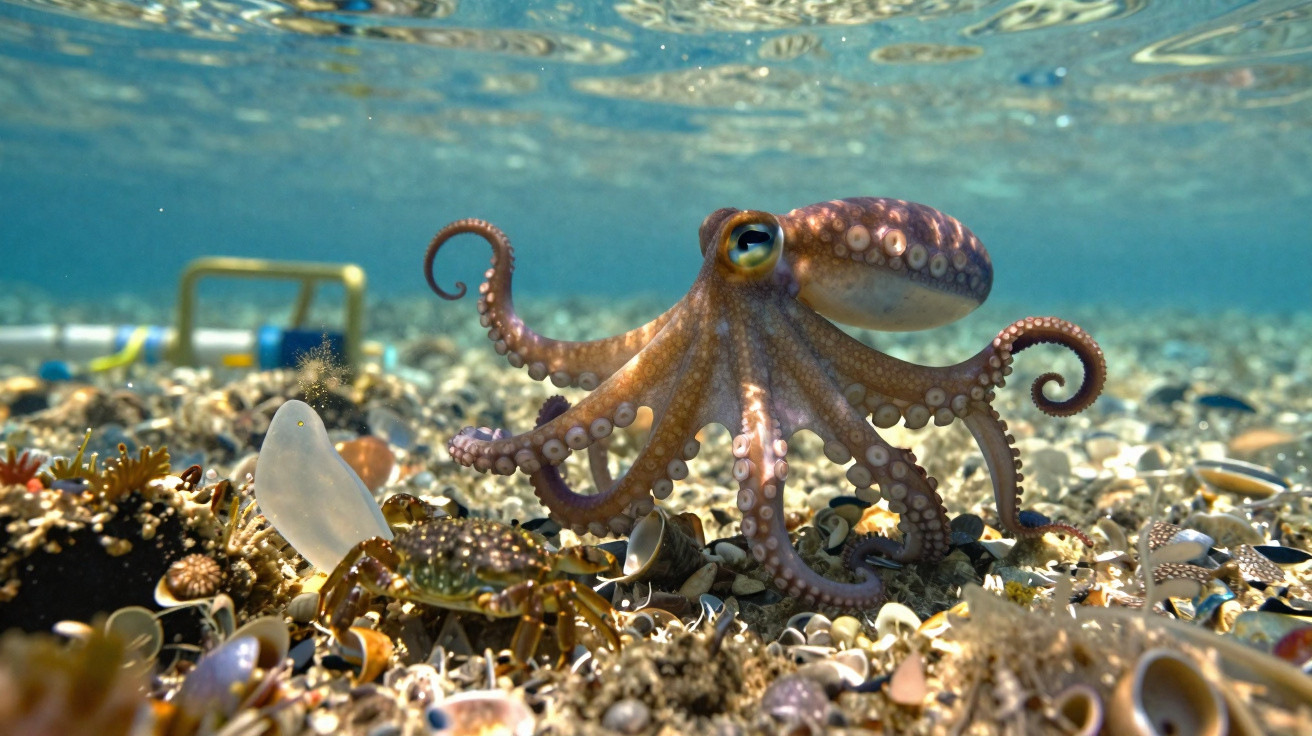
A seemingly ordinary piece of plastic could alter how ocean animals feed, conceal themselves and stay alive. Researchers are finding that chemicals released by plastic rubbish may subtly disrupt undersea life in previously unforeseen ways.
More than 350,000 chemicals are currently used worldwide. Plastic pollution carries many of them into the sea. As plastic accumulates in coastal waters, it gradually gives off substances known as additives.
These additives may disrupt the chemical cues marine animals depend on to locate food, avoid predators, select secure habitats and communicate.
One compound, called oleamide, is emerging as a particular concern.
Plastic chemical mimics natural signals
Manufacturers add oleamide as a lubricant to widely used plastics, including polyethylene and polypropylene. As these plastics gradually fragment in water, oleamide leaches out.
Oleamide is not solely man-made: living organisms produce it as well. In mammals, it influences sleep. For certain marine animals, it acts as a pheromone, a chemical signal used for communication.
It also closely resembles oleic acid, a chemical associated with death in species including crabs.
Its similarity to naturally occurring chemicals could cause marine animals to misread oleamide. That misunderstanding may alter their behaviour.
Testing octopus behaviour
Scientists at Florida Atlantic University set out to investigate oleamide’s effects on predator and prey behaviour.
They examined Octopus vulgaris, a species frequently found in the waters of South Florida. This octopus feeds on smaller marine animals, including crabs and clams.
In laboratory tanks, the researchers presented octopuses with four prey types: hermit crabs, free-living crabs, snails and clams. Cameras captured their behaviour in 90-minute sessions.
The scientists also monitored the octopuses’ food consumption over 24 hours. Altogether, they assessed more than 31,500 observations.
The researchers classified predator-prey encounters into three categories: successful hunts, failed attempts and brief grasps. Failed attempts and brief grasps were termed non-consumptive interactions.
What changed in the water
Before oleamide was introduced, the octopuses showed a clear preference for crustaceans. They selected hermit crabs and free-living crabs more often than clams or snails. Snails were the least preferred prey throughout the study.
Once scientists introduced oleamide into the water, behaviour shifted rapidly. The octopuses selected more free-living crabs and fewer hermit crabs.
This change persisted for at least three days after the chemical was removed. Hermit crab selection fell below clam selection, something that had not occurred previously.
Encounters between the octopuses and their prey became more frequent too. Yet successful hunts did not increase. Instead, failed attempts and brief grasps occurred more often.
When communication breaks down
The scientists suggest that oleamide could confuse crustaceans. It may resemble oleic acid, which signals death in some species. As a result, prey may keep looking for food rather than taking action to avoid danger.
“Many species rely on chemical information to detect food, assess predation risk, and balance the tradeoffs between foraging and staying safe,” said Dr. Michael W. McCoy, senior author of the study.
“What’s striking about this study is that when oleamide entered the system, that chemical communication appeared to break down.
“Crustacean prey reduced their predator-avoidance behaviors, even as the octopus became more exploratory and increased their interactions – especially grasps. Normally, more predator contact would heighten prey defenses. But in the presence of oleamide, that expected response simply didn’t happen.”
The octopus itself may also be confused. Octopuses use chemical cues in the water and through touch to identify prey. Oleamide may disrupt this ability, causing more contact without increasing successful hunts.
Broader implications of the study
Even slight behavioural shifts can influence an entire ecosystem. Food chains may change if prey do not properly evade predators. Greater contact between species can also alter how energy flows through the system.
“These changes in predator-prey interactions could have far-reaching effects on marine ecosystems,” said Madelyn A. Hair, first author and a research lab manager for the Gil Lab at University of Colorado Boulder.
“By altering how prey respond to predators and increasing non-consumptive interactions, oleamide leaching from plastics may ripple through entire marine communities.
“These subtle behavioral shifts could reshape the distribution and abundance of resources, change feeding dynamics, and affect interaction rates across multiple species, ultimately influencing the structure and function of coastal marine ecosystems in ways we are only beginning to understand.”

















Comments
No comments yet. Be the first to comment!
Leave a Comment