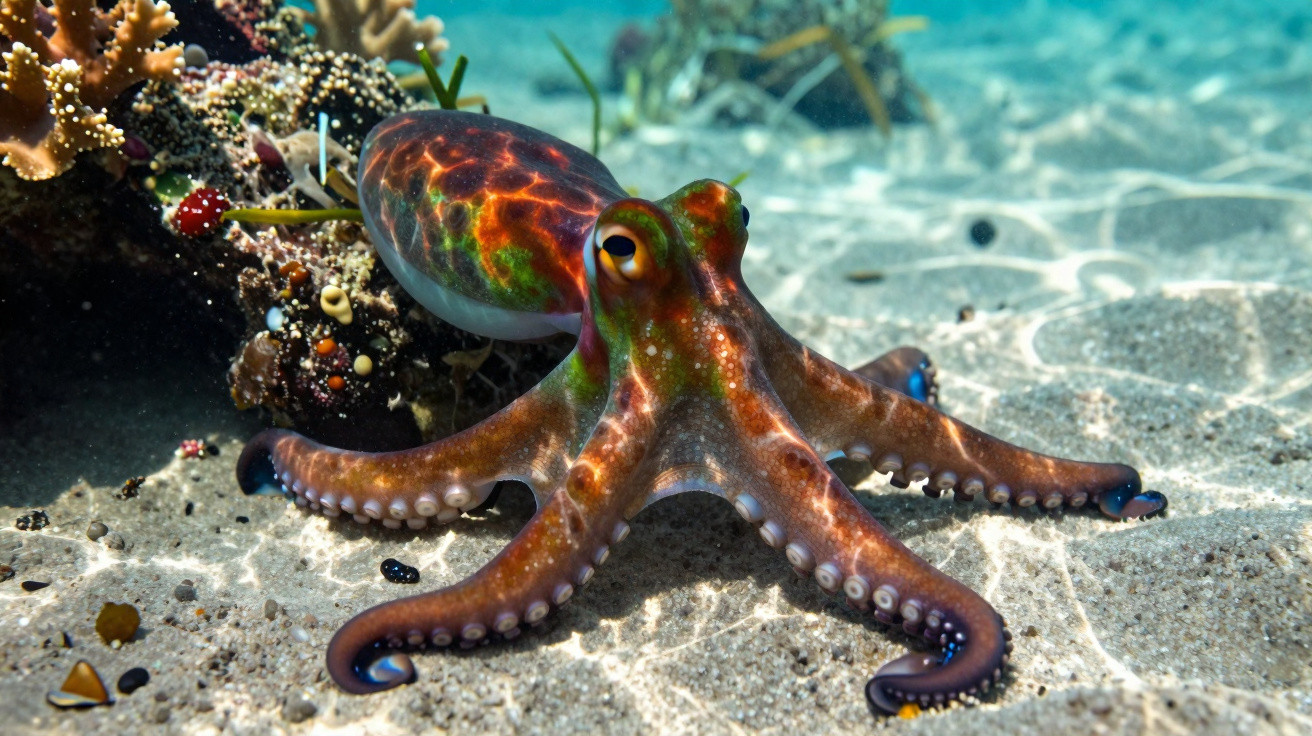
An octopus can match the shades of sand, rocks and corals within moments, even though its eyes are unlikely to distinguish colours in the way ours do. This seeming contradiction conceals an even more intriguing finding: as well as seeing through its eyes, the animal has light-sensitive skin that can respond to its surroundings without producing images.
Are octopuses genuinely colourblind?
Rather than colourblind in the human sense, scientists generally describe many cephalopods as likely monochromatic. Their eyes have only one known type of visual pigment, whereas humans have three kinds of cone cells, which compare distinct wavelengths and allow us to recognise a broad range of colours.
Behavioural experiments show that octopuses respond particularly well to brightness, contrast, outlines and polarised light. Therefore, despite lacking conventional colour vision, they can detect textures, shapes and differences in light levels that help the brain select a suitable camouflage pattern.
How does an octopus alter its appearance?
Octopus skin contains thousands of chromatophores: tiny pigment-containing organs connected to muscles and nerves. As the muscles contract, these structures spread out, making certain colours more visible. When they relax, the pigmented spots shrink, rapidly changing the pattern across the body.
Beneath the chromatophores are reflective cells, including iridophores and leucophores, which alter light to create sheen, metallic hues or pale areas. The animal can also contract muscles in its skin to form raised textures resembling rocks, algae and corals, bringing together colour, pattern and texture in a complete transformation.
Can octopus skin see light?
A 2015 study published in the Journal of Experimental Biology found that isolated pieces of California two-spot octopus skin responded to light. Its chromatophores expanded even without involvement from the eyes or brain, a phenomenon known as light-activated chromatophore expansion.
The researchers also found proteins and genes in the skin associated with phototransduction, the process that converts light into biological signals. The main distinctions between this sensory ability and ordinary vision are:
- The skin senses changes in illumination but does not create images;
- Opsins act as light-sensitive molecules;
- A local response can take place without direct instructions from the eyes;
- The brain remains vital for complex camouflage patterns;
- The precise role of this system is still under investigation.
Watch the video shared by the Pura Ciência YouTube channel for more mysteries about octopuses.
How do octopuses choose colours without recognising them?
The most widely accepted explanation is that an octopus does not need to perceive every colour as a person does in order to conceal itself. It can assess light intensity, the size of patches, edges and the visual texture of the setting. The brain then activates pigment combinations refined through evolution for different types of background.
Some scientists are also examining whether optical properties of the eyes could enable indirect discrimination between wavelengths. Another theory suggests that the skin may help monitor the animal's own appearance, providing a form of local sensory feedback. So far, however, there is no evidence that the skin independently recognises colours.
What does this octopus mechanism reveal about nature?
The octopus demonstrates that perceiving the world does not depend on a single biological solution. Its eyes supply detailed information, its brain organises responses, and its skin contributes to light detection while carrying out visual changes. The outcome is a fast, distributed system that differs greatly from human experience.
Examining this mechanism closely means moving beyond the assumption that complex senses must operate like our own. The more scientists study octopus skin, the more clues emerge about new forms of perception. Protecting these animals and their habitats is urgent, so that extraordinary discoveries do not vanish before they can be understood.

















Comments
No comments yet. Be the first to comment!
Leave a Comment