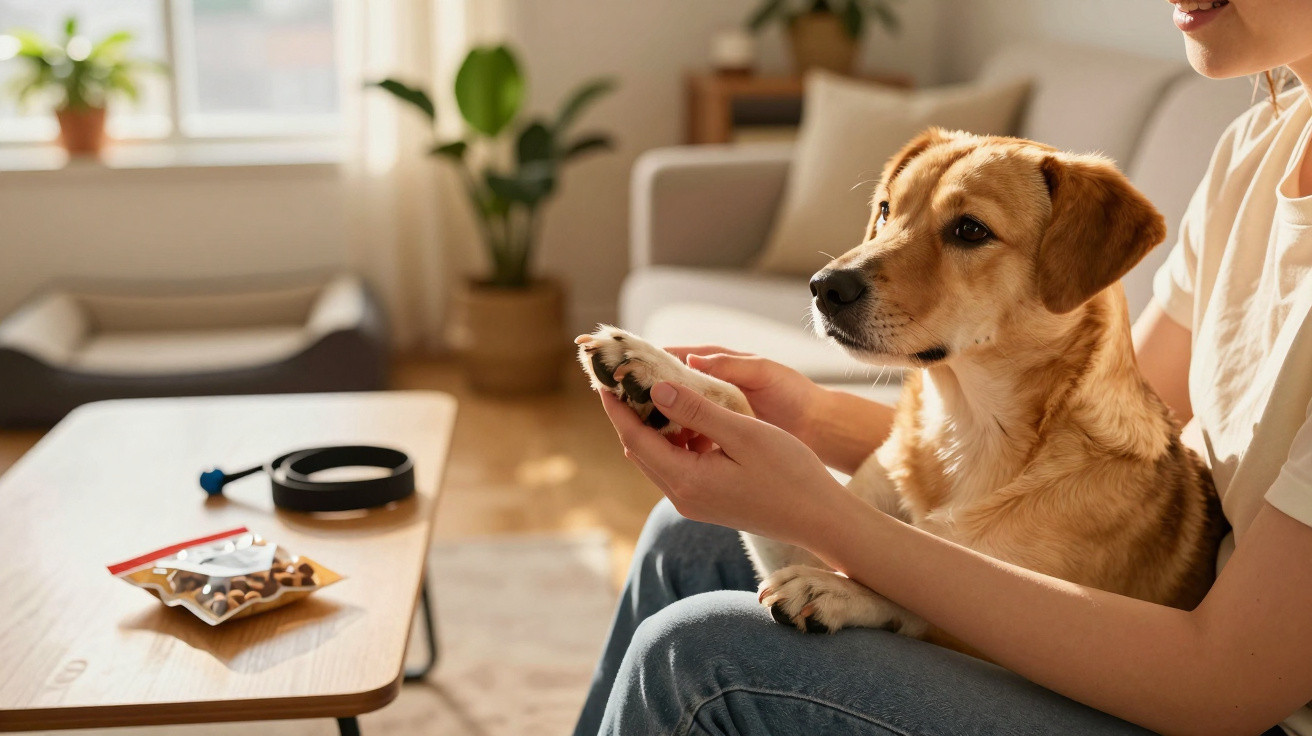
The dog looks at you first.
Then, slowly and almost timidly, a paw rises and settles on your knee. People often laugh and say, “Oh, are you saying hi?” or “You want to play again?” The setting barely changes: a sofa, a kitchen chair or perhaps the side of the bed, with that warm, persistent pressure of fur and claws asking for… something.
Our usual response is a chuckle, a treat or a quick stroke. Social media is packed with clips of “polite” paws and “handshake champions”. It seems sweet, innocent and almost instinctive.
But animal behaviourists repeatedly make the same point: that small, quiet paw is seldom meaningless. Often, your dog is trying to send a message that you have not yet learned to interpret. At times, the message may be more pressing than it appears.
When a paw on your leg means more than hello
The next time your dog puts a paw on you, watch the rest of their body. This is usually where the real answer lies. A dog seeking contact while feeling at ease will have relaxed shoulders, gentle eyes and a loose, wiggling body. The paw is simply one part of a wider emotional picture.
Animal experts explain that pawing is frequently learned behaviour. Dogs realise that touching us produces a result: attention, food, a walk or eye contact. Naturally, they do it again. Beneath this learned habit, however, is something more significant: the paw is a quick route through our distracted human minds. It is the canine equivalent of a gentle tap on the shoulder while you are absorbed in your phone.
Look more closely at these interactions and they seem less like play than a quiet appeal. Dogs do not have language. They use their paws.
Picture a late evening in a small Manchester flat. A woman in her thirties is replying to emails on the sofa, with her laptop on her knees. Her spaniel, Milo, is lying at her feet with half-open eyes. Suddenly, he sits upright and places one paw on her thigh. She laughs, “You again?” and gives his head a distracted stroke without looking away from the screen.
Two minutes later, the paw returns. Now Milo’s ears are held slightly back and he is breathing more quickly. When she finally gives him her full attention, she sees him licking his lips, moving his weight about and looking towards the door. She takes him outside. He has diarrhoea and is clearly unwell. That mild paw was not a comic gesture; it was more like an alarm bell.
Accounts like this are common. Trainers say many dogs paw more during stressful periods: when a new baby arrives, renovations create noise or an established routine abruptly changes. Pawing often increases when their familiar schedule is disrupted or physical discomfort begins. We may dismiss it as “clinginess”, but behaviour clinic data suggests otherwise: it can be a warning sign of unmet needs or underlying anxiety.
When specialists examine pawing, they generally identify three main motivations. The first is attention-seeking. Dogs want social contact; to them, we are their world, their pack and their entertainment. When looking at you has no effect, a paw often does.
The second is communicating a need: thirst, discomfort, the wish to go outside or a request for help with something that does not feel right. A dog with arthritis, for instance, may paw more because lying down is painful and they cannot quite find a comfortable position.
Third comes emotional regulation. Pawing may soothe a dog, helping them reconnect with the “safe base” that you provide. It is not manipulation; it is survival. A dog’s paw is often a bridge between their inner chaos and your calm presence. Viewed this way, the small touch carries far more weight. It is not always an invitation to play. Sometimes, it is about hanging on.
How to respond to your dog’s paw like an expert
Animal behaviourists suggest a straightforward routine when your dog paws at you. Begin by pausing for two seconds rather than reacting on instinct. Those two seconds allow you to observe what is actually happening.
Next, make a quick head-to-tail assessment. Are their eyes soft or wide? Is the tail relaxed or tucked under? Is their mouth open and loose, or closed and tense? Notice other signs too: yawning without being tired, frequent lip-licking, turning the head away or shifting weight between legs. Such small details reveal whether the paw is playful or carries concern.
Only then should you react. If your dog appears calm, make it a brief moment of connection: “I see you,” followed by a gentle stroke or a short game. If they seem agitated or tense, get up and check whether they need to go outside, have a drink, move away from noise or rest in a quieter room. Minor changes can bring considerable relief.
Many owners fall into the same trap: rewarding every instance of pawing without thought. Whenever their dog touches a leg, they stop everything and respond with huge enthusiasm or a treat. This can turn an occasional request into a relentless, almost compulsive demand.
The reverse mistake is to ignore the dog every time. Some people decide pawing is “annoying” or “pushy” and brush the paw away on each occasion. Their dog may then intensify the behaviour by scratching and whining, or withdraw and stop trying to communicate. Neither result builds trust.
Guilt can also become part of the picture. Between busy days, long shifts and children to look after, who has not seen their dog pawing at them and thought, “Not now, please”? That is ordinary life. Let us be honest: nobody manages this perfectly every day. The aim is not perfection, but improvement. Noticing the paw one time in three can already alter the relationship.
As canine behaviourist Laura Sanders puts it:
“When your dog gives you their paw, they’re not trying to be cute for the camera. They’re testing a simple question: ‘Are you emotionally present with me right now?’ Your answer, over time, shapes who they become.”
To simplify this, specialists often offer a short checklist to remember when that paw lands on your jeans, pyjamas or office chair.
- Check the basics – water, a need to go outside and the room temperature.
- Scan the body – limping, flinching, unusual stiffness or scratching.
- Read the face – whether the eyes are relaxed or tense, ear position and mouth shape.
- Consider the context – unfamiliar sounds, visitors, arguments or recent changes at home.
- Choose your response – attention, calm redirection or a health check if something seems wrong.
Reading the hidden messages behind your dog’s gentle paw
To understand pawing, step back from the individual moment. Dogs live through patterns. One paw on its own may reveal little. A paw that appears every evening at the same time, after the same street noise or whenever the same person arrives home, begins to look like evidence.
Some experts recommend keeping a brief note on your phone for a week. Each time your dog paws at you, record the time, location, activity and their body language in a single line. Within a few days, a pattern often becomes visible. Perhaps your dog paws most when you are using your phone, when a certain television programme’s theme tune begins or shortly before a storm.
That pattern may point to fears, such as loud noises or tension in the house; unmet needs, such as insufficient exercise between long work shifts; or even medical worries, including increased pawing alongside restless nights or appetite changes. Once a pattern emerges, you have a map. With that map, you can make meaningful changes.
For certain dogs, the paw also acts as a mirror. They use it more around humans who are anxious, distracted or sad, almost as though they are checking on us. We often say that we comfort our dogs, yet emotional support can move in both directions. On a difficult day, you may find a paw landing on your arm with unusual persistence as your dog presses closer than normal.
Within a family, pawing can expose unspoken relationships. A dog that paws only the teenager who walks them, rather than the parent who feeds them, may be showing who they genuinely trust to listen. A dog that paws more after arguments or raised voices is not necessarily attempting to stop the dispute; they may be trying to ground themselves in somebody’s calmness.
When you begin to treat pawing as a language, your home can feel subtly different. More peaceful, even if nothing outwardly changes. You no longer dismiss the behaviour as “quirky” and instead recognise it as an ongoing conversation. That conversation will not always provide tidy answers.
Some days, you will respond wonderfully: you will notice the tension, shorten a walk, arrange a vet appointment or create a quieter corner of the home. On other days, you will be abrupt, irritated or miss the sign entirely. That is part of sharing life with a sensitive animal in a loud, hurried world.
What usually shifts after you have listened carefully a few times is your basic attitude. Every paw becomes an invitation to pause for five seconds, look up from the screen or concern holding your attention, and ask one simple question: “What are you trying to tell me?”
You will not always understand correctly. Dogs are forgiving, though. They continue trying, continue pawing and continue offering that soft, slightly awkward gesture which says, in their own way, “We’re in this together, aren’t we?” Perhaps that is the real point: not interpreting every signal flawlessly, but recognising that your dog is quietly and persistently trying to speak.
| Key point | Detail | Why it matters to the reader |
|---|---|---|
| Pawing is communication | It often signals a need, emotion or discomfort rather than simple play | Helps you avoid overlooking early signs of stress or health problems |
| Context is everything | Body language, routine and surroundings alter the meaning of the paw | Gives you a clear way to “decode” your own dog’s behaviour |
| Your response shapes the habit | What you reward or ignore teaches your dog how, and how often, to paw | Enables you to reduce unwanted pawing while strengthening real connection |

















Comments
No comments yet. Be the first to comment!
Leave a Comment