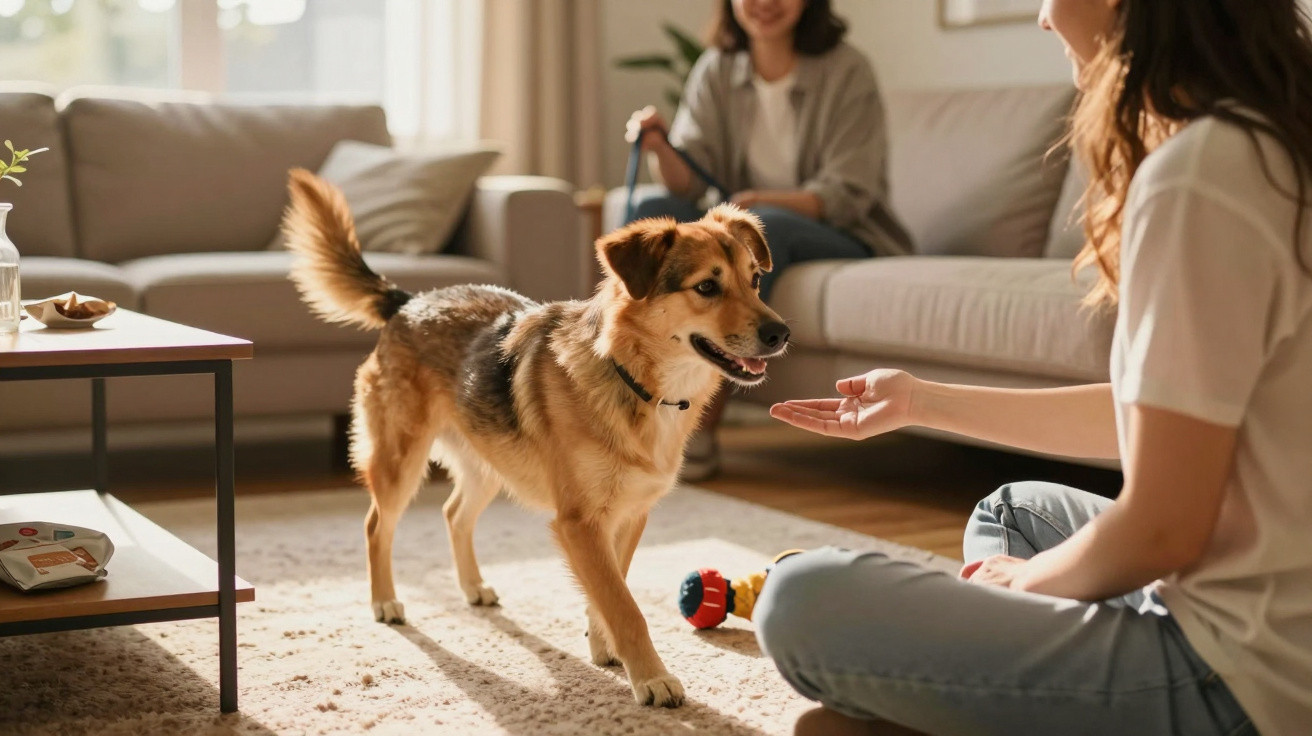
You are sitting on the sofa with a coffee, idly scrolling through your phone, when you hear it: keys turning in the front door.
Your dog has been dozing at your feet for the past hour, but suddenly springs up and races from the room as if you are not there. Moments later, delighted squeals erupt from the hallway. Their tail pounds against the wall, paws slide across the floor, and they make that high-pitched whine dogs seem to save for one particular person.
You wander out to see the reunion, feeling entertained and, perhaps, slightly slighted. You feed the dog. You take them for walks. You even buy the posh treats.
So why does it seem so obvious that they love somebody else a little more?
Yes, your dog probably has a favourite person - and it is not random
Speak to anyone in a household with several people and you will hear a familiar admission. The dog supposedly belongs to everybody, yet they really revolve around one person like a furry little moon. You are not imagining it. This is attachment.
Researchers describe this as the “secure base effect”: dogs treat one person as an emotional anchor. You can see it in the way they trail them from one room to the next, place their head on their knee, or stare at the door after they have gone out.
It goes beyond simple affection. Your dog has quietly decided which person makes them feel most secure.
Consider those everyday moments. A dog races to greet the teenager arriving home from school, yet barely raises an eyebrow when Dad comes through the door. A rescue dog shelters behind one partner at the vet while acting as though the other is not there. A puppy picks one lap on film night, then returns to that same lap thereafter as though it is their base.
A 2015 study by the University of Vetmed Vienna found that dogs investigated unfamiliar settings with greater confidence when their “favourite human” was there. Their heart rates fell, they sniffed more, and their muscles became less tense.
They are not merely attached to that person; they experience the world differently in their presence.
How, then, do dogs select this so-called favourite? It is seldom the person who loves them most loudly. More often, it is the person who remains calm, engaged and predictable. Dogs notice who understands their signals, who reacts in a consistent way, and who turns towards them rather than waving them away with a distracted hand.
They are taking in your scent, too, in ways humans barely notice. Stress, daily habits and diet all leave chemical clues that tell your dog whether being near you means “safe” or “tense”.
From their perspective, they are not being unfair or dramatic; they are simply choosing the human whose world feels easiest to understand.
How dogs secretly rank the humans in their lives
To work out who your dog truly adores most, ignore the Instagram photographs and watch the transitions. Notice whom they follow from the bedroom to the kitchen, whom they check on when an unfamiliar sound occurs, and whom they look towards before choosing whether to bark, play or settle down.
Dogs reveal attachment through tiny gestures. When a dog presses their full weight against your leg, they are saying, “You’re my pillar.” When they choose your side of the bed every night, they are making their preference known.
These small, repeated decisions form a private hierarchy they never declare, but follow every day.
Imagine a rescue dog called Luna living in a shared flat with four housemates. She receives endless cuddles, and everyone insists she is “their” dog. Initially, she is timid around all of them. Gradually, however, she starts sorting them into patterns.
When Emma is on a night shift, Luna sleeps by the door and paces until she hears Emma on the stairs. She plays more boisterously with Marco because he matches her energy. She accepts treats politely from the others, then takes them into Emma’s room to eat.
There was no vote and nobody asked Luna what she thought. Still, every action tells the same story: her emotional favourite is the person who kept turning up each day with a calm gaze and an even voice.
From a dog’s perspective, people are not equal pieces of information. They are patterns. A social animal’s brain is always keeping track: Who feeds me? Who frightens me? Who pays attention when I am frightened? Who makes everything noisy?
In time, their nervous system categorises these patterns as “safe base”, “playmate”, “background noise” and, at times, “danger”. A favourite person usually meets three conditions at once: a steady presence, clear communication and emotional safety.
In reality, no one manages that perfectly every day. Life becomes chaotic, stress gets to us, and we can be short-tempered. Dogs nevertheless register the overall pattern. The person whose presence is generally kind and dependable often takes the unspoken top place.
Can you become your dog’s favourite person?
If you are currently the person your dog treats as “background noise”, there is encouraging news. Dogs are remarkably adaptable. Their favourites can change over time, particularly when routines and relationships shift. The answer is not a grand gesture; it is repetition.
Begin with brief, undivided moments of attention. Spend five minutes on a sniff-filled walk at your dog’s speed. Give them two minutes of gentle ear rubs while looking at them rather than at your phone. Play short, enjoyable training games in which they receive rewards for straightforward choices.
You are creating a fresh association in their brain: when you appear, good and easy-to-understand things happen.
A common mistake is attempting to “buy” affection with excessive fuss while overlooking what the dog is actually communicating. That might mean hugging a dog who is leaning away, lifting them onto the sofa when they would rather rest on the floor, or trying to create excitement when their body is rigid with anxiety.
We have all experienced that moment of trying too hard, only for the dog to look... politely baffled. Resentment can then creep in for both of you. You feel rebuffed, while your dog feels under pressure.
Instead of asking, “how do I get them to love me most?”, ask, “how do I become easy to be around?” That small shift in thinking is often what unlocks the answer.
“Dogs don’t fall in love with the loudest person in the room,” says one canine behaviorist I spoke to. “They fall in love with the person whose behavior makes sense on a Tuesday afternoon when nothing special is happening.”
- Watch their body language: Soft eyes, relaxed muscles and slow tail wags say “yes, more of this”. Lip-licking, yawning and a stiff posture often say “this is too much”. Honouring those signals builds trust quickly.
- Use a consistent mini-ritual: It could be a brief “good morning” scratch in the same place or a three-minute training game before dinner. Rituals tell your dog, “You can count on this.” That dependability is invaluable.
- Be their safe exit: During parties or busy family meals, quietly provide a way for them to leave: a peaceful room, a bed in the corner or a walk outdoors. Being the person who releases pressure is among the quickest routes to favourite-person status.
The quiet bond your dog builds when you are not looking
Once you begin to spot it, the favourite-person pattern appears everywhere. Notice how your dog’s ears turn towards one voice in a loud room, how they sink into a slightly deeper state of relaxation when one particular person sits down, or how they seek that person’s eye contact when unsure - like a child searching a parent’s face before deciding how to react.
This hidden ranking is not about fairness or personal worth. From your dog’s ancient perspective, it is about survival. Who helps me make sense of this baffling human world? Who makes my body feel calm? Who gives me the clearest clues about what will happen next?
The answer may change. Someone might move away, a baby may arrive, work may alter, or health may change. As the household’s rhythm evolves, a dog can gradually move their deepest attachment from one person to another. Sometimes, though, that first favourite remains their favourite: a constant thread through years of walks, naps and shared habits.
If you are that person, it is a privilege. If you are not yet, the door is not shut. Bonds take shape in uneventful hours rather than major occasions: in how you fasten a lead, how you wait while they smell the same patch of grass for the fifth time, and how you say their name when no one else is listening.
Your dog is continually deciding who feels like “home” that day. Not in a dramatic, film-worthy fashion, but through a succession of little, ordinary votes expressed with paws, eyes and quiet sighs on the sofa.
Perhaps the more intriguing question is not “Am I the favourite?” but “What story is my dog telling themselves when I walk into the room?”
The answer lies in their body language, your routines and the invisible thread you are weaving together, one Tuesday afternoon at a time.
| Key point | Detail | Value for the reader |
|---|---|---|
| Dogs often have a clear favourite person | They reveal it by following, leaning and checking in during stressful moments | Helps you interpret ordinary behaviours and avoid taking them personally |
| Favourites are chosen through patterns, not grand gestures | Consistency, calmness and clear communication are more important than endless treats | Gives you a realistic way to strengthen your bond |
| You can gently move towards “favourite” status | Brief, focused attention and respect for body language create deep trust over time | Provides practical ways to become the human your dog feels safest with |
FAQ:
Question 1: Can a dog have more than one favourite person?
Yes. Plenty of dogs have one primary favourite alongside one or two “secondary favourites”. Depending on the situation, they may seek comfort from one person and play from another.Question 2: Do dogs ever change their favourite person?
They can. Significant changes, such as moving home, having a new baby or one person taking over day-to-day care, may gradually alter the bond, particularly for young or newly adopted dogs.Question 3: Does a dog’s favourite always match who feeds and walks them?
Not necessarily. Regular care is important, but emotional tone and predictability matter just as much. A calm, gentle person who does not feed the dog may still be their favourite.Question 4: How long does it take for a rescue dog to choose a favourite?
It may take weeks or several months. Some dogs form attachments fast, while others wait until they feel secure. For many, genuine preferences begin to emerge at around the three-to-six-month point.Question 5: What if my dog clearly prefers someone else in the family?
There is no need to compete. Concentrate on creating your own kind of connection through quiet walks, short training games and calm companionship. With time, you can become equally important in a different but equally special way.

















Comments
No comments yet. Be the first to comment!
Leave a Comment