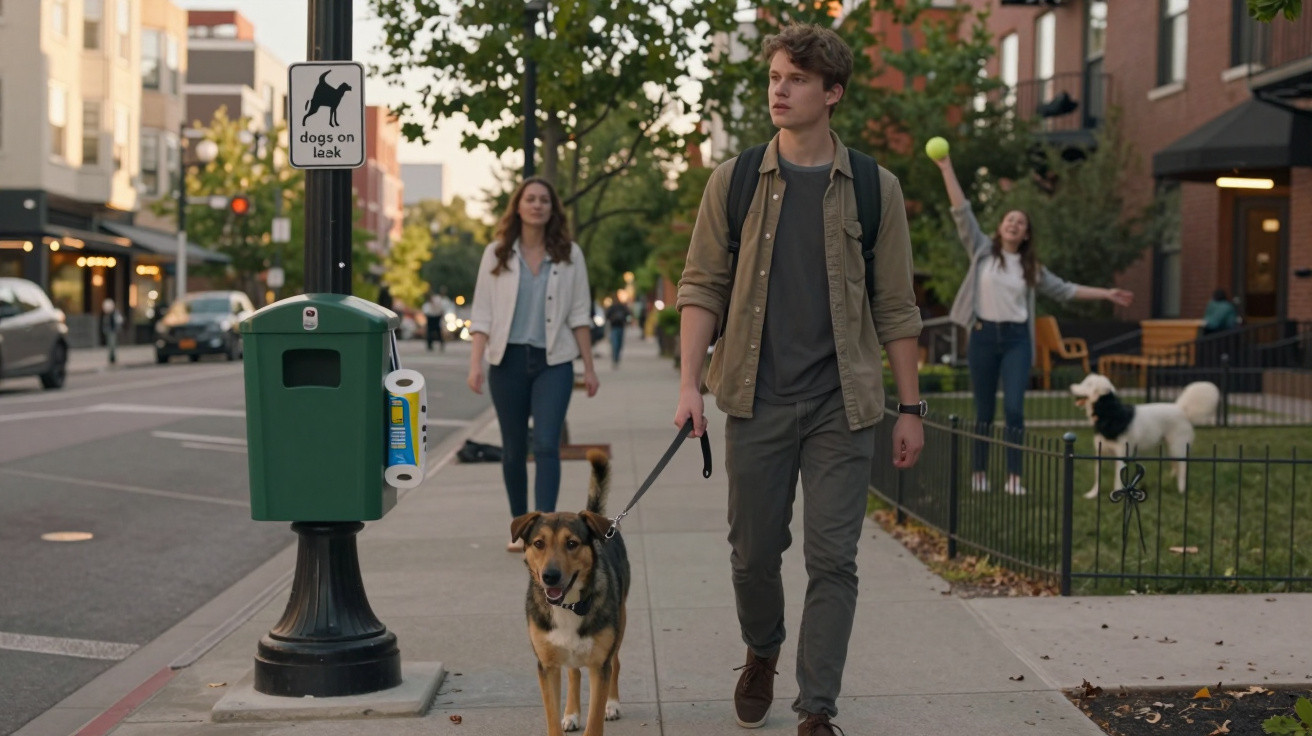
Cold pavements, crowded streets and a lead in hand: for many dog owners in cities, an ordinary walk has become unexpectedly fraught.
On busy urban streets, the everyday dog walk has changed from a peaceful habit into a minor social trial. Owners notice people watching, catch quiet remarks and alter their routes to prevent disagreements. Beneath these everyday irritations sits a broader issue: how can dogs continue to belong in cities becoming more crowded, tidier and more tightly regulated each year?
Dog walks under scrutiny: when a dog becomes a social statement
Glances, tension and narrow pavements
Speak to city dog owners in London, Paris, New York or Berlin and much of what they report is strikingly alike. A woman steps across the road as soon as she sees a staffie. A parent draws their child nearer while a Labrador passes by. A man complains about “filthy pavements” as he skirts a grassy patch. No individual moment is especially dramatic, but collectively they create an atmosphere of persistent, low-level strain.
For many owners, walking a dog no longer feels invisible. It feels like being silently graded by strangers.
Noise, cleanliness and fear are central to this unease. Night-time barking, packed stairwells, small lifts and tight pavements in winter encourage the view that dogs occupy “too much space”. Even animals with excellent manners are often placed in one broad category: a possible nuisance.
“You can feel the judgment before anyone says a word”
Owners tend to describe a change in social attitudes rather than a surge in serious incidents. Most report that outright confrontations are uncommon. Instead, they live with a continual background sense of disapproval: a sigh in the entrance hall when a dog shakes off rain, a neighbour rolling their eyes in the lift, or a stranger watching the poo bag in your hand as though deciding whether you will actually use it.
A number of familiar patterns appear in large cities:
- Parents placing themselves protectively between a child and a dog, even on broad pavements.
- Older residents objecting to muddy paw marks in shared corridors.
- Housemates or landlords demanding that dogs are never visible in communal areas.
- Residents’ associations treating any bark as a disturbance of the peace, including during the day.
For first-time owners, this can be unexpected. Many imagined that a dog would be a small social magnet; instead, every walk can feel as though it carries a degree of social danger.
From family companion to public nuisance? The divided image of city dogs
Advertising and social media still present urban dogs as appealing: sleepy whippets on mid-century sofas, French bulldogs carried in tote bags and golden retrievers wearing Christmas jumpers. Out on the pavement, those same animals can provoke the reverse response. A damp coat, an unanticipated bark or mud on an immaculate walkway can quickly change the impression from “cute” to “problematic”.
The same dog that warms the living room can feel, beyond the front door, like a walking controversy.
Research nevertheless continues to show that dogs help connect isolated people to neighbourhood life. They get owners outdoors on dark winter mornings, prompt brief exchanges between strangers and bring routine to people living alone. Cities gain from this subtle social bond, although they do not always recognise it.
How cities quietly reshape life with dogs
Dog runs, micro-parks and shared responsibility
As friction grows, some councils are beginning to view dogs as an urban-design matter rather than simply a source of nuisance. Rather than excluding them from additional places, they set aside purpose-built areas: enclosed dog runs in heavily used parks, compact gravel spaces beside playgrounds and weatherproof sections with lighting and drainage where dogs can exercise safely off lead.
| City measure | Benefit for owners | Benefit for non-owners |
|---|---|---|
| Fenced dog runs | Safe off-lead exercise, socialisation | Less chaos on shared lawns and paths |
| Dog-free quiet zones | Clear rules, fewer complaints | Spaces for people who fear or dislike dogs |
| Bag dispensers and bins | Easier clean-up on long walks | Cleaner pavements, fewer arguments |
Community schemes provide another layer of support: winter dog gatherings in parks, training sessions run by neighbourhood groups and building WhatsApp chats in which residents can raise concerns before they become formal conflicts. Such steps seldom attract headlines, but they can gradually ease some of the everyday tension surrounding dogs.
The hygiene issue that never fully disappears
Few things damage relations more quickly than one pile of uncollected dog mess on a frosty pavement. For many people without dogs, that single sight reinforces every existing prejudice. Cities are well aware of this and have responded through campaigns, higher fines, free bag dispensers near parks and, in certain areas, DNA registration programmes intended to identify irresponsible owners.
One owner who fails to pick up after their dog does not just break a rule. They damage the social licence that all owners rely on.
Conscientious owners can feel caught between their own conduct and the actions of a small minority. They bring bags, clean lifts after accidents and wipe muddy paws in entrance halls. Their efforts generally go unnoticed, whereas the mess left by a few does not.
Dog walkers, day care and digital solutions for crowded lives
Contemporary city living does not always accommodate an animal’s needs easily. Long working hours, limited homes and winter darkness can make sufficient exercise difficult. This shortfall has created opportunities for services such as app-based dog walkers, pop-up day-care centres close to office districts, subscription dog-sitting platforms and indoor play areas for rain-drenched evenings.
These services reshape the connection between dogs and the city in two respects. First, they offer animals more dependable routines and can lessen stress-related behaviour, including barking and destructive chewing, which neighbours commonly find troubling. Second, they make dogs seem like part of routine urban infrastructure rather than an inconvenient extra.
Rethinking the dog’s place in tomorrow’s city
Moving from improvisation to proper planning
Urban planners increasingly need to consider dogs with the same precision used for bicycles or bins. This involves mapping popular walking routes, locating “conflict zones” around playgrounds and cafés, and creating pavements wide enough for prams and large dogs to pass each other without drama. It also requires animals to be considered in housing policy, through ventilation in pet-friendly flats, sound insulation and clear pet clauses in tenancy agreements rather than vague prohibitions that many people quietly disregard.
Some cities are trying ideas such as communal “dog balconies” in new schemes, rooftop toilet areas in tall buildings or small indoor dog rooms at supermarket entrances, preventing illegal tie-ups at street level. These trials may appear modest, yet they communicate an important point: dogs are not merely an afterthought.
What considerate ownership means in dense neighbourhoods
Support from councils and neighbours has limits when owners behave without care. In confined places, small routines matter more than grand statements. Responsible urban owners commonly follow several unwritten principles:
- Keep the lead short in busy places, extending it only in open areas.
- Teach recall and basic obedience before attempting busy high streets.
- Do not allow a dog to approach children, prams or other dogs without clear permission.
- Schedule energetic walks for early morning or late evening, when pavements are calmer.
- Address barking through training, mental enrichment and veterinary support where necessary.
Respect in a dense city often looks very ordinary: a step to the side, a clipped lead, a quick apology, a clean pavement.
These ordinary actions lower the emotional temperature. They also demonstrate to people without dogs that welcoming dogs into city life does not mean allowing them to roam the streets without control.
Are attitudes beginning to soften?
There are early indications of a gradual change. More rental buildings now permit dogs under clearly defined conditions. Workplaces offer “dog-friendly days” governed by structured rules. Parks are testing periods when dogs can run off lead, balanced with quiet times for people wanting more space. Social media accounts increasingly post examples of good pavement etiquette alongside criticism of poor behaviour.
At the same time, surveys indicate that anxiety and irritation remain pronounced in some areas, particularly where green space is limited. Those raised without animals may read ordinary canine behaviour-sniffing, sudden play bows or louder barks-as threatening. Without basic education, infrastructure alone cannot close that divide.
Useful perspectives for owners, neighbours and city officials
Understanding dog body language to reduce anxiety for everyone
Much street-level tension stems from misunderstanding. People often interpret direct staring or swift movement as aggression, although it may simply reflect curiosity or excitement. Knowing several basic signals can help:
- Relaxed body, tail wagging at mid-height: generally calm, friendly interest.
- Rigid stance, tail raised, ears forward: alertness that may turn into conflict if pressured.
- Yawning, lip licking, turning the head away: indicators of stress; the dog wants space.
- Tail tucked, body lowered: fear, with a greater chance of reacting when cornered.
Brief public-awareness campaigns in schools or community centres explaining these signals can greatly reduce fear. They can also help owners recognise when their own dog is overwhelmed by crowds or noise and adapt walks or training accordingly.
Balancing the genuine risks and benefits of dogs in cities
Conversations about dogs can swing between alarmism and sentimentality. A more practical perspective considers the available figures. Serious dog bites are statistically rare when compared with other accidents in the home. Risks increase sharply when dogs have no training, live in unstable households or endure ongoing stress. Conversely, regular interaction with dogs is associated with greater physical activity, lower loneliness scores and more contact between neighbours.
Cities that approach these compromises seriously generally put resources into three areas simultaneously: owner education, basic infrastructure and fair rule enforcement. This combination cannot remove every point of friction, but it can stop an ordinary daily walk becoming a silent confrontation.

















Comments
No comments yet. Be the first to comment!
Leave a Comment