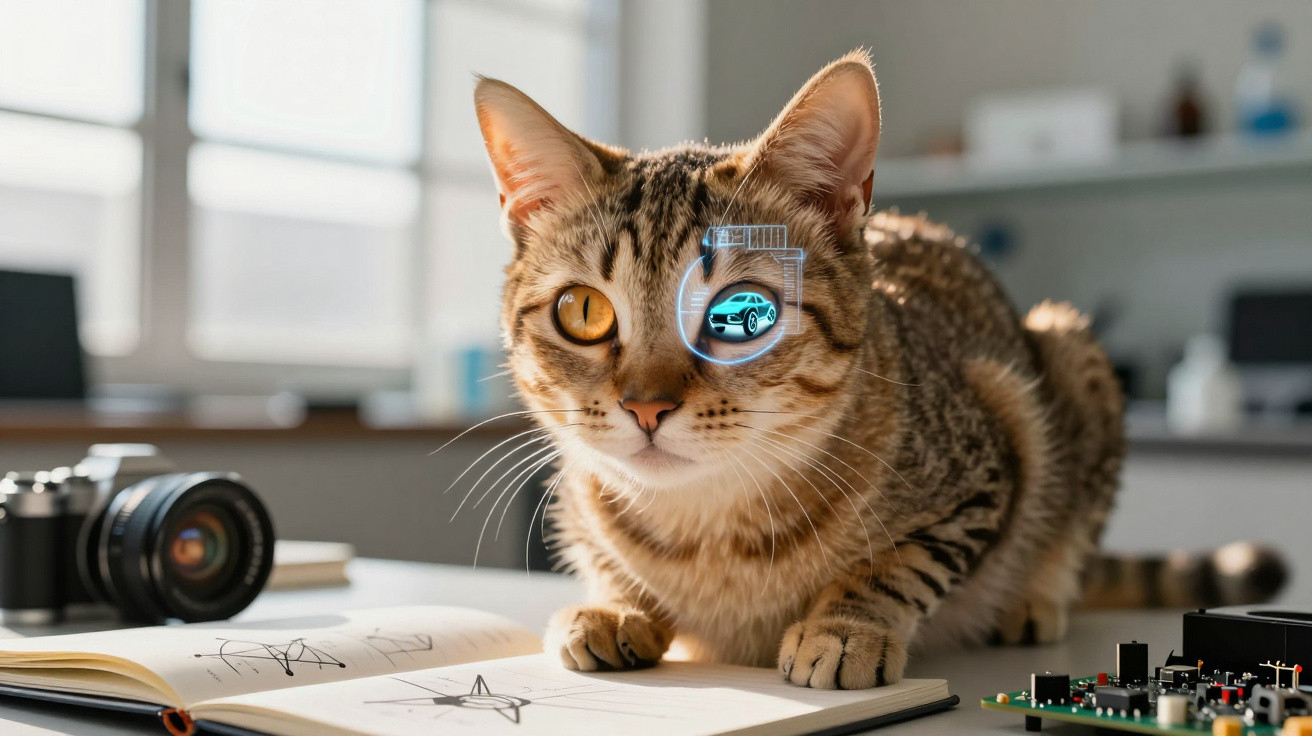
A nearly dark room, a motionless feline shape in the corner, and two shining points that seem to see everything passing by.
While most people feel their way through the gloom, cats move with almost flawless precision. This advantage is neither magic nor urban myth: it comes from a remarkable blend of anatomy, physics and evolution - and it is now becoming a model for engineers seeking to build far smarter cameras.
Twilight hunters: why the cat’s eye is so different
Cats are predators that are particularly active at dawn and dusk, when light is limited but potential prey is still moving about. Their vision must operate where ours struggles: it does not prioritise fine detail, but rather what matters for survival.
Rather than producing a flawless image, the feline visual system concentrates on three essential tasks:
- detecting subtle movement within its field of view
- noticing very slight contrasts between light and shadow
- swiftly separating the subject (prey) from a confusing background of vegetation, stones and shadows
This visual “curation” of information lowers the brain’s workload and speeds up decisions. For a wild cat, that can mean making a successful pounce or going hungry.
Tapetum lucidum: the internal mirror that reuses light
The cat’s greatest advantage lies behind the retina: a reflective layer known as the tapetum lucidum. It can be thought of as a microscopic mirror.
When light enters the eye and passes through the retina, some of it is not absorbed by the photoreceptors. In humans, that light is simply lost. In cats, it is not: the tapetum sends it back towards the retina, providing a “second chance” to capture it.
“This reuse of photons increases sensitivity in low light without requiring larger eyes or extreme energy expenditure by the brain.”
The same tapetum accounts for the yellowish or greenish glow seen when a torch is pointed at a cat in the dark. To a phone camera, it may appear supernatural. In biological terms, it is simply optical efficiency.
Slit pupil: a living aperture adapted for hunting
The second part of this puzzle is plainly visible: the vertical pupil. In bright daylight, it closes into an almost straight line. In darkness, it expands to fill a large part of the eye.
What the vertical slit does differently
Photographers would immediately recognise the principle: the pupil works as a living aperture, although with geometries that conventional cameras still struggle to reproduce.
- In bright light: the narrow slit blocks excessive brightness and, because it is vertical, retains greater sharpness along the horizontal axis. This is vital for judging distances across the ground and calculating a leap.
- In dim light: the opening widens substantially, allowing more light in and supplying the photoreceptors and tapetum more effectively.
This shape delivers an unusual combination: protection from glare in daylight and a dramatic increase in night-time sensitivity. The trade-off is a less detailed overall image. For a cat, however, the priority is different: seeing what moves, rather than seeing the texture of a wall.
“The feline eye works as an intelligent filter: it brings what matters into focus and ‘switches off’ the rest of the scene.”
How engineers are copying the cat’s eye
Faced with so many natural tricks, artificial-vision laboratories have begun asking the same question: what if cameras worked like a cat’s eye instead of attempting to become a perfect human eye?
A group of researchers in South Korea, for instance, developed a sensor prototype directly inspired by feline anatomy. Two ideas stand out:
| Feline feature | Technological version | Main function |
|---|---|---|
| Tapetum lucidum (reflective layer) | Reflector behind the hemispherical sensor | Boost light capture in low-light conditions |
| Vertical slit pupil | Controlled elliptical aperture | Filter light and emphasise relevant objects in complex scenes |
In testing, this arrangement produced better object detection in settings with highly uneven lighting, such as streets with car headlights, deep shadows and brightly lit shop windows in the background. The system “switches off” some of the visual noise and prioritises outlines and movement that are often lost by conventional sensors.
From the dark room to the autonomous car
Its potential is wide-ranging. Household robots operating at night, drones flying at dawn and autonomous cars on unlit rural roads all face the same problem: unstable light and visually confusing surroundings.
At present, the most common solution relies on very expensive sensors, huge algorithms and high energy use. Feline-inspired design offers another route: rather than “forcing” the system to read everything, the optics can be redesigned to deliver only what matters.
“Imitating the cat’s eye does not mean seeing like a cat; it means copying the logic of prioritising useful information before the processor even begins to work.”
This reduces the amount of data sent to the computer-vision system, which could lower equipment costs while making it faster and more reliable in critical situations - for example, when a pedestrian emerges from shadow between two parked cars.
Keywords for this bionic vision
Several terms appear frequently in these studies and help explain the technological progress:
- Photosensitivity: the ability of a sensor, whether organic or electronic, to respond to very small amounts of light.
- High dynamic range: the ability to handle very bright and very dark areas in the same scene at once, without blowing out whites or losing shadows.
- Optical pre-processing: any mechanism that “edits” light while it is still inside the optical system, before digital processing. In cats, this includes the pupil and tapetum; in cameras, it includes specialist lenses, filters and controlled apertures.
Risks, limitations and next steps
Not everything can be copied without adaptation. A camera inspired by the cat, for example, may pay less attention to important static details such as text on signs while favouring moving elements. That may work extremely well for a surveillance robot, but less well for a document scanner.
There are manufacturing challenges as well: hemispherical sensors with internal reflectors require more complex industrial processes than traditional flat chips. Companies will only adopt the technology at scale if the performance gains justify the added cost.
Even so, engineers are already testing compelling combinations: hybrid systems that switch between a “cat mode”, optimised to detect hazards and movement, and a “human mode”, designed for close reading of detail. In an autonomous car, for example, the first could monitor pedestrians and obstacles in critical lighting conditions, while the second would handle traffic signs and road markings.
To someone watching their own cat stare into nothingness in the half-light, it may seem like just another feline quirk. Behind the scenes of technology, however, these eyes serve as a living laboratory, providing tangible clues for the next generation of intelligent cameras: more economical and far better suited to difficult scenes that confuse even today’s most advanced sensors.

















Comments
No comments yet. Be the first to comment!
Leave a Comment