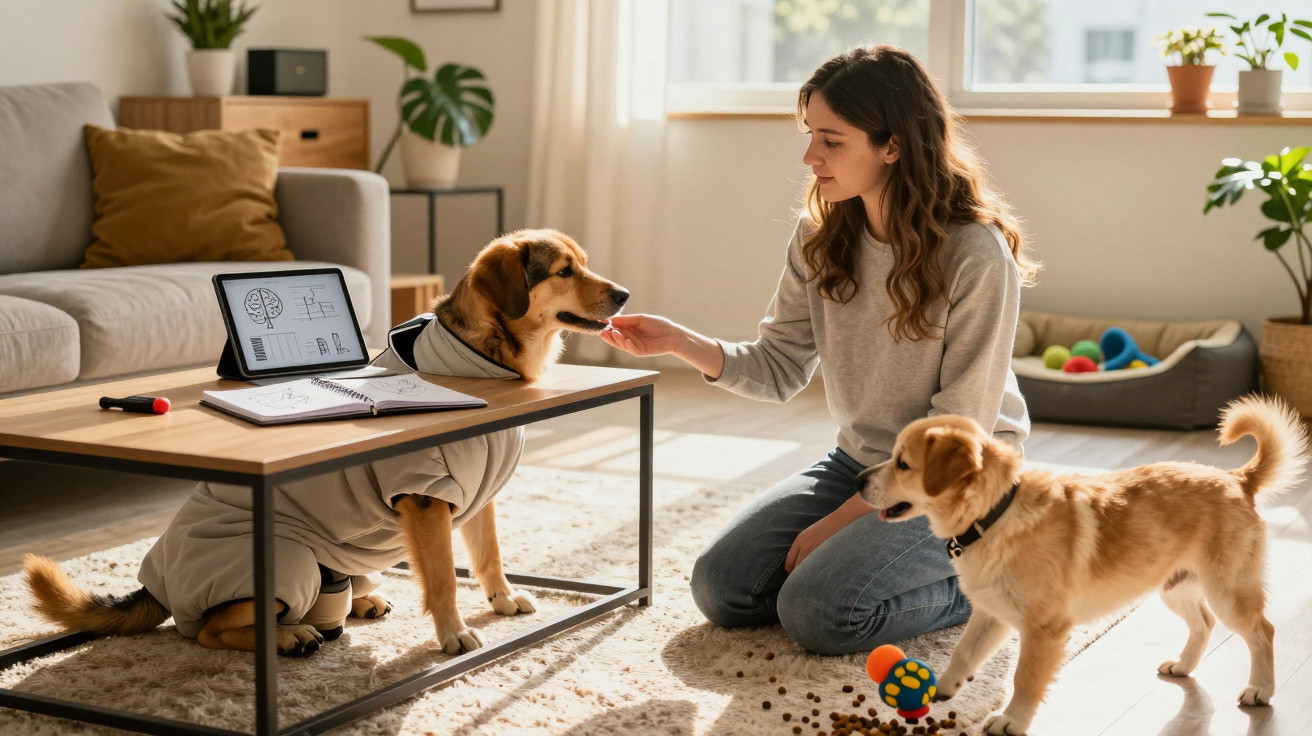
I share my home with several cocker spaniels. They are intelligent and loving, yet can also be scatterbrained, impulsive and remarkably sensitive. When one of my canine whirlwinds races past, friends often say my dogs are "having ADHD".
Awareness of neurodiversity is growing, while diagnoses including autism and ADHD (attention deficit hyperactivity disorder) are becoming increasingly common. Scientists, too, are beginning to examine whether some of our animal relatives may experience the world differently because their brains function in diverse ways.
Although this is an emerging concept, such research could strengthen the relationships we have with our pets.
Can animals be neurodivergent?
Anyone who has lived with, trained or looked after animals will know that their personalities vary enormously between individuals. Yet can animals genuinely be neurodivergent? And what could this mean for the way we care for, train and manage them?
Neurodiversity refers to variation in human behaviour and brain function, arising from structural and chemical differences in the brain. Applying human diagnoses to animals, however, can be difficult.
Animals cannot explain directly how they experience the world or respond to the usual diagnostic questions. We can only interpret their behaviour through our own perspective, such as when we call certain dogs impulsive.
For those dogs, though, apparent impulsiveness may be entirely normal for their breed, just as many cats naturally prefer solitary lives.
Nevertheless, research suggests that several species - including dogs, rats, mice and non-human primates - can display genetic and behavioural indicators of neurodivergence.
For example, dogs have been found to possess structural changes in genes known to be associated with hypersocial behaviour.
Dogs’ impulsive behaviour is also connected with low levels of the neurotransmitters serotonin and dopamine. Serotonin plays a key role in emotional stability, whereas dopamine supports concentration.
Difficulty regulating these neurotransmitters, and imbalances in them, may also be linked with ADHD in people, which is frequently marked by impulsivity.
This creates the intriguing possibility that, through breeding animals to live with humans, we may have selected for behaviours resembling those reported by neurodiverse people.
Modelling animal autism
Researchers have created animal models of autism to investigate factors associated with greater risk and to explore possible therapeutic support. These models use selectively bred animals kept in laboratories, so they may not completely reflect diversity within ordinary populations.
Even so, they remain useful for improving our understanding of the biological foundations of neurodiversity.
Some beagle dogs, for instance, carry a mutation in the gene Shank3. This gene is associated with autism in humans, which is often characterised by challenges in social interaction. Beagles with the Shank3 mutation also show little interest in interacting with people.
Their cell-to-cell signalling is reduced in brain areas associated with attention.
They also show less neural coupling with humans. Neural coupling occurs when the brain activity of two or more individuals becomes aligned during an interaction.
It commonly happens when people tell stories or teach one another, but a 2024 study found that it also occurs when dogs and humans look into each other’s eyes.
The Shank3 mutation may therefore impair neural processing and signalling, reducing spontaneous social contact and bonding between people and dogs.
Brain development and behaviour are shaped by numerous factors, however.
Puppies with limited or unpleasant early encounters with people may become less sociable and less focused on humans. Determining whether this behaviour has a biological cause, an environmental cause or both is not straightforward.
Research involving Shank3 in dogs has also offered an indication of potential medical support for human autism.
Dogs carrying the Shank3 mutation received one dose of the psychedelic drug LSD. Over five days, this produced greater attention and stronger neural coupling with people.
Following LSD administration, mice and humans also appear more inclined towards social behaviour. Its use clearly involves legal, safety and ethical concerns, but animal models can help reveal the underlying differences in how neurodivergent brains work.
Animal studies and ADHD-like behaviour
These models could also assist in diagnosing neurodivergence in people. Standard adult diagnostic procedures involve extensive discussion and assessment of how an individual manages everyday life. This can be challenging because neurodivergent people may experience communication difficulties.
Dogs with behavioural differences are likewise assessed using rating scales, generally completed by handlers and carers. Video analysis and machine learning have, however, been tested as a more objective method of identifying dogs with ADHD-like behaviour.
Under this approach, a machine analysed dogs’ movements in an unfamiliar setting and while they encountered a robot dog, rather than relying on a human observer. A 2021 study involving dogs found 81 percent agreement between the objective approach and more conventional diagnosis.
This type of animal research may support efforts to reduce subjectivity in human diagnosis. Objective measures have also been tested in people, including eye movement during ADHD assessments.
Neurodiverse behaviours in pets
Behavioural difficulties in cats and dogs that undermine their welfare are widespread. A 2024 paper using owner-reported information from more than 43,000 dogs in the United States found that over 99 percent of enrolled pet dogs had at least one behavioural problem.
Once again, some of the reported concerns - including separation-related behaviour, fear, anxiety and obsessive behaviour - resemble challenges linked to certain forms of neurodivergence in people.
Caring for pets with these behavioural difficulties can be upsetting, and may even result in rehoming or euthanasia. Better owner understanding of what is happening could perhaps prevent this in some cases.
In essence, the evidence indicates that animals, like humans, may perceive and respond to the world in different ways. Some variation will reflect natural personality differences, but it is also probable that some pets have differences in their brain chemistry and structure.
Neurodivergent children benefit when their particular, and sometimes complex, needs are understood. We may similarly be able to develop enriching training and management methods for animal companions that could be neurodiverse.
Jacqueline Boyd, Senior Lecturer in Animal Science, Nottingham Trent University
This article is republished from The Conversation under a Creative Commons licence. Read the original article.

















Comments
No comments yet. Be the first to comment!
Leave a Comment