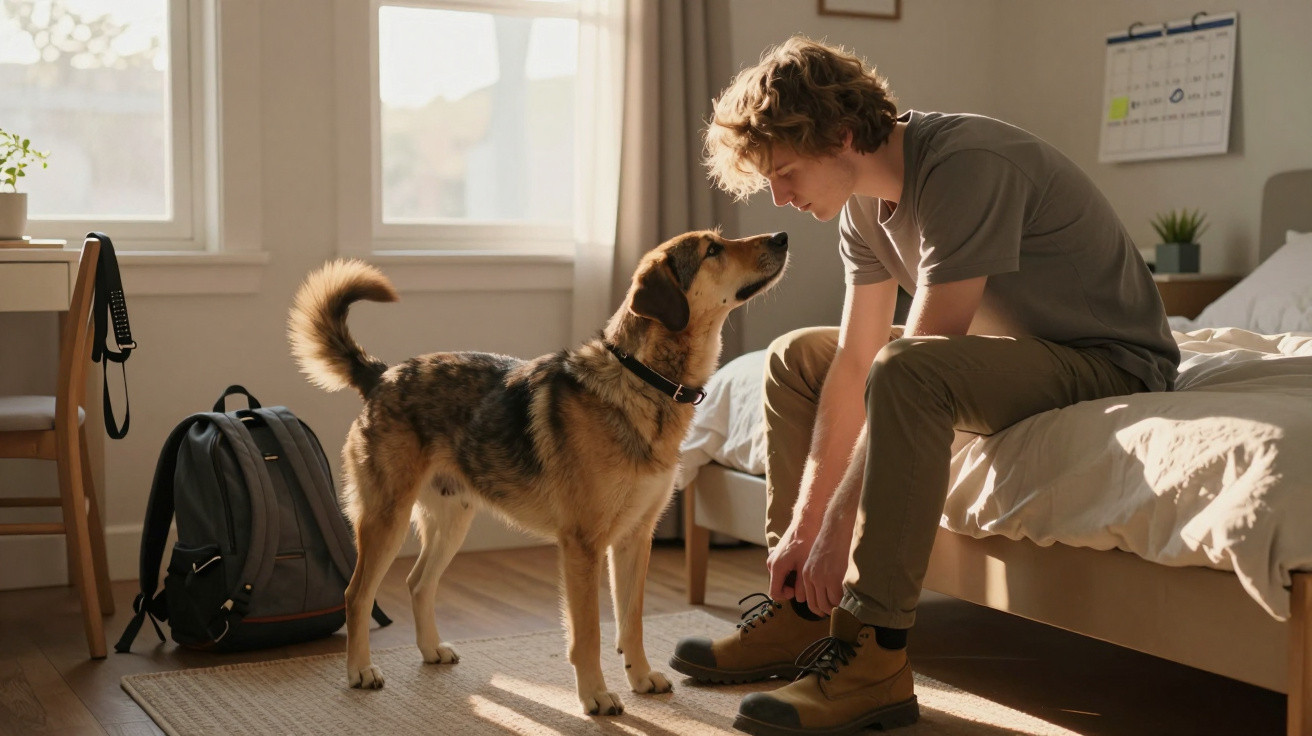
December twists routines, frays nerves and packs diaries with noise, while a quiet observer takes it all in from the hall rug.
As people’s plans accelerate and unravel, the family dog is left trying to understand the unfamiliar script, one step at a time, without any choice in the matter.
When our routine breaks down: what dogs truly notice
How dogs interpret small changes in our day
Your dog monitors your life like a living seismograph. A walk that starts five minutes late, a tenser voice during a phone call or a hurried kitchen breakfast: every small change registers. Dogs derive security from familiar patterns, including the order of your alarm, the sound of the food bowl and the route used for the evening walk.
When that pattern alters, the signal can feel stark. For a dog, a skipped morning walk does not mean “busy day at work”. More often, it means “something is wrong, and I don’t know why”. Shorter daylight hours, extra visitors and noisier homes over the festive period introduce further variables the dog has to interpret in real time.
“Dogs do not understand ‘I’m overwhelmed’; they only see ‘everything has changed, and I have to work out whether it is dangerous’.”
Having to make these constant assessments is tiring. Plenty of dogs remain quiet and well behaved, yet their bodies reveal the strain: evening pacing, more laboured breathing indoors, slower eating or more clingy welcomes at the door.
Breed, age and temperament: three lenses for change
Dogs do not all respond alike when household life becomes hectic. Breed offers an initial indication. Herding and working breeds often cope well with busy surroundings and changing tasks, provided their minds have a purpose. Calmer companion breeds may favour a gentle, predictable pace and struggle with continual surprises.
Age changes the situation too. A puppy may take chaos in its stride more readily, but it has fewer ways to calm itself. An older dog can become unsettled by abrupt timetable changes, louder music or furniture moved to make space for a Christmas tree. Arthritis, hearing loss and reduced eyesight may make each disruption seem more significant.
Temperament adds a third consideration. An easy-going dog may barely react to late meals or boisterous visitors. An anxious dog, however, can become unsettled quickly when familiar rules disappear. It may bark at every ring of the doorbell, stop eating when guests arrive or trail its owner from room to room, as though keeping watch were its sole responsibility.
“A dog’s ability to adapt often depends on a trio: breed, age and temperament shape the room it has to cope with change.”
When people are unsettled, dogs bend - or break
Stress travels down the lead. During demanding weeks, owners often sleep less, rush about more and speak more abruptly. Dogs may read this as a sign that “the group is on alert”. Some show remarkable flexibility, settling into a new routine with very little difficulty. Others come apart: barking overnight, destroying soft toys or retreating behind the sofa when voices get louder.
Research into emotional contagion between dogs and people indicates that sustained owner stress can be reflected in the animal’s cortisol levels. Put simply, when the person never relaxes, the dog is unlikely to relax either. This can create a loop: the dog’s agitation fuels its owner’s guilt or frustration, adding yet more tension to the household.
How far can dog adaptation go? Where dogs quietly set limits
The essentials: exercise, safety, rest and connection
Even the most “well-behaved dog” in a chaotic spell has certain needs that cannot be compromised. Most behaviourists identify four foundations: physical activity, mental stimulation, rest and a sense of safety. Take away one of them for too long, and the whole structure begins to shake.
- Movement: walks, play and time to sniff freely.
- Mental work: training, scent-based games and puzzle toys.
- Rest: undisturbed sleep in a consistent place.
- Safety: predictable contact and gentle handling.
During the festive season, many dogs get less exercise, sleep in busier rooms and encounter more unfamiliar people. Outwardly, they may appear to “cope”. Beneath the surface, though, pressure accumulates: cushion chewing, paw licking or a tucked tail while laughter carries through the house. Such behaviour seldom appears without reason. It can indicate a dog attempting to restore balance using the tools available to it.
Spotting early signs: when coping becomes strain
Stress in dogs does not usually begin with a bite or frantic barking. It often starts quietly. Owners who notice these early clues can make changes before more serious problems develop. Behaviour specialists regularly identify the same signs:
| Signal | What it may mean during busy periods |
|---|---|
| Change in appetite | The dog misses meals or eats much faster than normal. |
| Sleep changes | Restless nights, sleeping in unfamiliar places or regularly changing position. |
| Excessive grooming | Licking paws, flanks or tail without an obvious medical explanation. |
| Avoidance | The dog leaves when visitors enter or hides beneath tables. |
| Over-attachment | Following the owner everywhere or whining after a brief separation. |
“It would be a mistake to see these signs as complaints; they are better understood as quiet notifications about a dog’s mental load.”
A dog that handles altered schedules with a relaxed body, soft eyes and normal eating habits is probably adapting successfully. By contrast, a dog that stiffens when visitors stroke it, yawns repeatedly while children cuddle it or startles at minor sounds is communicating something else: “I’m reaching my limit”.
Practical support for a dog during a chaotic week
Everyday life is rarely perfectly steady in modern households, but a few decisions can reduce the disruption. Behaviourists commonly recommend three straightforward approaches: preserve at least one daily ritual, provide a protected area for the dog and turn “busy days” into “brain days” rather than “nothing days”.
A quiet sleeping area away from visitors lets the dog withdraw without being punished. Brief sniff-focused walks on the pavement offer mental relief when longer outings are not possible. Ten minutes of nosework, using treats hidden in boxes, can use more energy than a rushed 30-minute jog in freezing rain.
“When days spiral out of control, it is not the number of hours together that matters most, but the quality of the few moments fully shared.”
Living together on uncertain ground: creating a flexible agreement
Adapting the human timetable for four paws
Modern work arrangements, shared childcare, hybrid jobs and social commitments create uneven weeks. Long, rigid routines for dogs rarely withstand that reality. A more achievable aim is a “flexible framework”: some anchors remain dependable while their timings can move.
For instance, meals may always be served in the morning and evening, although the precise time falls within a set range. Walks can vary in duration, but each day should still offer at least one proper opportunity to move, sniff and toilet. What reassures a dog is not military precision, but a clear pattern: its needs will be met, even when the clock changes.
Owners who accept that things will not be perfect often deal with their dogs more calmly. A shorter but focused walk involving games and training may satisfy a dog more than an unfocused hour on a park bench while its owner scrolls through their phone. Releasing guilt can help people be genuinely present during the time they do have.
Caring for the dog by caring for yourself
When life becomes pressured, many owners sacrifice self-care first, telling themselves that the dog must come before everything else. In reality, the two are connected. Dogs detect human strain through posture, breathing and voice. Studies of heart-rate patterns even suggest that some dogs and owners synchronise their stress responses.
Planning small moments of decompression with the dog can benefit both of you. A five-minute slow walk without your phone, a brief session of hand-feeding kibble alongside simple cues or sitting quietly with a hand on the dog’s chest can lower both heart rates. The dog receives calm physical contact and focused attention. The person gains a small point of stability in a noisy day.
“Ten minutes of genuine presence with your dog can matter more, for both of you, than a whole hour spent nearby with your mind elsewhere.”
What people learn when they try to synchronise
Sharing life with a dog during unsettled times can reveal how a household responds to change. Some families prepare ahead: booking dog sitters for late-night events, establishing rules for children around a nervous animal or keeping a quiet room off limits to guests. Others adapt from day to day, watching the dog’s signals and responding as they arise.
Either approach can succeed if one principle remains central: the dog did not choose this pace of life. Once owners recognise that, they are more likely to ask better questions. What can change in my timetable so my dog keeps its four foundations? Which commitments matter less this week than my animal’s basic stability? Where can technology - cameras, automatic feeders and dog walkers - offer support without replacing genuine presence?
Those questions lead into broader issues: how we relate to rest, the limits we set at work and our willingness to say no. The dog becomes a living gauge of household overload. If the animal starts to fray, the people may already be doing the same. Paying attention to that message does more than safeguard a pet. It encourages us to examine how quickly we drive our own lives and how much room we truly make for quiet time together.
For many owners, small trials are useful. Try keeping walks fixed for a week while moving other plans around them. Introduce one rule of “no visitors after 9 pm” to protect the dog’s sleep. Notice whether your own mood changes when the dog appears more settled. These small real-world tests provide practical feedback on a question that is often left unclear: how much change can this particular dog absorb, and what does that require from the people who love it?

















Comments
No comments yet. Be the first to comment!
Leave a Comment