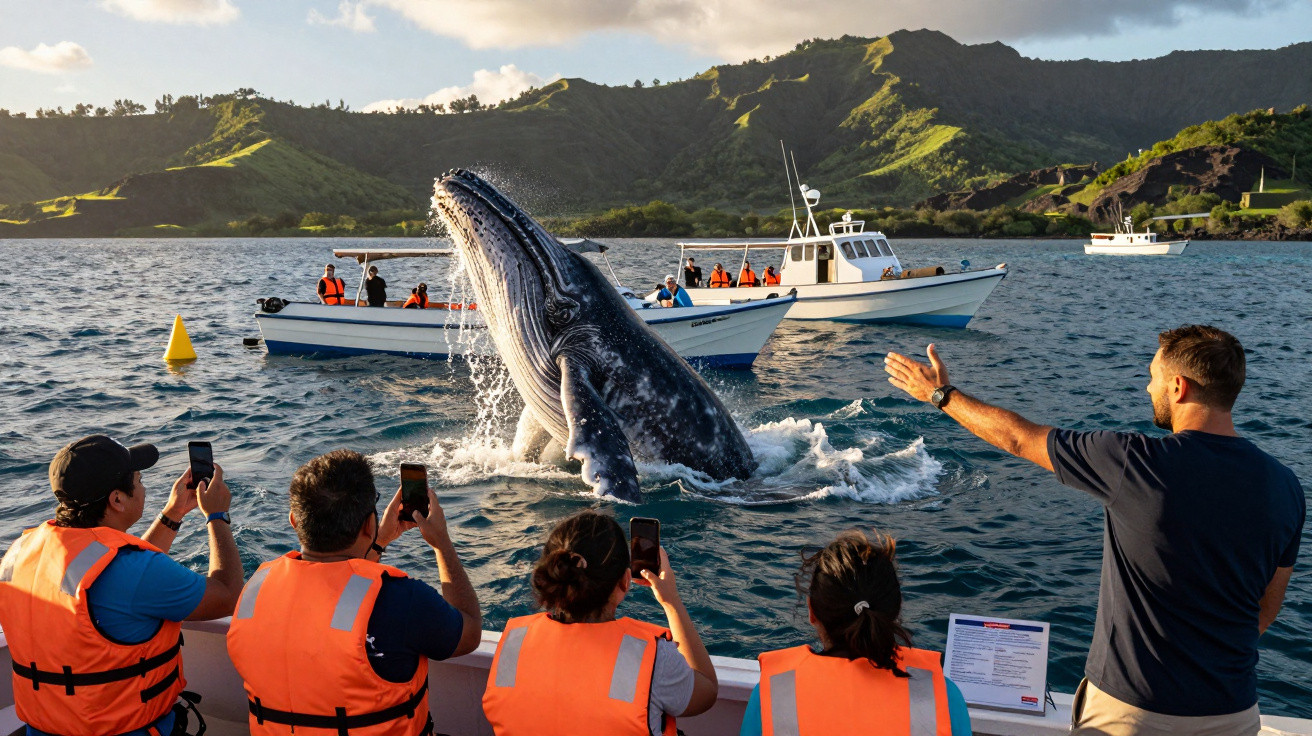
For years, locals and visitors alike have regarded the sight of humpback whales passing close to Réunion’s coastline as magical. This season, however, one whale named “Moustache” is making authorities and tour operators reconsider the question of how close is too close.
A local star becomes a warning sign
Moustache is a humpback whale identifiable by her unusual tail fin and two prominent white bulges. Scientists at the Centre for the Study and Discovery of Marine Turtles (CEDTM), which also tracks cetaceans around Réunion, have documented her regular returns over several seasons.
She returned in June, coinciding with the beginning of the southern winter whale season. At this time, hundreds of humpbacks travel from Antarctica to reproduce and give birth in warmer seas. In the previous year alone, 1,156 whales were logged off Réunion’s shores, making the island a popular whale-watching destination.
Initially, Moustache acted much like other inquisitive humpbacks. She came near beaches, remained alongside boats and appeared at ease when swimmers quietly entered the water close by. Images and footage soon circulated across social media, while tour companies realised that an excursion involving Moustache was almost certain to delight customers.
Moustache shifted from approachable curiosity to clear defensive behaviour as tourist interactions multiplied, day after day.
CEDTM observers say the change began as encounters became increasingly frequent. Marine biologists report that, on certain days, she experienced 30 to 40 approaches by boats, swimmers or paddleboarders. This scale of human activity seems to have driven the whale towards a markedly different pattern of behaviour.
From playful giant to unpredictable neighbour
Over recent weeks, Moustache has repeatedly shown behaviours experts link to stress, defence and intimidation. Swimmers have described abrupt, rapid changes in direction. Boaters have watched her lift her huge pectoral fins and forcefully slap the surface. Beneath the water, she has started making brief, direct “charges” towards people in the sea.
Researchers identify three common behaviours observed around Moustache:
- “Scissor” movements of her pectoral fins, cutting through the water near swimmers.
- Sabre-like strikes, in which a fin lashes out sideways and could hurt anyone nearby.
- Short charges intended to drive intruders away, resembling a whale’s response to a suspected predator.
These actions are not signs of play. They indicate that the whale feels under threat and needs more space. As marine mammals can weigh up to 30 tonnes, a single defensive blow could be fatal to a person.
Moustache is behaving as if the constant, unmanaged presence of people has turned her breeding ground into hostile territory.
Local officials have not so far recorded any serious injuries connected with Moustache, although repeated near misses are causing growing concern. The island’s popularity increases the danger: Réunion has around 80 licensed sea excursion companies, many of which permit guests to enter the water when whales are close.
Whale tourism in Réunion meets fragile wildlife
Whale watching is now a significant attraction within Réunion’s tourism economy. Seasonal humpback visits generate substantial income through boat trips, accommodation, restaurants and social-media promotion.
However, the industry’s expansion has moved faster than its regulation. Skippers commonly repeat core guidance, such as approaching at low speed, switching off engines at a distance and not making abrupt changes in direction. Once passengers enter the sea, though, their behaviour becomes more difficult to manage.
On a crowded winter day at sea, Moustache can find herself encircled by multiple boats, snorkellers, freedivers and paddleboarders simultaneously. Every group may consider its own encounter short-lived. Taken together, however, they form an almost permanent ring of people around a wild animal that requires rest, feeding space and calm surroundings to look after a calf, where one is present.
| Pressure factor | Potential impact on whales |
|---|---|
| Frequent boat approaches | Stress, disrupted communication, collision risk |
| Swimmers in close contact | Defensive behaviour, aggressive displays |
| Loud engines and shouting | Acoustic disturbance, avoidance of key areas |
| Repeated interactions per day | Chronic fatigue and behavioural changes |
CEDTM researchers emphasise that Moustache’s situation is not merely an isolated incident. It could provide an early warning of the ways frequently visited marine mammals respond when people disregard distance guidance and treat them almost as though they were theme-park attractions.
Calls for stricter rules in Réunion’s waters
Marine specialists on the island are calling for a more robust legal framework. Existing advice centres on “good practice” guidance, but adherence varies, particularly during peak season, when demand for close encounters rises.
Researchers argue that protecting whales now is the only way to avoid more animals responding with force later.
Measures being considered include:
- Introducing firm minimum distances for boats and swimmers near whales.
- Capping the number of boats that may approach one animal at a given time.
- Limiting or prohibiting in-water encounters in sensitive locations or where calves are present.
- Expanding patrols and imposing fines on operators that disregard regulations.
Some Réunion tour operators already advocate a low-impact model, voluntarily giving whales more room and declining to place customers directly in their route. Others, however, worry that tighter restrictions may make their trips less appealing in a market where close-range photographs and dramatic footage generate bookings.
What Moustache reveals about wild animal encounters
Moustache’s behavioural change poses a wider question: at what point does wildlife watching become harassment? Humpbacks select coastal lagoons and protected bays as breeding areas because they provide security. Converting these spaces into busy recreational zones can weaken the refuge they naturally offer.
Scientifically, several important points emerge:
- Ongoing disturbance may alter an animal’s behaviour for an entire season.
- Continued pressure can make stress responses, including tail slaps and charges, habitual.
- Animals that come to associate people with disruption may transmit those reactions to their offspring.
In practical terms, people hoping to swim with whales may be influencing how later generations behave around boats and beaches.
Reading the signs: when a whale wants space
Anyone preparing for a whale-watching excursion can reduce risks by recognising basic behavioural signals. Marine guides regularly point to several clear warning signs:
- Rapid, unpredictable movement instead of slow, elegant swimming.
- Frequent tail or pectoral-fin slaps close to people or vessels.
- Sudden dives followed by resurfacing farther away, seemingly in an effort to escape.
- Direct “charges” towards a swimmer or boat, even where the whale stops before contact.
If these behaviours occur, the safest course is straightforward: get out of the water, move the boat back and allow the whale time to settle. This protects people while also avoiding the reinforcement of aggression as the whale’s only means of gaining space.
Balancing once-in-a-lifetime moments with long-term care
For many travellers, swimming beside a whale is a bucket-list ambition. Moustache’s case demonstrates that repeated bucket-list experiences, one after another, can push a wild animal beyond its tolerance. A more careful approach to whale tourism may mean fewer exceptionally close views, but it could also result in healthier, less stressed whales returning year after year.
During future seasons around Réunion, authorities may view Moustache almost as a case study. Should new rules ease her behaviour and lower the number of conflicts, they may help shape policy throughout the Indian Ocean and further afield. If nothing changes, other whales may begin to respond as she has, with broad fin movements, forceful splashes and sudden charges expressing one unmistakable message: keep your distance.

















Comments
No comments yet. Be the first to comment!
Leave a Comment