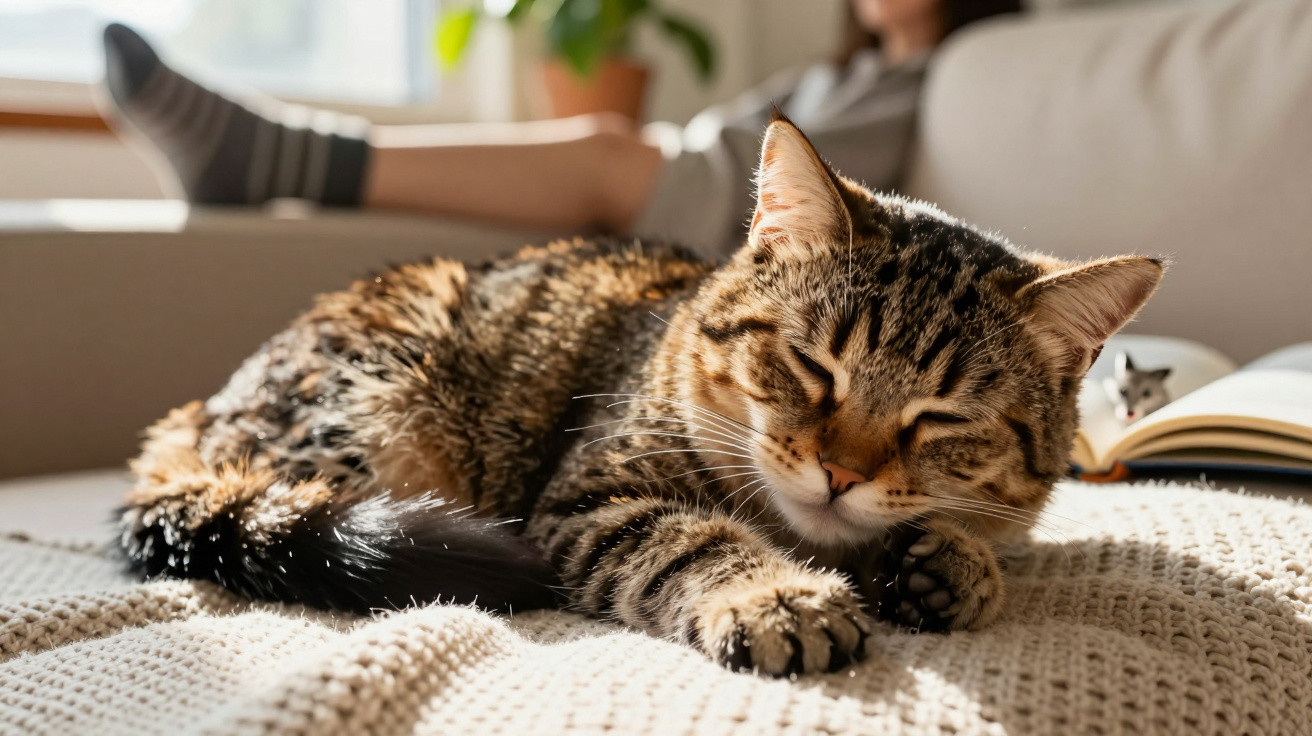
There is far more to this pose than simple cuteness.
Anyone who shares a home with a cat will know the sight: their four-legged companion settles on the sofa, curls up, drifts off, then places its front paws right across its face. Many people take a quick photo before wondering whether it is merely adorable or whether the position has a real purpose. Behaviour specialists and vets give a clear answer: this pose serves several important functions relating to a cat’s health, safety and wellbeing.
Why cats need genuine darkness when sleeping
Paws as a natural sleep mask
Although cats are commonly thought of as nocturnal animals, artificial light indoors can disturb them far more than many owners realise. Ceiling lights, screens and streetlights outside the window can all feel glaring when a cat is resting.
When cats place their paws over their eyes, they deliberately block out light and create a natural “sleep-mask effect”.
Cats’ sensitive eyes detect even low levels of brightness. Faint reflections alone may be enough to pull them from a deeper stage of sleep. By drawing their paws over their face, they effectively make a private darkened space. Their head is supported, their eyes are protected and outside stimuli are kept at bay.
This behaviour is particularly common in homes where televisions, tablets or lamps remain on late into the evening. The cat is not being amusing: it is responding in a highly practical way, trying to achieve good-quality sleep despite a restless environment.
No fit cat without deep sleep
Cats sleep for long periods, but every stage of their sleep is not equally important. Alongside brief naps, they need deep, uninterrupted periods of rest. During these phases, the immune system recovers, muscles relax and the nervous system processes experiences.
Light stimuli disrupt that process. The cat may twitch or briefly open its eyes, while its body remains on alert. Covering its eyes with a paw reduces the chance of such interruptions. Rather than simply “getting used to it”, the cat is arranging better conditions for sleep.
- Bright living-room lighting: the cat quickly puts its paws over its eyes.
- Dim lighting or a darkened room: the position occurs less often.
- A quiet bedroom without screens: many cats sleep openly in their basket.
Owners who watch their four-legged friend closely can often spot a direct link between brightness and this characteristic sleeping pose.
Saving warmth: the hidden trick involving the nose and paws
The sensitive area around a cat’s nose
Cats may look like furry hot-water bottles, but their bodies have vulnerable points. The nose is one of them. It lacks the insulating undercoat that protects other areas, leaving the skin exposed. Surprisingly large amounts of warmth can escape through this small surface.
When a cat places its paws over its face and nose, it forms an insulated chamber. Its breath warms the space, while the paws keep cold air away. This area can warm up slightly, particularly at night or in cooler rooms. As a result, the body needs to use less energy overall to maintain its temperature.
Cats are especially likely to sleep this way in the following situations:
- near windows or doors during winter
- in older flats with a slight draught
- on floors that cool quickly, such as tile or parquet
The pose is therefore not a “whim”, but an intelligent energy-saving measure. The colder the sleeping spot, the more often this trick can be seen.
A self-made cocoon against sensory overload
Everyday life can feel like a constant stream of activity to cats: voices, footsteps, doorbells, smartphones, vacuum cleaners and passing cars. Many cats cope well with this, but they still need periods when they no longer have to take anything in.
By putting its paws in front of its face, a cat shuts out part of the outside world – creating a small cocoon for its head and senses.
Its eyes cannot see anything, its head is slightly shielded and even gentle movements of air are blocked. In this position, its body can relax without expecting a potential disturbance every second. Anxious or particularly watchful cats, in particular, regularly use this form of protection.
Complete trust: what this sleeping position reveals about a cat’s sense of security
Only a relaxed body can “forget” its surroundings
Cats are both predators and prey. In the wild, they rarely sleep completely unprotected. Their ears stay alert, and their eyes can open again in an instant. The situation is different in the living room, provided they feel safe there.
An animal that willingly obstructs its own view is communicating that no danger is expected here. It does not anticipate needing to flee. Instead, it consciously gives up control of its surroundings. For owners, this unusual-looking sleeping position is a compliment.
A cat that sleeps deeply with its paws over its eyes has accepted its home as a safe place of retreat.
People observing newly adopted cats will often notice a progression. At first, they may sleep with half-open eyes and their body poised to spring away. As trust grows, positions that show greater vulnerability begin to appear: belly upwards, paws over the face and hind legs stretched out.
How to respond properly to a sleeping cat
However tempting it may be to photograph the tiny paw-covered face or give it a little poke, this period is precious to the cat. Any interruption pulls it out of a valuable moment of recovery. Many cats react irritably, or may eventually choose to rest elsewhere.
Anyone wishing to support their cat should follow a few straightforward rules:
- do not touch it when it is clearly in a deep sleep
- dim the lights slightly, or at least avoid switching on an extra lamp
- explain to children that the cat is “on holiday” and needs to be left undisturbed
- do not make loud noises directly beside its sleeping place
This creates a routine in which the animal learns that it can truly switch off there, even while life continues around it.
What owners can learn from this cuddly cat pose
Creating the ideal sleeping place for a cat
Owners who take their cat’s signals seriously can make minor adjustments around the home. Small changes are often enough to improve sleep quality. Useful guidelines include:
- set up a quiet area, such as a basket away from hallways
- choose a spot where no lamp shines directly into it
- provide a position as high as possible, for example on a shelf or windowsill
- use a soft base that keeps draughts from the floor away
If a cat frequently puts its paws over its eyes when the television is on, it may help to reduce the brightness and volume as a trial, or to offer another quiet place in the next room.
When unusual sleeping behaviour may be a warning sign
The pose described here is generally completely normal. However, some situations call for closer attention. Owners should take note if their cat seems disorientated on waking, suddenly becomes aggressive, avoids touch or squints noticeably often.
Pronounced sensitivity to light can point to eye problems, inflammation or headaches. Anyone who is unsure should have the animal examined by a vet. Older cats, especially, are more likely to develop conditions that affect sleep behaviour and sensory perception.
In most homes, however, the sight remains one thing above all: a touching moment that says much about a cat’s inner world. Paws over the eyes are no coincidence, but a small masterpiece of instinct, protective behaviour and trust – as well as a good reason to slow down for a moment and simply watch the sleeping animal quietly.

















Comments
No comments yet. Be the first to comment!
Leave a Comment