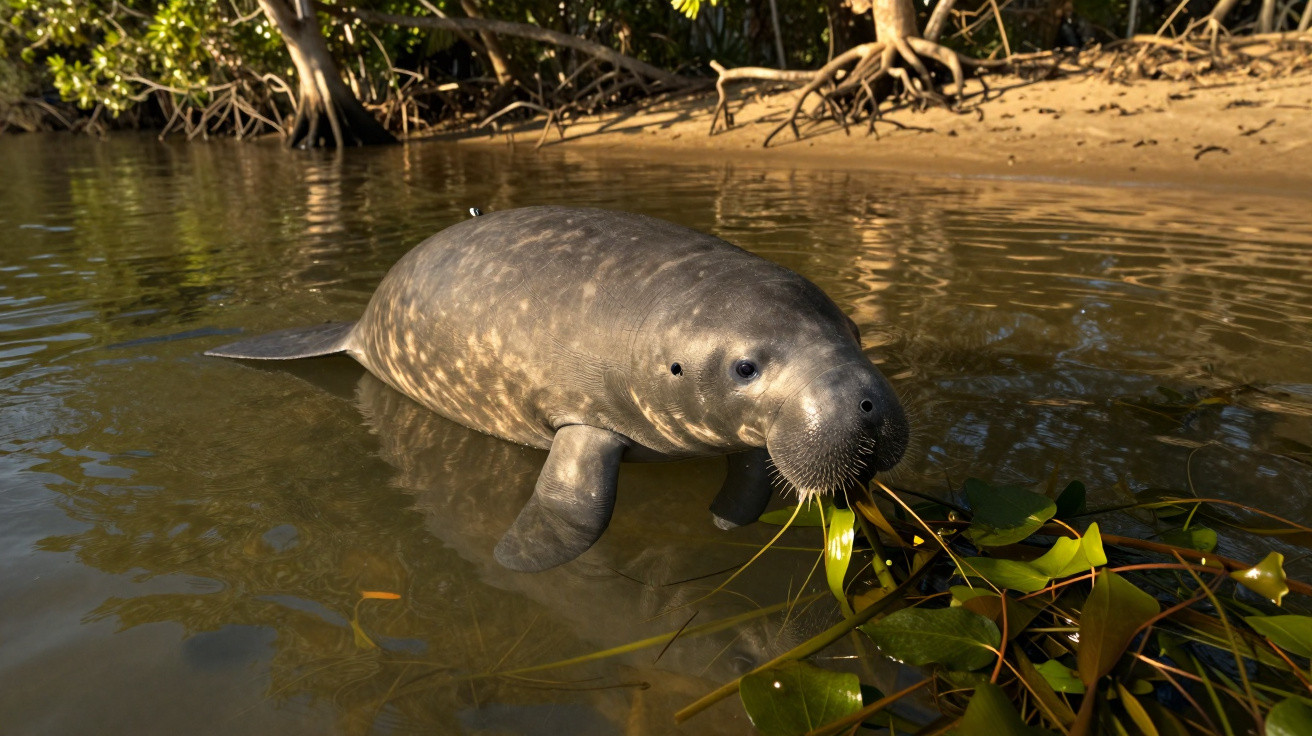
The Amazonian manatee stands out for its ability to survive in rivers that change dramatically between the flood and dry seasons. As food becomes scarce, this aquatic mammal cuts its bodily energy use and relies on stored fat, an unusual adaptation in the Brazilian Amazon.
Why can the Amazonian manatee go for months with little food?
Its renown stems from the close link between its body and the seasonal pulse of Amazonian rivers. During floods, it finds plentiful vegetation in flooded forests and grasslands, building up energy reserves to withstand the rivers’ prolonged dry season.
As water levels fall, some populations become confined to the deep sections of large lakes. At this stage, they are thought to fast for up to seven months, drawing on fat stores and an extremely low metabolic rate in deep water.
This approach relies on a combination of factors:
- Floods: abundant plants allow energy to be stored before the dry season.
- Fat: bodily reserves help sustain lengthy fasting periods.
- Metabolism: a low metabolic rate limits energy expenditure.
- Lakes: deep areas provide shelter as water levels recede.
- Seasonality: the river cycle determines where it feeds and remains.
How does its herbivorous diet help during floods?
The Amazonian manatee is a non-ruminant herbivore that mainly eats aquatic grasses, particularly emergent species. It also feeds on macrophytes, including water lettuce and water hyacinths, as well as palm fruits that fall into the water during the Amazon’s annual floods.
Its plant intake may equal roughly 8% of its body weight each day, with a significant proportion converted into energy. This pattern changes when food availability declines and its diet becomes more diverse.
Which physical adaptations support this way of life?
The animal spends almost all its time underwater, yet surfaces regularly to breathe, exposing only its nostrils above the waterline. It has the lowest degree of rostral deflection among sirenians, enabling it to feed effectively close to the water surface.
Energy conservation
A body adapted to the dry season
During the dry season, some populations stay in deep parts of lakes, where little or no food is available.
Large fat reserves and a low metabolic rate help the animal endure this critical period.
This anatomy suits a discreet existence in murky waters and habitats that are difficult to observe. The species also uses subcutaneous fat to limit heat loss, while adapting its circulation and respiration to its aquatic routine.
Its main survival features include:
- Nostrils that close underwater and open when the animal rises to breathe.
- Subcutaneous fat that helps reduce heat loss.
- Efficient feeding near the surface, where much of its food is found.
Where does it live, and why does it indicate well-preserved rivers?
The Amazonian manatee occurs throughout the Amazon Basin, from areas near Marajó Island to parts of Colombia, Peru and Ecuador. Its distribution is uneven, with concentrations in flooded forests, calm waters and shallow places away from human settlements.
Because it relies on rivers, lakes, lagoons and backwaters containing aquatic vegetation, the animal reveals much about the conservation status of these habitats. It also supports nutrient cycling, as its excrement promotes primary production in the water.
Its presence is associated with environments that have these features:
- Nutrient-rich flooded forests during part of the year.
- Lakes, backwaters and lagoons linked to major rivers.
- Calm, shallow waters away from intensive human occupation.
Why does the species remain threatened in the Amazon?
The species remains vulnerable because historical hunting depleted its populations and still continues in some areas, despite protective legislation. At the same time, habitat degradation, nets, boats and pollution increase risks for Brazilian Amazonian aquatic wildlife.
Protection requires preserved rivers, engaged communities and programmes able to rehabilitate calves and monitor released individuals. As an aquatic mammal found exclusively in freshwater, the Amazonian manatee continues to embody the fragility and richness of these ecosystems.

















Comments
No comments yet. Be the first to comment!
Leave a Comment