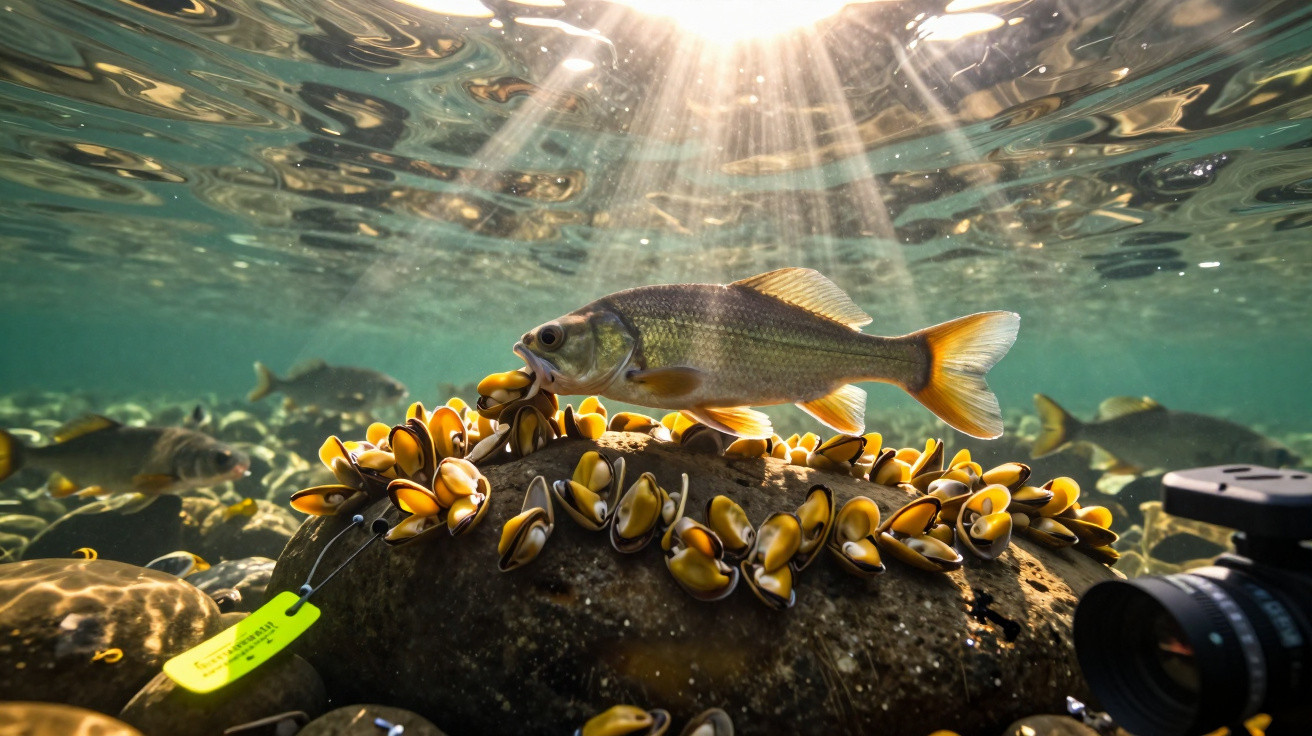
The golden mussel has become one of the most troublesome invasive species in Brazilian waters, creating colonies that can block hydroelectric power plant pipes and water abstraction systems. In Paraná, research by the Centre for Research in Limnology, Ichthyology and Aquaculture at the State University of Maringá, Nupélia/UEM, shows that some local wildlife has found a way to make use of the invader: several native fish have added the mollusc to their diet.
How did the golden mussel colonise Brazilian rivers?
Native to Asia, the mollusc arrived in South America in the early 1990s, mainly through ships' ballast water. It then spread through the Plata Basin, reached the Itaipu reservoir and subsequently the upper Paraná River floodplain, expanding across habitats favourable to its reproduction.
One of its key advantages is its ability to attach securely to hard surfaces. Thousands of individuals can cover rocks, concrete structures, sluice gates and pipes, restricting water flow and raising maintenance costs for hydroelectric plants, treatment works and other facilities.
- It forms colonies containing large numbers of individuals;
- It attaches to rocks, concrete, metal and pipes;
- It spreads readily through connected rivers and reservoirs;
- It competes with native organisms for space and food;
- It can cause operational problems in infrastructure that uses water.
Which native fish have started eating the invader?
Studies carried out in the Itaipu reservoir found golden mussels in the digestive tracts of several species. Fish that have begun using this new resource include piapara, armado, black pleco and pacu, showing that local wildlife can incorporate a relatively recent invasive species into the food chain.
Does eating golden mussels mean their population is being controlled?
Not necessarily. Effectiveness depends on the number consumed and, above all, on each fish's ability to crush the shell. The piapara and some plecos can break down hard structures while feeding, increasing the likelihood that the mussels they eat are genuinely eliminated.
The armado displays more complex behaviour. Although it may consume large quantities of the mollusc, researchers have found specimens with intact shells in their digestive systems. This means that merely finding mussels inside a fish is not enough to determine that the species provides effective control.
- Piapara can crush some shells while feeding;
- Plecos have structures suited to eating organisms attached to the riverbed;
- Armados eat mussels but do not always destroy them completely;
- Pacus can also include the invader in their diet;
- The level of predation differs between species, sizes and environments.
What does recent research reveal about this natural control?
Experiments and food-web analyses indicate that the golden mussel has already become an important food source for certain fish in reservoirs within the Paraná Basin. Experimental work involving piapara has even shown a reduction in the mollusc's biomass when the fish were present, supporting the hypothesis that some native predators can exert pressure on its populations.
Can fish alone prevent the golden mussel from spreading?
Natural predation is not enough to eradicate the golden mussel from rivers and reservoirs where it has already become established. Its high reproductive capacity and ability to disperse mean that conserving wildlife must be combined with monitoring, preventing its transfer to new basins, and targeted measures to protect water supply and energy-generation systems.
However, native fish provide an important additional biological barrier. Piaparas, plecos and other consumers continuously remove individuals from the environment and help integrate the invader into the food chain. Protecting these populations in Paraná's rivers may strengthen a natural control mechanism and, at least locally, lessen the pressure caused by one of the country's most difficult aquatic invasions to manage.

















Comments
No comments yet. Be the first to comment!
Leave a Comment