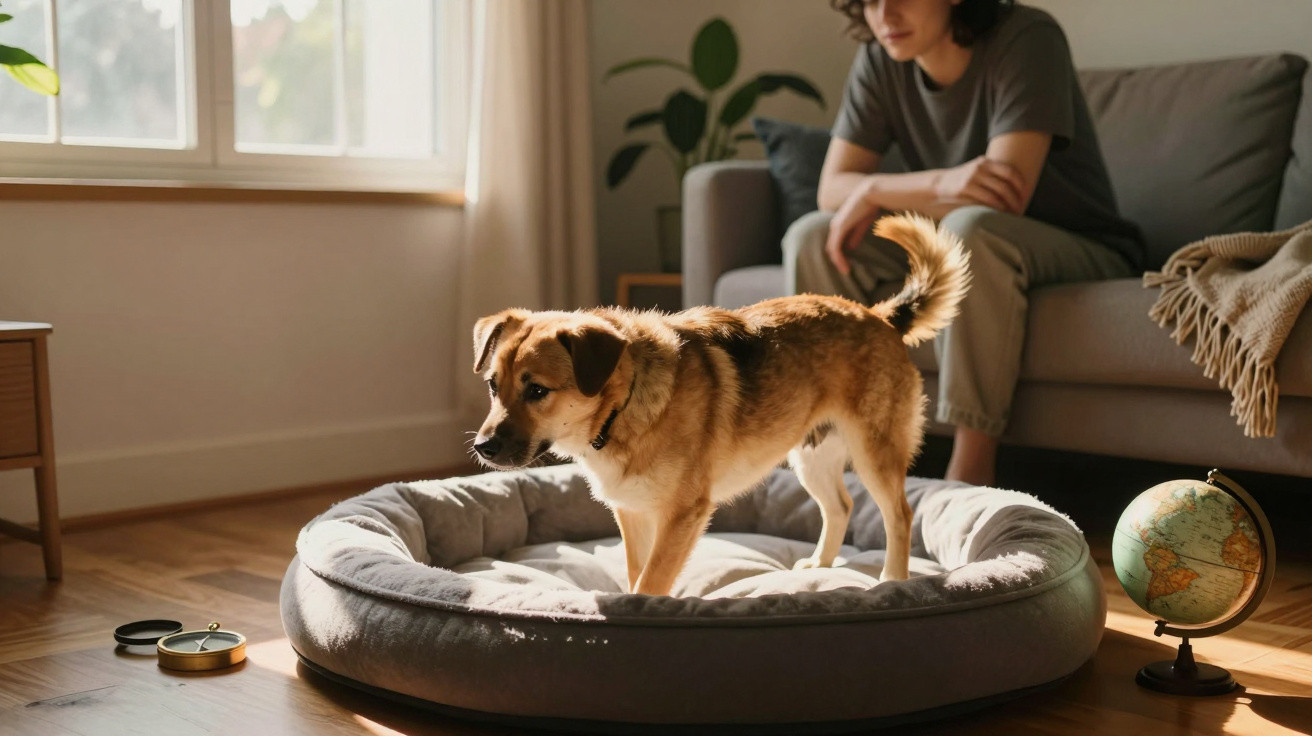
Living with a dog means knowing the scene: your four-legged companion circles its bed several times, perhaps scratches briefly, then finally curls up. It looks adorable and slightly odd. Yet there is more behind this seemingly pointless ritual than a simple quirk. It reflects traces of wild ancestors, a remarkable internal compass and, at times, even warning signs of serious pain.
An ancient survival instinct, not a cute habit
How wolves prepare their resting place
Long before dogs slept in orthopaedic beds or on the living-room sofa, their ancestors had to manage outdoors. Grass, shrubs and stones made it unlikely that simply lying down would be comfortable or safe. Wolves therefore used a straightforward method: walking in circles, treading and flattening the ground.
This turning motion smooths the surface. Tall blades of grass bend over, small twigs are pushed aside and the ground becomes more even. What appears to be a little dance is actually a highly practical process: an improvised mattress made with paws and body weight.
“Many pet dogs perform the same ritual – even on smooth tiles or a perfectly level dog bed. Their genes do not recognise laminate flooring.”
This behaviour is embedded so deeply in a dog’s inheritance that it still occurs when it no longer serves an obvious purpose. Watch closely and you can see the dog assessing the area, testing it with its paws and shifting its weight – all part of an internal programme that has worked for thousands of years.
Protection from predators and hidden hazards
Circling before lying down also had a second purpose: safety. In the wild, grass and fallen leaves can conceal plenty of unwelcome visitors, including snakes, biting insects, parasites and small rodents. Repeatedly treading the area allowed the dog’s ancestors to drive away at least some of these risks.
At the same time, they checked their surroundings. While walking in circles, they scanned the space with their eyes, ears and nose. Are there unusual smells? Sounds nearby? Movement in the bushes? Only once everything felt “right” would the dog settle down.
When lying down, dogs usually curl into a ball. Their back faces outwards, while their belly remains protected in the middle. This posture reduces the exposed surface of the body and safeguards vulnerable organs. Turning around therefore also helps the dog find a final position in which it feels secure enough to sleep.
The built-in compass: dogs and the Earth’s magnetic field
Why dogs align with the north-south axis
In recent years, researchers have observed a striking detail: when defecating or urinating, and also when settling down, many dogs prefer to position themselves along the north-south axis – provided that the Earth’s magnetic field is relatively stable. The circling then seems to act as a form of calibration.
Dogs appear to have a biological sensor that detects the magnetic field. As they make their rounds, they adjust the direction of their body until this sensor is “satisfied”. Only then do they lie down for good.
“Dogs can seem as though they are spinning aimlessly – but in reality, their internal compass is arranging the ideal sleeping position.”
Magnetic fields and inner calm
Why this alignment benefits dogs has not yet been fully explained. Much suggests that orienting themselves along magnetic lines provides stability for the brain and nervous system. In this way, a dog finds a position in which its body can relax.
Many owners know the situation: the dog circles apparently indecisively ten times, stops, changes direction and starts again. From a human perspective, this looks like uncertainty. From the dog’s point of view, however, it is a complex comparison of smells, the surface beneath it, sounds and the magnetic field.
- Checking the surface: too hard, too soft, too cold or too warm
- Scanning the environment: sounds, movement and smells
- Adjusting alignment: turning the head and body along a preferred axis
- Choosing the final position: safe, comfortable and easy to defend
The more unsettled the environment, the longer this process may take. In a noisy flat beside a main road, a dog may need more “calibration rounds” than in a quiet bedroom.
When circling is a warning sign of pain
The key question: how many circles are still normal?
A few turns before lying down are entirely unremarkable. It becomes a concern when a dog circles noticeably longer and simply cannot settle. Many vets offer a rough rule of thumb: more than three to four circles, repeatedly, combined with visible dissatisfaction, may indicate discomfort.
Older dogs and animals with pre-existing joint or spinal problems are particularly affected. In these cases, circling becomes a desperate attempt to find a position that does not hurt.
“If a dog keeps fussing, fussing, fussing – and still cannot relax enough to lie down – there is often more going on than a harmless habit.”
Typical accompanying symptoms that should be taken seriously
Several signs can suggest that the circling is linked to pain. Anyone noticing one or more of the following signals should arrange a veterinary appointment promptly:
- increased panting immediately before lying down, without heat or previous exertion
- quiet whining, crying or squeaking as the dog bends its legs
- visibly stiff movements, hesitant steps or uncertainty when lowering its hips onto the cushion
- getting up frequently shortly after lying down, as though no pain-free position can be found
These issues are often more noticeable in cold, wet or changeable weather. Arthritic joints react sensitively, while ligaments and muscles tense more easily. The evening “bedtime ritual” can then become a strain test for the entire musculoskeletal system.
How owners can support their dog effectively
Adapting the sleeping area to the dog
Observing your dog soon reveals its preferences: does it favour a soft or firmer surface? Does it seek coolness or warmth? Does it curl up or stretch out? A suitable sleeping place relieves pressure on the joints and back, and may reduce the urge to circle endlessly.
| Dog type | Suitable sleeping place |
|---|---|
| Older dog, joint problems | Orthopaedic mattress, firm foam, non-slip surface |
| Young, healthy dog | Standard dog bed, blanket or cushion – preferably not too soft |
| Dog that feels the cold strongly | Space away from draughts, insulated base, possibly a heat pad |
| Dog seeking peace and quiet | Quiet corner, little foot traffic, muted noise |
If you notice that your dog circles for longer and finds it harder to lie down on a hard floor, try a thicker cushion or better base. Sometimes an extra blanket alone is enough to create the perfect comfort zone.
Careful observation rather than simply smiling
Of course, it is fine to smile at a four-legged companion spinning in circles. At the same time, this behaviour provides valuable information. A dog that has turned two or three circles for years before dropping down in a relaxed way is unlikely to be showing anything unusual. If the pattern suddenly changes – more turns, more restlessness, more noises – it is worth taking a closer look.
It can help to ask yourself a few questions:
- Since when has the ritual seemed longer or more tense?
- Does the behaviour occur in every sleeping place, or only in particular spots?
- Are there times of day when it is especially noticeable?
- Does the dog also show difficulties getting up or climbing stairs?
Raising these observations with a vet makes diagnosis considerably easier. Early joint problems can often be identified and treated before they cause the animal severe pain.
What circling reveals about a dog’s inner world
The evening circling routine before sleep is far more than an amusing detail of life with a dog. It shows how closely wild heritage, modern daily life and refined sensory abilities come together in one behaviour. The dog shapes its resting place, checks its surroundings, aligns itself internally and externally, and at the same time signals whether its body is still coping without difficulty.
Taking a few minutes to watch this ritual calmly helps you get to know your dog much better. You can identify patterns, spot small changes more quickly and develop a sense of what benefits the animal. A suitable sleeping place, consideration for age and health, and a watchful eye turn the classic pre-sleep “circling” routine into a valuable indicator of wellbeing and quality of life.

















Comments
No comments yet. Be the first to comment!
Leave a Comment