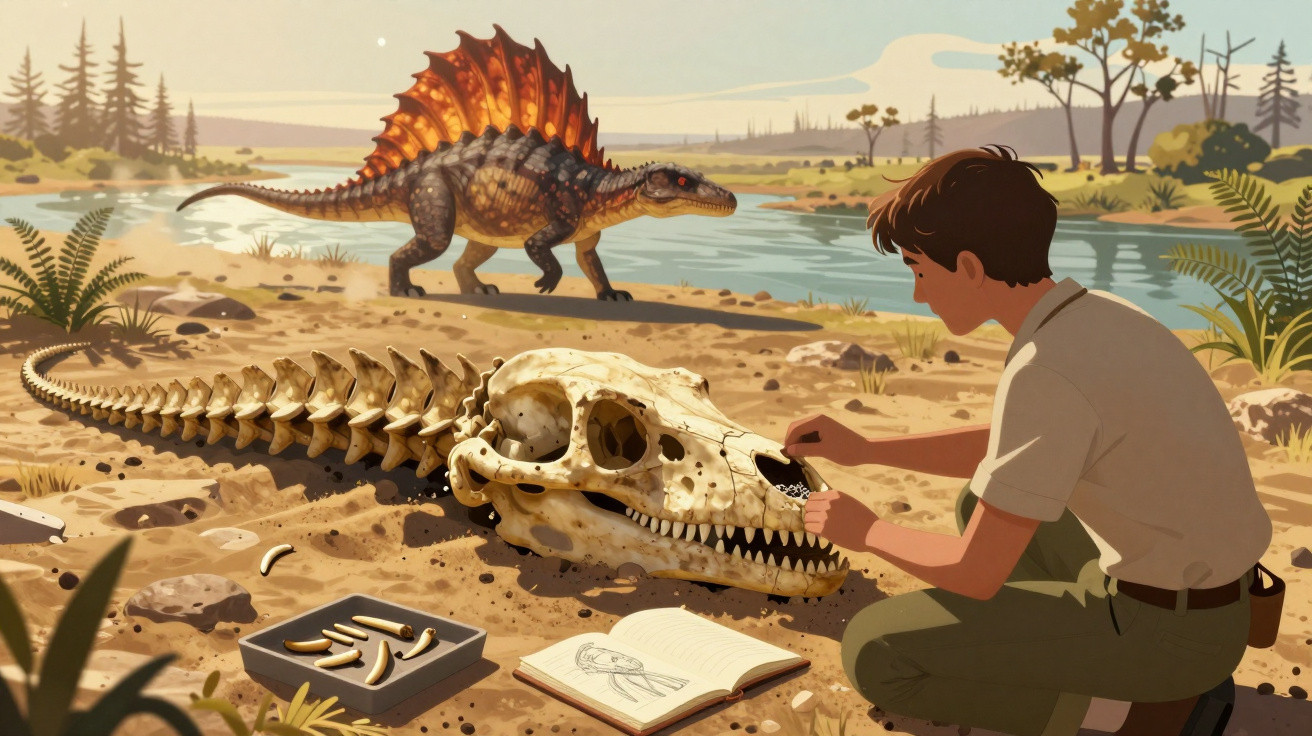
Long before any dinosaur walked the Earth, a predator with blade-like teeth already sat at the top of land-based ecosystems. Dimetrodon, which lived during the Permian, resembled a huge reptile with a sail along its back. That resemblance is misleading, however: it belonged to the synapsids, an evolutionary lineage more closely related to mammals than to dinosaurs.
Why was Dimetrodon not a dinosaur?
Dimetrodon lived tens of millions of years before the first dinosaurs emerged. Although its stance, skull and overall appearance led the public to associate it with reptiles for a long time, its anatomy tells a different story. It was one of the synapsids, a group identified by particular features of the skull.
Palaeontologist Kirstin Brink of the University of Manitoba describes the relationship in a striking way: humans are evolutionarily closer to Dimetrodon than to modern reptiles. This does not mean that it was a direct ancestor of mammals, but rather that it occupied a branch of the tree of life connected to the lineage that would give rise to them much later.
How did a fossil help correct this account?
Some of the confusion dates back to the 19th century. In 1845, a jaw found on Prince Edward Island was named Bathygnathus borealis and was initially believed to belong to an early dinosaur. Later research revealed that the animal was actually a synapsid related to Dimetrodon.
In a 2015 study published in the Canadian Journal of Earth Sciences, Brink and her colleagues argued that the specimen should be identified as Dimetrodon borealis. The genus's classification still raises questions, as specimens regarded as separate species may instead be young individuals of other species.
- Dimetrodon lived in the Permian, long before the first dinosaurs appeared.
- The genus belonged to the synapsids, an evolutionary group linked to the origin of mammals.
- Some species grew beyond 2 metres in length and held the position of major predators.
- At least 14 species have been assigned to the genus, although part of that classification remains debated.
What was the enormous sail on Dimetrodon's back for?
The structure created by its elongated vertebral spines is Dimetrodon's best-known feature, as well as one of its most enigmatic. A long-standing hypothesis suggests that the sail assisted thermoregulation, allowing the animal to gain or lose heat depending on its position relative to the Sun.
The difficulty is that anatomical evidence does not support such a straightforward explanation. Studies of the structure have not found convincing signs of blood supply suited to highly efficient heat exchange. Brink also notes that relatives such as Sphenacodon had similar proportions without developing a comparable sail, leaving open the possibility that it served social or visual purposes.
Watch the video shared by the Zoomundo YouTube channel, which presents interesting facts about Dimetrodon.
What did its teeth reveal about its diet?
Its teeth provide firmer evidence. Research by Brink published in Nature Communications documented dental changes across the group's evolution, including blade-shaped teeth and, in later forms, serrated edges capable of slicing through tissue efficiently. This points to a predator well suited to processing meat.
Its potential prey included large amphibians such as Diplocaulus and Eryops, as well as other vertebrates found in Permian ecosystems. Brink summed up the position of these predators by saying that they ate “basically whatever they wanted”, referring to the considerable advantage large species could hold over other animals in their environment.
Why does this predator remain so fascinating?
Dimetrodon vanished long before large dinosaurs came to dominate, and it no longer existed when the Permian–Triassic extinction took place around 252 million years ago. Even so, its fossils have preserved an unusual combination of clues about feeding, evolution and anatomical experiments in a terrestrial world very different from today's.
Most surprising of all, an animal so often mistaken for a dinosaur actually tells a story much closer to the mammalian lineage. Looking again at Dimetrodon changes our view of prehistory: before dinosaurs ruled the planet, other extraordinary predators had already filled that role.

















Comments
No comments yet. Be the first to comment!
Leave a Comment