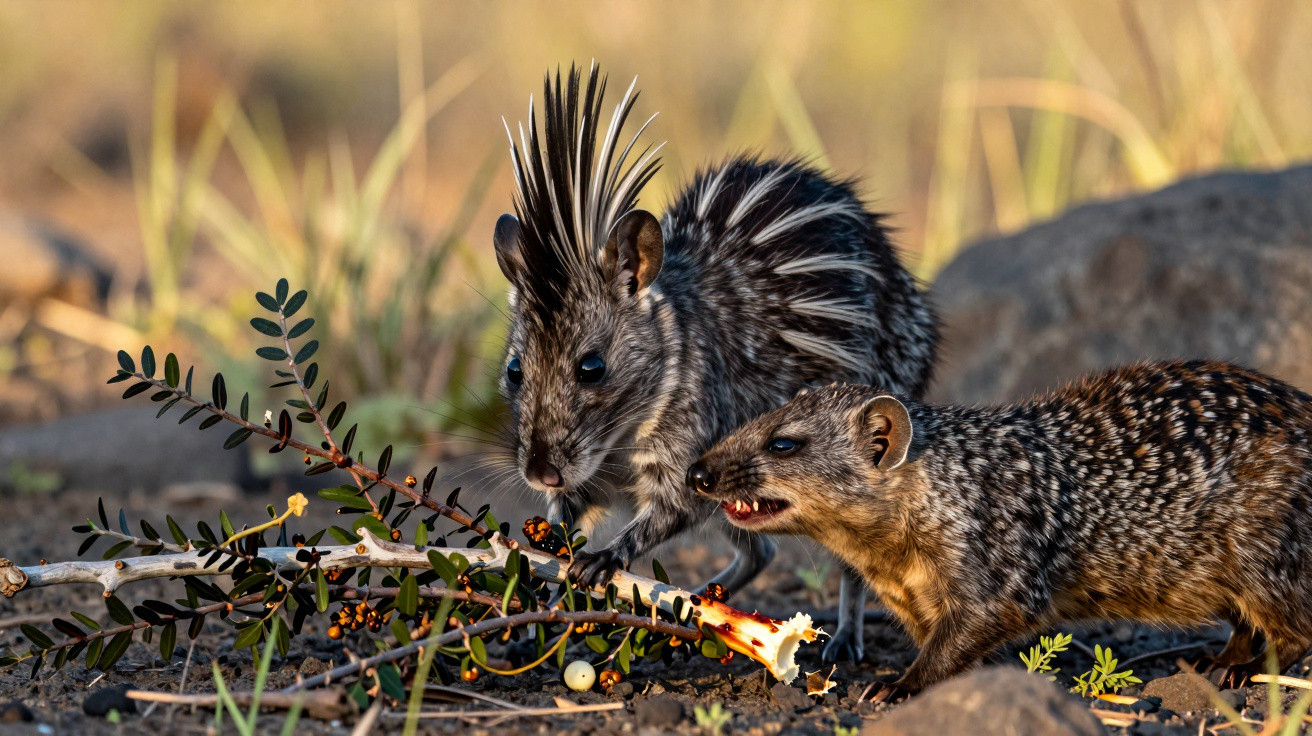
Rather than producing its own venom, an African rodent has adopted a far more unusual tactic: it takes toxins from a plant and works them into its own coat. The African crested rat (Lophiomys imhausi) chews parts of a poisonous tree before spreading the material across specialised hairs, creating a chemical defence against anything that tries to bite it.
How does the African crested rat turn a plant into a defence?
The African crested rat chews the bark and roots of Acokanthera schimperi, a plant known to contain toxic compounds called cardenolides. It then uses saliva containing these substances to moisten particular areas of the fur along the sides of its body.
What makes this especially remarkable is that the rodent does not distribute the mixture at random. Instead, it places it on highly specialised hairs with a fibrous structure that can soak up and hold the liquid. The plant toxin therefore remains in the precise area likely to come into contact with a predator's mouth.
What happens when a predator tries to bite it?
When it feels threatened, the rat can raise its coat, making the strip of specialised hairs along its flanks more conspicuous. Should a predator attempt to seize it in its jaws, it may come into contact with the substances held there, potentially making the bite a dangerous experience.
- The rodent chews parts of the toxic Acokanthera schimperi plant.
- Its saliva mixes with the compounds found in the plant material.
- The animal spreads this mixture over specialised hairs on the sides of its body.
- A predator biting this area may encounter the chemical defence.
This approach allows a comparatively small animal to turn its body into both a physical and chemical warning. Rather than needing to strike first, it makes the act of biting the very moment when a predator meets the substance intended to deter it.
Why can these hairs retain the toxin?
Microscopic studies have found that the hairs in this lateral band have an unusual construction, featuring a fibrous, porous internal structure. This arrangement helps them absorb the liquid applied by the rodent, making them very different from the ordinary fur covering the rest of its body.
The mechanism is notable because it combines behaviour and anatomy within a single defence. Chewing the plant alone would not be enough: the animal also has a body region adapted to receive the toxic material and display it exactly where a potential attacker might try to bite.
Watch the video shared by the YouTube channel VIDA SELVAGEM SELVAGENS, which shows how the African crested rat's unusual defence system works.
Why is this behaviour so rare among mammals?
Researchers describe Lophiomys imhausi as the only known mammal to sequester plant toxins in this way for defence. Other animals use compounds acquired from their surroundings, but a mammal that deliberately chews a plant and transfers its toxins to specialised hairs is exceptional.
The case also challenges the usual idea of venomous or toxic mammals. The rat does not have to manufacture the protective substance inside its own body. Instead, it exploits an external chemical source and has adaptations that allow it to store it, pairing a dangerous plant with a coat equipped to act as a shield.
A single bite can expose an extraordinary defence
The African crested rat demonstrates how evolution can create unexpected solutions. A plant that could pose a danger to many animals becomes part of this rodent's defensive arsenal, as it can handle the material and position it strategically over its own body.
The next time an unassuming-looking animal appears defenceless, it is worth remembering this rodent. Its fur does more than cover its body: it can carry a defence taken from a toxic plant. For a predator, learning that only after biting may be too late to decide that this prey was a sensible choice.

















Comments
No comments yet. Be the first to comment!
Leave a Comment