The scene is almost always identical: you open the door, put down your bag and spot a small, motionless shape on the doormat. A mouse, lizard, bird or perhaps merely a dead leaf: the cat waits there with a proud expression, as though it has completed an essential task. We all know that awkward moment when we wonder whether to thank it, scream a little too loudly or call for help. Many people see a gift, an clumsy expression of affection. Ethologists, however, offer a far less flattering explanation for our ego. This trophy is not necessarily meant to please us. The real reason is much more fascinating.
What your cat is really doing when it leaves prey at home
A cat returning with a mouse in its mouth is not following human rules of politeness. Above all, it has brought its catch back to a familiar place that it considers safe, where it can eat, play with its prey or abandon it without interruption. The home is its territory, shelter and base. We tend to view the act through our own instincts: a present, an offering or a way of saying thank you. Yet a cat does not think like a guest arriving with a box of chocolates.
Owners often report one unsettling detail: their cat meows loudly before dropping its discovery, then watches the household's reaction closely. This can make it seem as though praise is expected. In fact, the vocalisation is often connected to the excitement of the hunt or to the presence of its humans, with whom it communicates more than it does with other cats. A British study of domestic cats' predatory habits has shown that prey brought home represents only some of the animals they actually catch. The doormat, then, does not reveal the whole story.
The romantic explanation says that a cat feeds us because it believes we are unable to hunt for ourselves. This idea is widespread because it is both amusing and reassuring. Experts are more cautious: a female cat may indeed bring live or dead prey to her kittens so they can learn how to handle it, but applying that scenario to an adult human is uncertain. The behaviour is primarily driven by predatory instinct. Your presence, home and reactions may shape the scene, but that does not make you an especially inept kitten.
Why your home becomes your cat's pantry
To reduce these grisly homecomings, the first step is to understand hunting times. Many cats are most active at dawn and dusk, when small mammals and certain birds are also emerging. Keeping your pet indoors during these periods, or giving it secure access to a suitably equipped balcony, lowers its chances of catching prey. A fenced garden with an outdoor enclosure, often known as a “catio”, can also let a cat experience the fresh air without turning every outing into a hunting trip.
A common mistake is to punish a cat after it drops prey in the living room. We raise our voice, push it away, then wonder why it runs beneath the bed to hide. It cannot clearly connect punishment with an action completed several minutes earlier. Let us be honest: nobody handles this calmly and gracefully every day, particularly when the mouse is still alive. It is better to place the cat in another room, deal with the situation without shouting, then clean the affected area thoroughly.
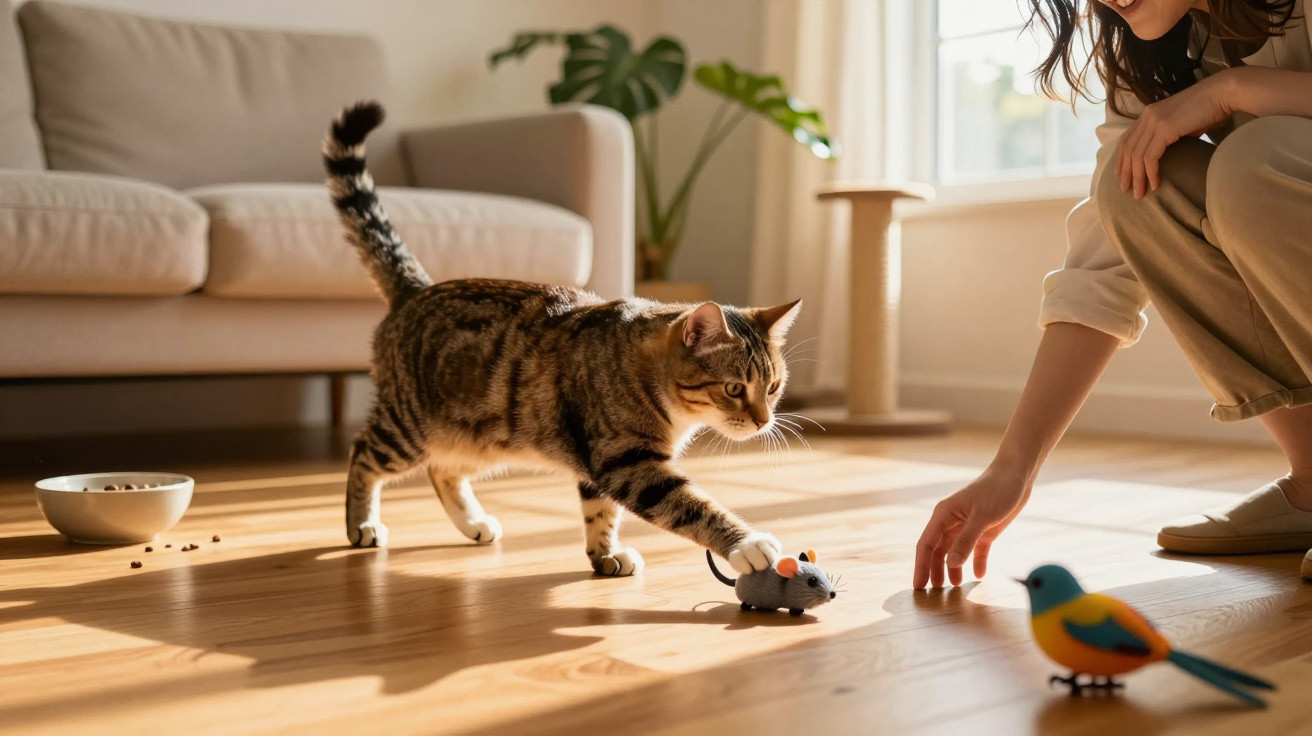
Play is still a useful tool, although it will never entirely remove the urge to hunt. Brief sessions using a feather wand, rolling ball or imitation prey allow the cat to stalk, pounce and catch in a controlled setting.
“Playing with a cat does not make its instinct disappear, but it gives it an acceptable outlet for part of its hunting sequence,” many feline behaviourists summarise.
A few straightforward habits can make a genuine difference:
- offer two or three active play sessions each day;
- rotate hiding places and toys;
- avoid letting the cat outside at night;
- check its identification and health regularly.
An ancient instinct in a very modern home
A domestic cat may live on our sofa, sleep on our jumpers and demand cat food at fixed times, yet it retains an extraordinarily effective hunter's machinery. Even when well fed, it may chase prey because of stimulation, curiosity or simple sensory enjoyment. Hunger therefore does not explain everything. This gap can create an amusing misunderstanding: we see a companion animal, while it also sees a space full of scents, hiding places and furtive movement. Its world remains wilder than it appears.
This raises a broader question as well: how can local wildlife be protected without frustrating an animal acting according to its nature? Bell collars are sometimes used, but their effectiveness differs between individual cats and species. Some colourful devices that birds can see may help in certain situations, though they are no substitute for supervision or a secure environment. The most protective option is often to limit unsupervised outdoor access, especially near areas where birds nest or small reptiles live.
Seeing your cat return with prey does not mean you must condemn it as cruel, nor applaud the display. You can love your pet deeply while acknowledging the effect of its behaviour on wild species. That little mouse left on the rug ultimately tells two stories at once: that of a perfectly adapted predator, and that of modern coexistence requiring a few adjustments. Next time your cat looks at you proudly beside its find, you can speak to it gently. But you will know that it is probably not waiting for a word of thanks.
| Key point | Detail | Benefit for the reader |
|---|---|---|
| The “gift” is not always a gift | Cats often bring prey back to a safe location within their territory. | Understand the behaviour without assigning human intentions to it. |
| Punishment works poorly | A cat does not easily associate a delayed reprimand with the capture. | Respond more calmly and protect the relationship with your pet. |
| Play and controlled outdoor access help | Simulated predatory activities and secure outdoor access reduce catches. | Limit prey being brought home and protect small wildlife. |

















Comments
No comments yet. Be the first to comment!
Leave a Comment