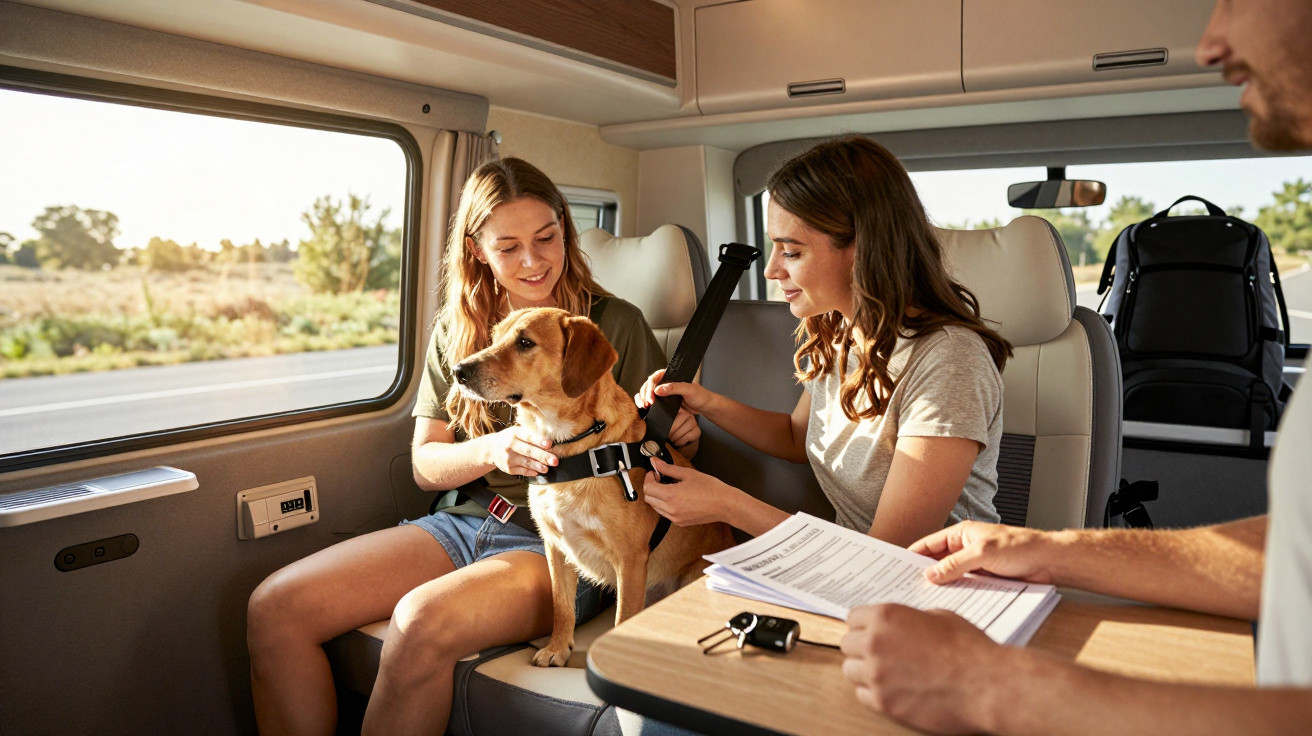
At a motorway service area, Nadine slides open the door of her motorhome and her golden retriever bounds out with the excitement of a child on holiday. While travelling, the dog roams freely between the seating area and the cab: he watches the road, changes position and sometimes rests his head beside the handbrake. “He is calm; he has always travelled like that,” says the 59-year-old retiree, slightly surprised by the question. We all know the feeling of not wanting to upset a pet, particularly after hours on the motorway. Yet, following a collision or a roadside check, the real issue may extend far beyond a fine. A little-noticed term in an insurance policy can make all the difference.
A loose dog in the motorhome: a detail that can prove costly
On holiday journeys, many drivers regard their dog as a fully fledged passenger, free to settle anywhere in the motorhome. It may look charming, until sudden braking turns a 25-kilogram animal launched from the rear bench into a projectile, endangering both the dog and everyone else aboard. The Road Traffic Code does not expressly state that a dog must be restrained. However, it does require drivers to remain able to carry out every manoeuvre without obstruction and to retain clear visibility.
A paw on the gear lever, a dog moving between the seats or barking unexpectedly during an overtaking manoeuvre: such everyday situations can be enough to constitute an obstruction. Article R. 412-6 of the Road Traffic Code is regularly cited during checks, as it requires the driver to be able to act freely and without hindrance. The offence may fall within the second class of penalties, carrying a fixed fine of €35, reduced to €22 if paid within certain time limits. That sum is minor compared with the consequences that may follow an accident.
The most immediate risk is not necessarily the one Nadine has in mind. If her dog distracts her and she hits another vehicle, compulsory motor third-party liability insurance will normally compensate the other victims: this cover is designed first and foremost to protect others. However, damage to the motorhome, injuries to the dog, certain costs and the driver’s own compensation may depend on the cover selected and on the exclusions in the policy. An animal travelling loose does not automatically result in a refused claim, but it can make the case considerably more complicated.
The motorhome insurance clause to check before setting off
The sensible step is to take out the policy wording, even though nobody wants to read 30 pages of small print before leaving. Look for sections headed “exclusions”, “damage”, “animal transport”, “policyholder negligence” or “driver cover”. Some policies provide limited, or no, cover for veterinary bills after an accident; others restrict compensation for items or equipment that have moved around inside the vehicle. Calling the insurer, asking one straightforward question and obtaining a written answer can prevent vague interpretations at the worst possible time.
A common mistake is to assume that motor insurance protects everything inside the vehicle in every circumstance. In truth, hardly anyone checks every clause before a trip to the shops or a two-day break. A motorhome is different, however, because it often carries expensive belongings, passengers and an animal moving around in a larger space than a car. The dog may also be injured without the owner being able to rely on motor insurance to meet the full cost of treatment.
An exclusion cannot be created after an accident: under insurance law, it must be clearly written, prominent and limited. Article L. 113-1 of the Insurance Code states this plainly:
“Exclusions from cover are valid only where they are formal and limited.”
- Ask whether injuries to the animal are covered, and up to what limit.
- Check the driver cover if you are responsible for an accident.
- Review exclusions connected with negligence or failure to comply with transport conditions.
- Keep the insurer’s response by email or in your customer account.
- Plan for a suitable crate, a separating grille or a harness secured to a solid anchor point.
Securing your dog without making the journey feel like a punishment
Nadine does not need to give up motorhome breaks with her golden retriever to travel with greater peace of mind. In a motorhome, the most secure option is often a properly anchored travel crate, selected for the animal’s size and positioned where it does not obstruct an exit. A grille may be suitable if it genuinely separates the driving area from the living space. A harness attached to a seat belt is practical for some dogs, provided it is designed for transport rather than simply being a lead hastily fastened in place.
The transition may take several practice journeys. A dog accustomed to watching the kilometres pass from the passenger seat may object at first, but can soon associate its crate with a blanket, a treat or a pleasant stop. The intention is not to punish the animal, let alone treat it as luggage. It is to give it a secure refuge that does not shift at the first bend. In an accident, a few seconds of preparation can make an enormous difference.
The question also goes beyond the fine alone. An insurer will assess the declared circumstances, witness accounts, the accident report and, in some cases, the police report where the collision was serious. Stating that an unrestrained dog hindered the driver may influence how a claim is assessed, particularly when optional cover is being sought. That does not mean an insurer can disregard all its obligations towards victims, nor can it rely on just any policy term. Still, it is better not to discover this issue from a recovery truck, with an injured pet and a holiday brought to an abrupt end.
A motorhome trip is better when nobody becomes a projectile
Nadine’s situation mirrors that of thousands of caring owners who believe they are pleasing their companion by allowing it freedom. The intention is kind, but it meets the reality of emergency braking, a sharp bend or a driver distracted for half a second. Between the fear of a fine and the fear of an accident, the insurance clause highlights one very practical point: cover has limits, even when premiums have been paid for years. Preparing for the journey, securing the dog properly and asking the insurer the right questions take nothing away from the spirit of motorhome travel. They simply help protect what truly matters: the passengers, the animal and that sense of freedom which should never turn into regret.
| Key point | Detail | Benefit for the reader |
|---|---|---|
| Loose dog | There is no general rule expressly stating “dog must be restrained”, but the animal must not obstruct the driver’s manoeuvres or reduce visibility. | Understand that roadside checks are chiefly based on the actual safety situation observed inside the vehicle. |
| Possible fine | Obstruction caused by an animal may be linked to Article R. 412-6 of the Road Traffic Code and result in a penalty. | Avoid treating the risk as merely an accepted holiday habit. |
| Insurance policy | Optional cover, veterinary treatment and certain losses may depend on specific policy terms or clearly drafted exclusions. | Know what to ask your insurer before travelling with your dog. |

















Comments
No comments yet. Be the first to comment!
Leave a Comment