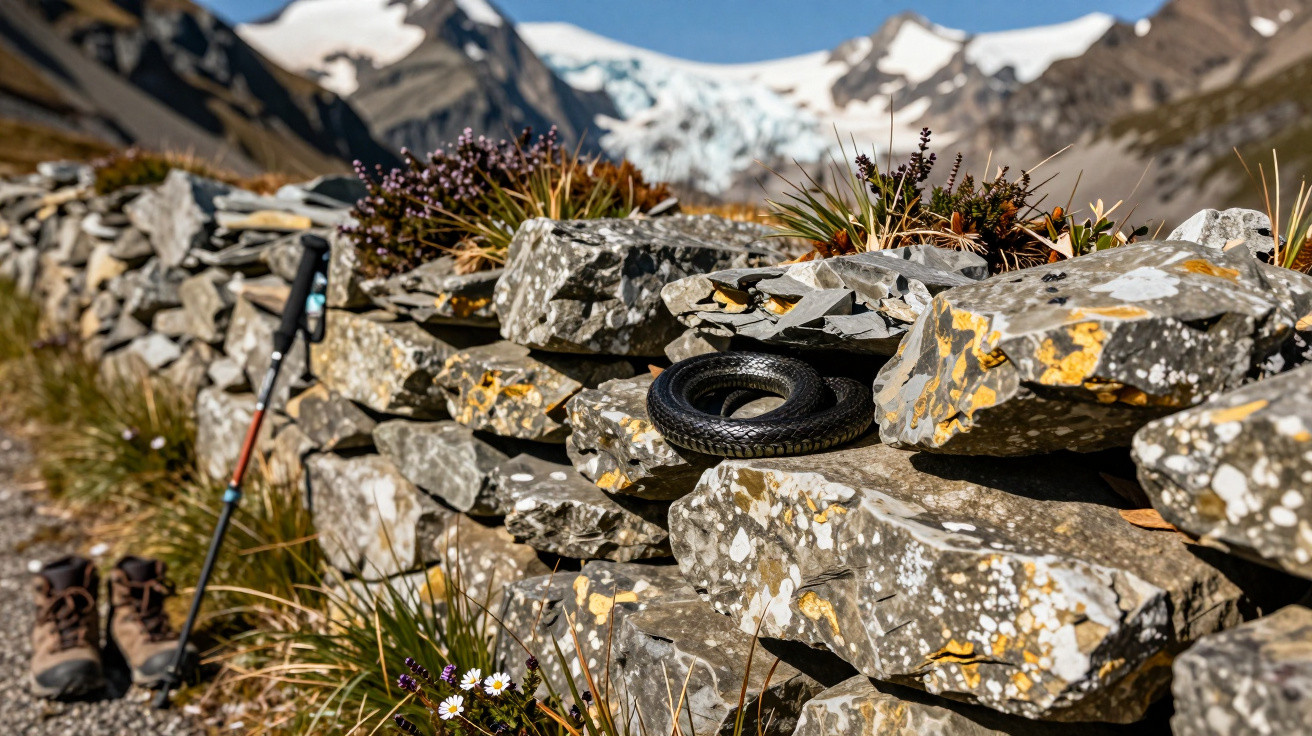
At 1,700 metres above sea level, a forgotten line of stones draws in a discreet species built for cold climates.
In the Trentino alpine pastures of northern Italy, the scene unfolds early in the morning, as the sun is only beginning to reach the grazing land. Among tall grasses, wild orchids and larches, an old dry-stone wall provides perfect shelter for a reptile that is as captivating as it is feared: the common adder.
An old stone wall transformed into a natural shelter
The setting is the Mòcheni Valley, an Alpine area of peat bogs, larch woodland, wet meadows and steep terrain. At around 1,700 metres, this old low wall once marked out grazing areas beside a mountain farm. Its gaps now provide countless places to hide.
The stones retain warmth from the first rays of sunlight. They also offer protection from wind, rain and predators. For an adder, such a structure is far more than an obstacle in its path: it is a strategic spot for resting, regulating body temperature and vanishing within seconds.
“In half an hour along this wall, six common adders were observed, with very different colourations.”
The first snake spotted is an almost entirely black female. Her dark skin, gleaming in the morning light, stands out against the green grass and grey stone. Further on, another female shows the species’ more familiar pattern: a reddish-brown background crossed by a dark zigzag stripe. Then, beneath larches, a young grey male slowly retreats across a carpet of needles.
The only snake able to live beyond the Arctic Circle
The common adder, known scientifically as Vipera berus, has an exceptional geographical range. It occurs from Great Britain to the far east of Russia, across much of Europe and Asia. It is also the only snake found beyond the Arctic Circle.
In the northern part of its range, it can live almost at sea level. Further south, the cool conditions it favours are found at higher elevations. In the Alps, it therefore inhabits areas ranging, depending on location, from 1,000 to 2,600 metres.
An expert in small-scale warmth
This reptile does not generate the heat it needs for activity itself. Its body temperature depends largely on its surroundings. It must therefore select its resting place carefully: a sunlit stone, a sheltered woodland edge, a clump of dry grass or a nearby damp patch.
Conditions can shift dramatically over just a few metres. A dark rock warmed by the sun may provide a far more suitable temperature than neighbouring woodland. Research carried out in the Italian Alps has shown that low vegetation, rocks and wet areas strongly affect the presence of these reptiles. Altitude alone cannot explain their distribution.
- Cracks between stones provide shelter from cold and predators.
- Meadows attract small mammals, which serve as prey.
- Wet areas support frogs and other amphibians.
- Sunny spaces allow adders to warm up quickly.
Why are some common adders black?
The female seen by the wall displayed melanism: an especially dark colouration caused by high production of black pigments. In cool habitats, this is far from insignificant.
A black animal absorbs solar radiation more readily. In mountains, where mornings are cold and sunny periods can be brief, this ability offers a genuine advantage. The adder reaches a temperature suitable for moving, hunting or digestion more quickly.
“A dark colouration helps to capture warmth, but it can also make the animal easier to spot in the landscape.”
The benefit is therefore not guaranteed. A black adder is more conspicuous in a pale meadow or on stony ground. It may be easier for certain predatory birds to detect. The different shades seen in the species reflect this trade-off: gaining valuable degrees of warmth without becoming overly exposed.
A discreet animal to watch from a distance
The common adder has venomous fangs connected to glands. It uses them to immobilise prey and, when it feels cornered, to defend itself. In the vast majority of cases, it would rather escape or remain still. Bites often happen when someone steps too close, tries to pick it up or puts a hand into a crevice.
A bite can be very painful and requires prompt medical attention. Deaths remain rare among healthy adults, but the risk should never be underestimated, particularly for children, older people or those with underlying health conditions.
Sensible precautions when walking
- Keep to paths where vegetation is dense.
- Wear ankle-supporting boots and watch where you place your feet.
- Do not lift stones or explore cracks with bare hands.
- If you see a snake, keep your distance and allow it to move away.
- If bitten, call the emergency services, keep the limb still and avoid unnecessary movement.
Do not cut the wound, attempt to suck out the venom or apply a tourniquet. These actions can sometimes worsen injury and delay useful treatment.
Warming threatens its high-altitude refuge
The presence of this adder in the mountains may suggest a species perfectly suited to cold. The reality is more precarious. Heatwaves are becoming more frequent, including at high altitude, and are changing animals’ biological timing.
A study conducted in England highlighted a particular risk: as temperatures rise, adders emerge earlier from winter dormancy. Yet the ground may still be frozen at that time. The animal wakes in an environment that appears favourable but remains hazardous. Researchers describe this as a climate trap.
In the Alps, moving towards the summits offers only limited escape. Cold meadows and peat bogs cannot climb indefinitely. Old stone walls, woodland edges and small wet areas therefore take on particular importance: they are tiny but tangible refuges for a species dependent on every pocket of coolness.

















Comments
No comments yet. Be the first to comment!
Leave a Comment