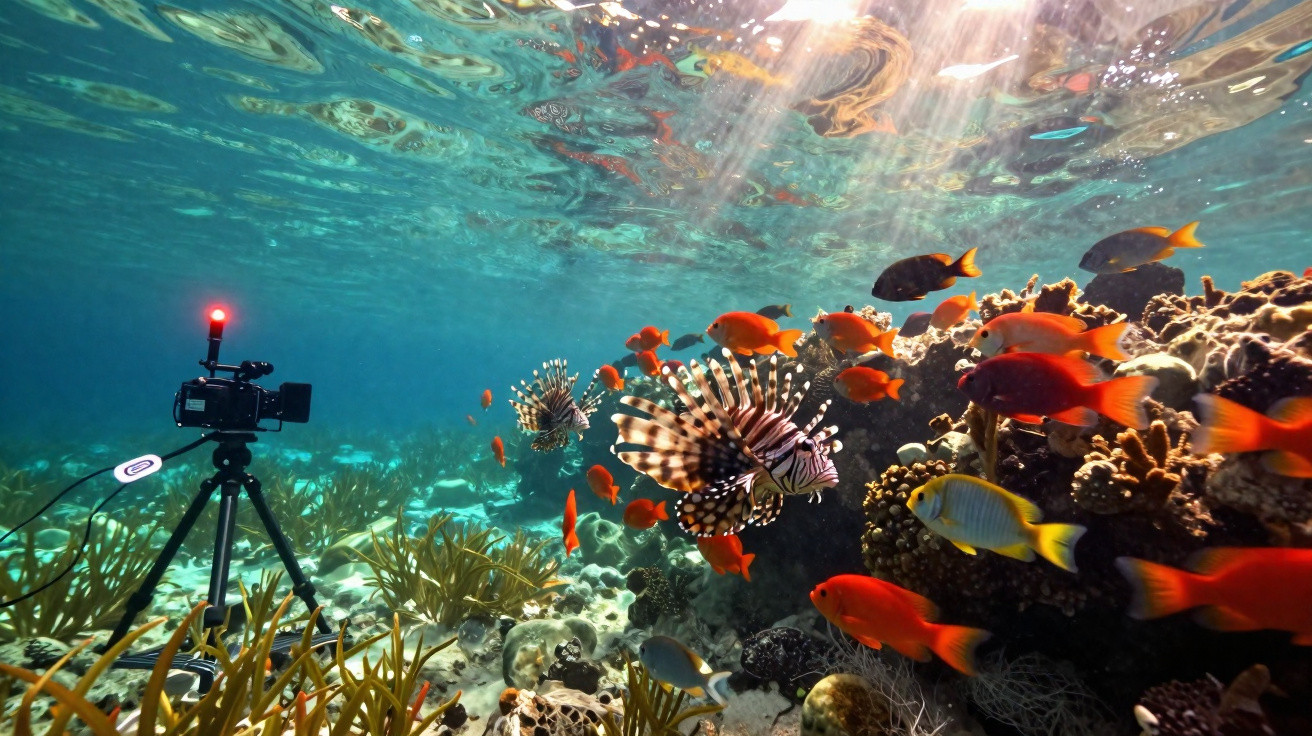
Fish have travelled from the Red Sea to the Mediterranean since the Suez Canal created a saltwater passage linking the two seas in 1869.
Over 120 fish species have completed this journey and established permanent populations.
Until now, forecasts of which species might follow have largely been based on hindsight. A new statistical model developed by researchers at Tel Aviv University offers a different approach.
Rather than waiting for a species to appear in the Mediterranean, the model assesses Red Sea fish according to their likelihood of becoming the next successful migrants.
Dr Shahar Chaikin led the research during his doctoral studies at Tel Aviv University, supervised by Professor Jonathan Belmaker of the School of Zoology.
Fish at the top of the Mediterranean watch list
This increasingly familiar movement even has a scientific name: Lessepsian migration.
It is named after Ferdinand de Lesseps, the French diplomat responsible for the construction of the Suez Canal.
Drawing on more than a century of migration records, the new model identifies three species as particularly likely to make the crossing: the stellate pufferfish, the cinnabar goatfish and the yellow-spotted trevally.
The published paper includes a more extensive list of possible candidates.
Chaikin’s team created the tool for reasons beyond scientific interest.
With the Mediterranean becoming warmer and tropical species continuing to spread northwards, a ranked watch list could give marine scientists and authorities advance warning.
The researchers said that such a list could aid early detection, environmental surveillance and decisions intended to safeguard the marine ecosystem.
The most powerful predictor of success
For many years, researchers assumed that generalist fish - species capable of living in a wide variety of settings - would be the most successful invaders. The new model reaches a different conclusion.
The key predictor is not adaptability. It is whether a fish is independent of coral reefs.
“The Suez Canal and the Mediterranean contain very few coral reefs like those found in the Red Sea. Species that depend on coral reefs are therefore unlikely to complete the journey,” Chaikin explained.
Fish that are strongly dependent on reef structures ultimately lose access to the habitat they require, both within the canal and along the largely reef-free Mediterranean coastline.
By contrast, the species that successfully invade are those that do not need coral reefs to survive.
Underwater cameras enabled the comparison
To investigate this theory, Chaikin’s group installed underwater units combining paired cameras with bait.
The equipment was deployed at depths ranging from 5 to 150 metres in the Gulf of Eilat and off Israel’s Mediterranean coast.
Known as a stereo-BRUV, this arrangement captures fish behaviour without a diver in the water affecting it.
After reviewing hundreds of hours of recordings, the researchers assessed 179 fish populations.
They compared fish species that had already invaded the Mediterranean with species still restricted to the Red Sea.
Previous studies of the issue had generally considered fish only once they had reached the Mediterranean. This research also investigated the original populations in the Red Sea.
This allowed the team to distinguish characteristics that enable an invasion from changes that occur only once a fish has arrived.
Fish enter already occupied habitats
Arriving in the Mediterranean is only part of the process. The researchers also examined how invasive fish behave after reaching it.
They expected the migrants to continue using the same habitat types they occupied in the Red Sea. Instead, the fish adapted quickly, settling in whichever habitats were available in their new environment.
Another expectation was also challenged. Invasive species are commonly believed to occupy unfilled ecological niches - habitats not being used by native fish.
Chaikin’s team instead observed migrant fish entering habitats that native Mediterranean fish already occupied. This suggests greater competition for food, shelter and space than scientists had previously expected.
Predicting the next invasions
“Until now, researchers have tried to understand biological invasions primarily by examining species that had already reached the Mediterranean,” said Professor Belmaker.
“We took a step back and asked what characterizes these species before they begin their journey.”
Through this method, the researchers could move from explaining past invasions towards forecasting future ones.
The team intends to incorporate models of this kind into continuing environmental monitoring.
As Mediterranean waters continue to warm, additional tropical species are expected to become capable of establishing populations there. A watch list prepared before an invasion occurs is therefore more valuable than one compiled afterwards.
The complete study was published in the Journal of Animal Ecology.

















Comments
No comments yet. Be the first to comment!
Leave a Comment