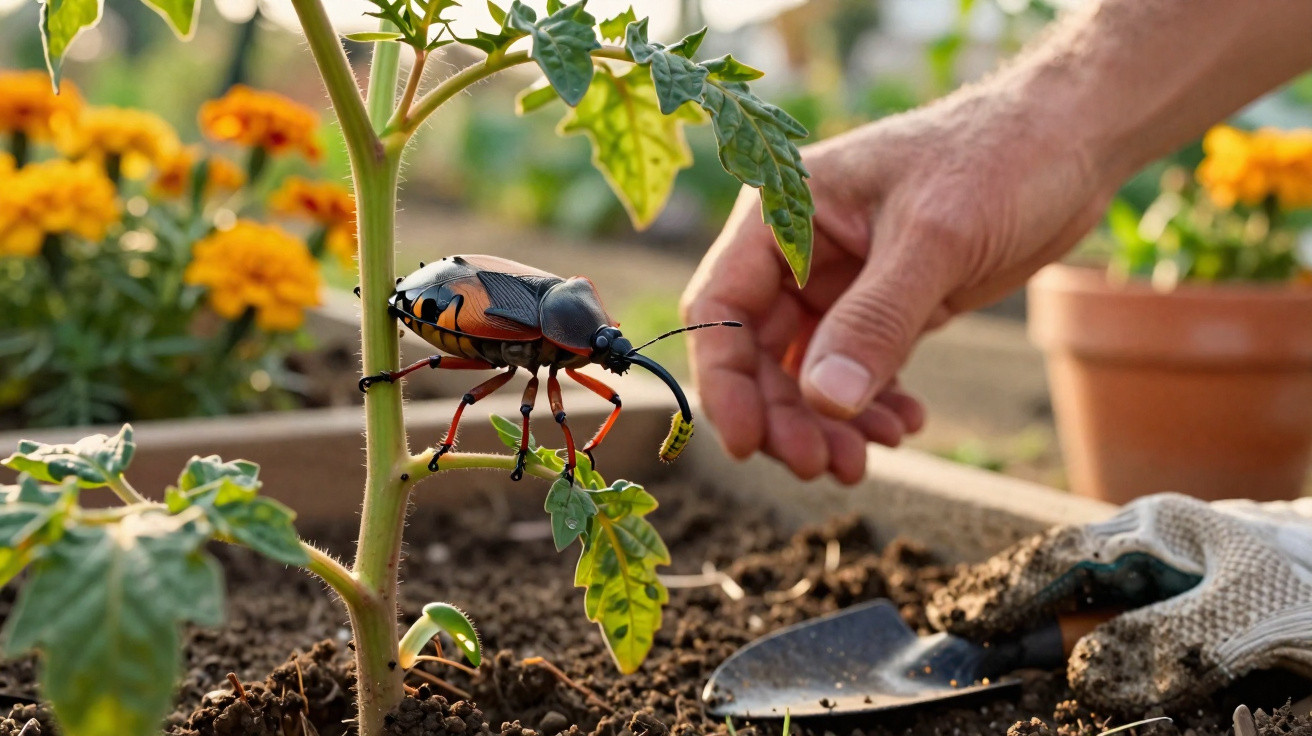
Among the leaves and branches of North America, one insect looks as though it has a tiny cog fixed to its back. This is Arilus cristatus, commonly called the wheel bug. Its toothed crest is only the most conspicuous feature of a predator that uses a piercing rostrum and paralysing saliva to overcome other insects.
What is the toothed wheel on its back?
Situated on the adult's thorax, the structure forms a tall ridge with projections resembling the teeth of a cogwheel. It is distinctive enough to have inspired the English name, wheel bug. Nymphs do not have the complete wheel; it develops as they mature into adults.
Despite its mechanical appearance, it has no moving parts and no confirmed purpose in spinning or cutting. The ridge is part of the exoskeleton. Its precise role has not yet been fully explained, although it is an excellent visual feature for identifying an adult without handling the insect.
How does the wheel bug hunt other insects?
The wheel bug belongs to the assassin bug group. It approaches its prey and inserts a needle-like rostrum. Through this structure, it delivers saliva containing substances that can paralyse the victim and begin breaking down its internal tissues, allowing the predator to suck out the contents afterwards.
The University of Florida reports that prey can be immobilised within minutes. Caterpillars, beetles and other insects are on the menu, which is why the wheel bug is regarded as an ally in gardens and agricultural areas. The same highly effective hunting apparatus also explains why handling this animal is a bad idea.
Is a wheel bug bite really that painful?
The insect does not hunt humans and will generally try to escape, but it may use its rostrum defensively if it is squeezed, caught in clothing or held. Reports compiled by the University of Florida Extension describe the pain as more severe than that caused by ordinary bee, wasp and hornet stings.
Possible effects include immediate severe pain, numbness and discomfort that lasts for days. Recovery is usually free of serious complications, but secondary infection or hypersensitivity can occur. Seeking medical attention is sensible if there is a severe reaction, signs of an allergy or progressively worsening symptoms.
- The wheel-shaped crest occurs in adults and is part of the exoskeleton.
- The rostrum pierces prey and delivers saliva that helps to paralyse and digest tissues.
- The insect preys on several species that may damage plants.
- Its defensive bite can cause intense pain in people, so there is no reason to try catching it with bare hands.
Watch the video shared by the YouTube channel stubotics, which shows a “wheelbug” in detail.
Why can the wheel bug be useful in the garden?
Generalist predators can help reduce populations of other insects without intervention from the gardener. Wheel bugs eat a range of prey and form part of this natural control network. The presence of one adult does not mean every pest will disappear, but it does indicate that an active predator is in the area.
Because it is not highly selective, it may also attack insects that are not regarded as pests. This is another reason to observe rather than handle it. Its ecological value lies in its role as a predator, not in using it as a manual pest-control tool or attempting to move it by hand.
What should you do when you find a living cogwheel?
If the insect is on a plant or outdoors, the best approach is to leave it alone. If it is inside the house, use a container and a rigid surface to guide it outside without direct contact, if necessary. Children and pets should be kept away while it is being removed.
Its almost industrial appearance may make it tempting to pick it up for a photograph, but the crest is harmless; the risk lies in the rostrum. Looking closely without touching lets you appreciate one of the strangest forms among assassin bugs while respecting an important predator in the garden's small wildlife community.

















Comments
No comments yet. Be the first to comment!
Leave a Comment