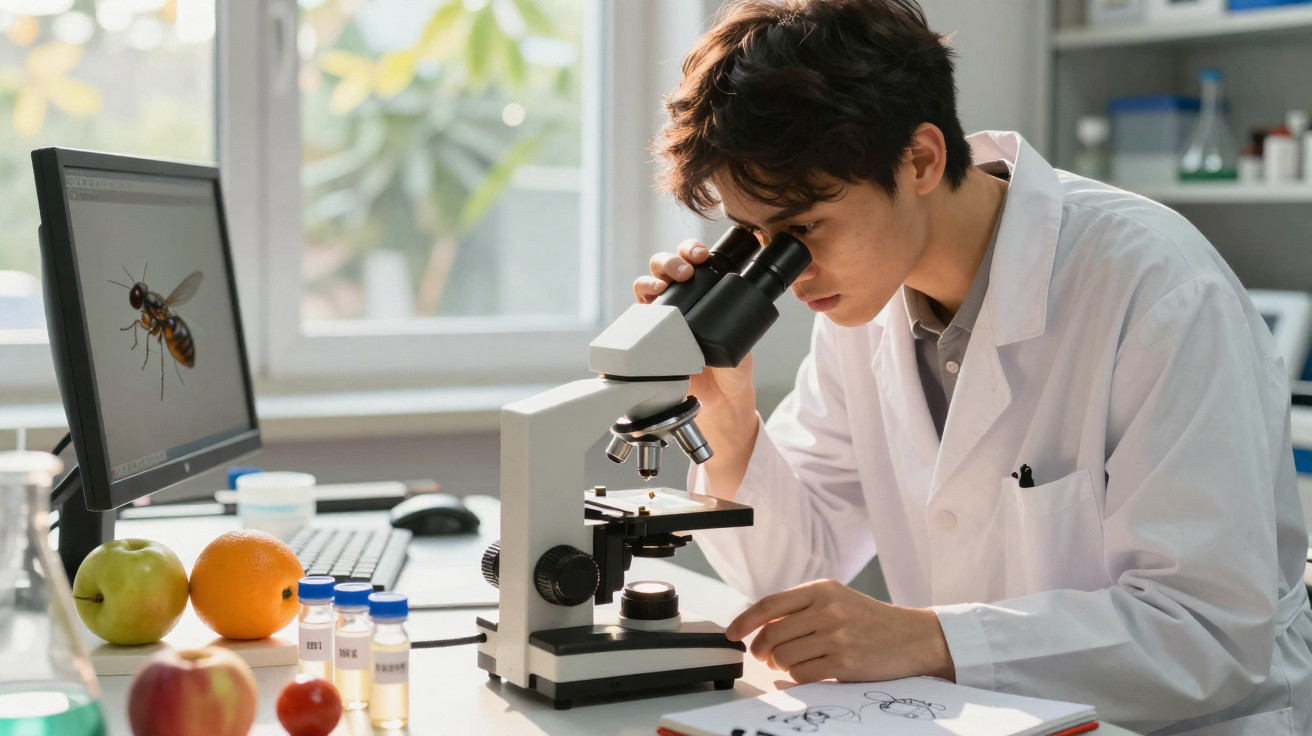
Syntretus perlmani: a wasp found inside adult fruit flies
Biologists have discovered a new wasp species in a highly unexpected location: the rear abdomen of an adult fruit fly.
The previously unrecorded species has been named Syntretus perlmani. Its most remarkable feature is that it starts life within the abdomen of adult Drosophila flies, a host site no other wasp is known to use.
An unusual adult fruit fly host
Parasitoid wasps deposit their offspring inside the bodies of many insect species, and as many as 200 species use juvenile, larval Drosophila as hosts.
Certain wasps in the Euphorinae subfamily, which includes this newly identified species, are already known to target adult beetles, wasps, bees and lacewings. However, none had previously been observed developing inside an adult fruit fly.
The researchers first encountered this unusual nursery in March 2023, when they used traps in Mississippi gardens to catch flies. Their original aim was to search for nematode infections, but they instead uncovered something arguably more intriguing.
Inside the soft abdomen of an adult male fruit fly sat a parasitoid wasp larva. Mitochondrial DNA sequencing showed that it belonged to an as-yet-undescribed Syntretus species.
Over the following 11 months, the team gathered and examined more than 6,000 male flies (Drosophila affinis) from Mississippi, Alabama and North Carolina, carefully checking for evidence of wasp larvae.
Less than 1 percent of the flies were infected across the full year of sampling, although the rate changed seasonally, ranging from 0.5 to 3 percent.
The scientists also examined females, yet only one of the 477 female flies contained a wriggling wasp larva.
How Syntretus perlmani develops
After collecting these offspring, the researchers reared them in the laboratory to watch their development and behaviour.
They found that the larva takes around 18 days to develop after the egg has been laid, while its fly host continues to remain active.
As the moment approaches, the larva starts twisting and writhing inside the fly. It ultimately chews through the host’s abdomen in chestburster fashion, then squirms away to a protected location to pupate and emerge as an adult wasp.
Being the host fly may seem demanding, but female wasps have little time to spare as well. Just 24 hours after leaving their laboratory cocoons, female wasps were already ovipositing in flies and restarting the cycle.
Using adult hosts to rear developing larvae may bring particular benefits. Adults face less competition from other parasites, while their cellular immune responses may be less powerful than those of juvenile hosts.
"This wasp can be easily collected from backyard fly baits and has a broad geographic distribution throughout the eastern USA," the researchers write, noting this could make the species an ideal study tool for biologists.
"Parasitoid research continues to uncover unusual biology and supports fundamental mechanistic insights into immunity, metabolism, ecology, evolution and behavior," they write.
Laboratory opportunities with Drosophila melanogaster
In laboratory tests, the wasp also attacked other fruit fly species, including Drosophila melanogaster. Its short life cycle, vigorous reproduction and straightforward, giant chromosomes have made this fly among the world’s most widely used and genetically well-understood organisms.
Researchers successfully raised nine adult wasps from the 44 confirmed infections in female D. melanogaster flies in the laboratory.
"We anticipate that this wasp's association with the laboratory model organism, D. melanogaster, will provide new research opportunities across the life sciences," the team writes.
The research is published in Nature.

















Comments
No comments yet. Be the first to comment!
Leave a Comment