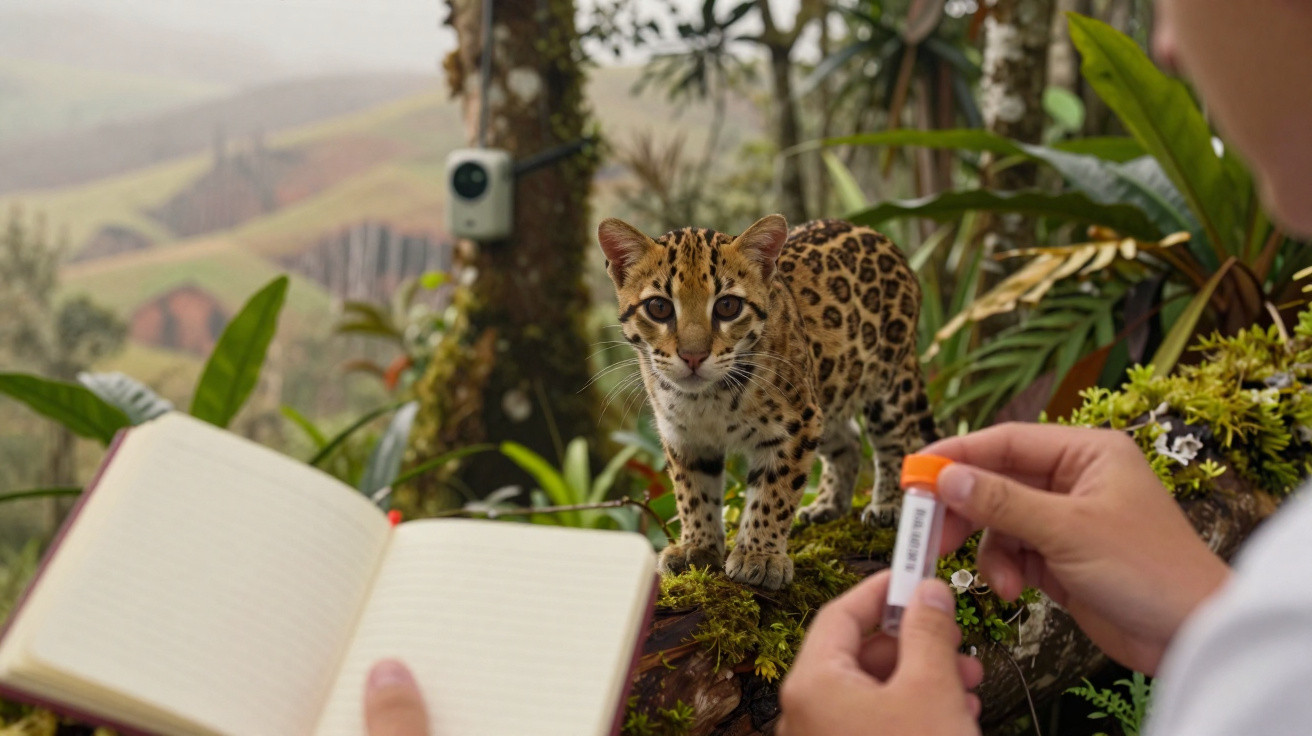
In Bolivia’s Yungas, a small spotted wildcat, long mistaken for a kitten, is reshaping what is known about local wildlife.
People living in this mountainous region have known of it for generations. Scientists, however, had never examined or described the animal as a species in its own right. Genetic testing has now confirmed the existence of Leopardus tilcayo, an elusive wildcat living between the foothills of the Andes and the Amazon Basin.
An animal smaller than a domestic cat
Tilcayo has a slender build, rounded ears and a coat covered in spots. Its size is striking: it is smaller than an adult pet cat. This appearance also played a part in its unusual story.
One of the first individuals examined closely was taken in near La Paz, Bolivia. A resident of a forest community had assumed it was an abandoned kitten. Hoping to help, he fed it pasta, rice and eggs. He eventually realised that the animal was not domestic and placed it in a specialist sanctuary.
“This wildcat was not a lost young animal, but an adult belonging to a lineage still absent from scientific records.”
At the Senda Verde sanctuary, the first observers considered the possibility that it was a wildcat already known from other parts of South America. Yet several features did not match: the arrangement of the spots, the shape of the tail and its overall size differed from those of closely related species.
Two animals, then genetic confirmation
Researchers collected samples from two individuals that had arrived separately at the same sanctuary. The results showed that they belonged to the same species and were clearly distinct from the other small cats in the Leopardus genus.
According to work published in a scientific journal, this branch split from other comparable lineages around 1.4 million years ago. Such genetic separation supports the classification of tilcayo as a distinct species.
The announcement is particularly significant. Medium-sized and large mammals across the world are still comparatively well documented. Zoologists describe many species each year, but these are often insects, fish, reptiles or small organisms. Identifying a previously unknown mammal remains an uncommon event.
- Tilcayo lives in north-western Bolivia.
- Its habitat lies in the Yungas, an area of humid highland forests.
- It belongs to the Leopardus genus, which includes several small American wildcats.
- Its total population is still unknown.
- Scientists are now looking for evidence of the species using camera traps.
A name already passed down by local communities
Scientific recognition does not mean that the animal had been unknown to everyone. In several Bolivian communities, the name tilcayo had already circulated for a long time. Families say they heard the term from their grandparents, though it was not necessarily given a precise translation in an indigenous language.
The teams involved in the identification chose to retain this local name. The decision highlights a reality that is sometimes overlooked: the knowledge held by residents, livestock farmers, forest guardians and indigenous communities can predate the catalogues produced by science.
“Tilcayo was known in local memory before it was recognised in zoological classifications.”
A forest already under pressure
The newly identified species occurs in a vulnerable landscape. The Yungas comprise a vast mosaic of cloud forests, damp valleys and steep slopes. They support remarkable biodiversity because they form a transition zone between the Andes and the Amazon.
This richness is threatened by the expansion of roads, agriculture, grazing land and settlements. The gradual loss of trees fragments animals’ territories. For a solitary small wildcat, this can make it harder to find prey, move between areas and reproduce.
Other species related to tilcayo already face similar pressures in several South American countries. Shrinking forest areas can also increase contact with domestic animals, bringing risks of disease transmission or conflict with local people.
Why the number of tilcayo individuals remains unknown
Specialists do not yet know how many tilcayos live in the wild. Two animals are not enough to assess the true condition of a population. Several occupied areas must be identified, observations compared and data gathered over a number of years.
Camera traps have a central role in this work. These devices activate automatically when an animal passes in front of their sensor. They make it possible to detect nocturnal or highly elusive species without capturing them. Coat patterns can sometimes help distinguish individuals, acting like a visual fingerprint.
- Place cameras in different forest areas.
- Identify frequently used routes and hunting grounds.
- Compare photographs taken across several seasons.
- Assess threats around sites where the species is detected.
- Tailor protection measures to the findings.
An identification that changes conservation priorities
Classifying an animal as a distinct species is not simply a matter of scientific terminology. Recognition can alter conservation strategies. A species that has remained invisible in the data may receive no specific monitoring, no suitable protected area and no surveillance programme.
The case of tilcayo also shows how wildlife sanctuaries can provide valuable clues. An individual taken in after an encounter with a local resident can reveal a much wider reality. However, teams need the resources required to carry out analyses and continue field research.
Over the coming months, scientists hope to obtain more images, traces and non-invasive samples. Hairs left on a branch, droppings or photographs captured in the forest can help map the presence of this small wildcat. Every piece of evidence matters in preventing this species, only just recognised, from already facing the threat of extinction.

















Comments
No comments yet. Be the first to comment!
Leave a Comment