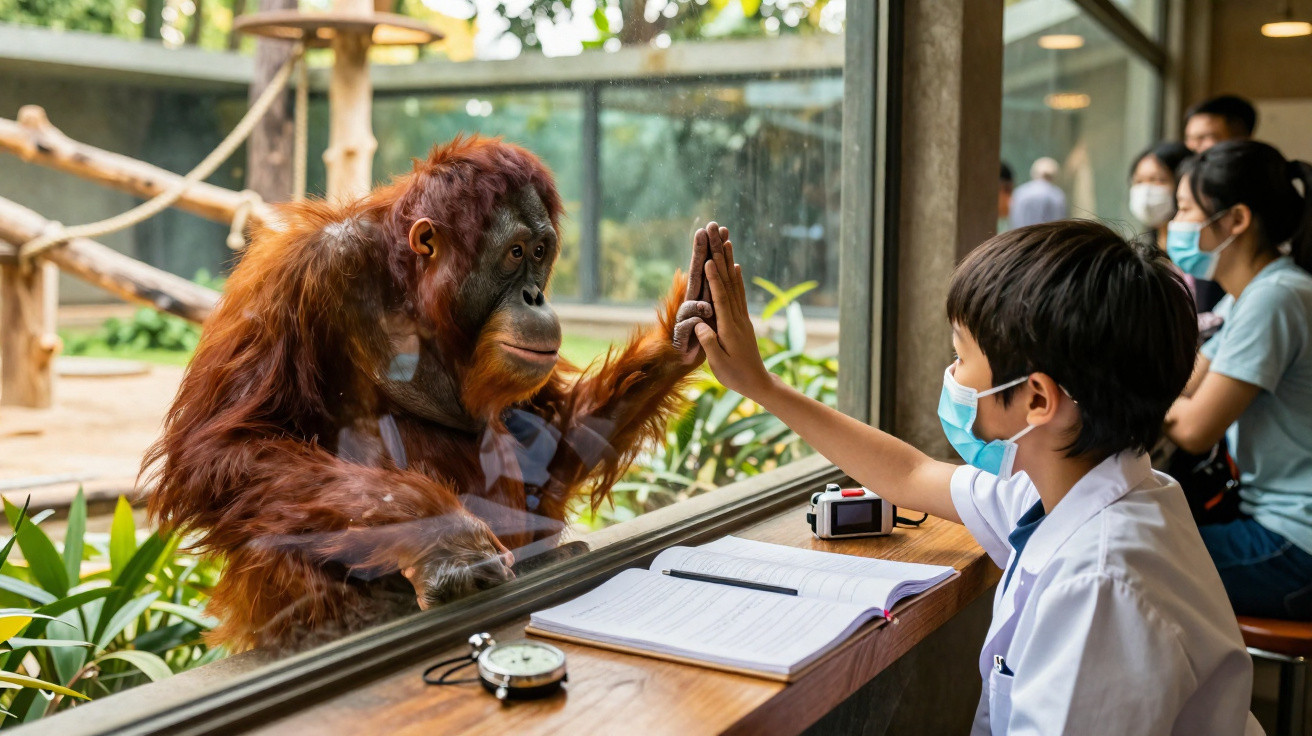
As the COVID-19 pandemic developed, everyone had to adapt – including zoo animals, which abruptly stopped seeing streams of visitors passing their enclosures each day.
A 2022 study examined how primates responded to this change. Researchers tracked bonobos, chimpanzees, western lowland gorillas and olive baboons, finding that the animals altered their routines in several respects, including how long they spent resting and feeding.
How zoo visitors affect primate welfare
Contact with visitors is considered important to the welfare of animals in zoos, but its effects can be beneficial or harmful. The researchers therefore wanted to understand what happened when the usual crowds were absent.
"Primates are some of the most cognitively advanced species in zoos and their interactions with visitors are complex," zoo animal welfare scientist Samantha Ward from Nottingham Trent University in the UK explained at the time.
"A limitation to understanding how visitors can affect behavior of animals in zoos and parks is that they rarely close to the public for prolonged periods, so this provided us with a unique opportunity."
The observations took place at Twycross Zoo and Knowsley Safari in the UK, both before visitors returned and afterwards.
COVID-19 closures changed zoo primate behaviour
Across several months, encompassing repeated periods of opening and closure, the primates displayed clear behavioural shifts. These changes differed between species.
When visitors started returning to the zoo, bonobos and gorillas spent less time by themselves. The gorillas also rested less. After zoos reopened, chimpanzees spent more time eating and interacting with their enclosures.
At the safari park, olive baboons showed less sexual and dominance behaviour after visitors returned. Compared with the ranger vehicles present while the park was shut, they were also more likely to approach visitors' cars.
Interpreting the changes in animal behaviour
It is harder to determine whether every one of these changes was beneficial.
The researchers propose that returning visitors appeared to provide stimulation for chimpanzees and baboons. Bonobos and gorillas spending less time alone may likewise be interpreted positively.
However, it is also possible that crowds disturbed gorillas – naturally more sedentary animals – because they reduced the time they spent resting.
Gorillas also changed the areas of their enclosures where they spent most of their time once visitors returned. This indicates that the animals may be able to manage such disruption to a degree.
"Behavioral changes and changes in enclosure use in the presence of visitors highlights the adaptability of zoo species to their environments," said zoo animal welfare researcher Ellen Williams from Harper Adams University in the UK.
"Provision of environments which enable animals to actively adapt in this manner is really important for their welfare."
The team further found a threshold in visitor numbers for olive baboons. Beyond that point, the animals no longer became progressively more active or stimulated by cars travelling through the safari park.
These findings provide useful information for animal welfare researchers, who recognise that visitors can affect wildlife in many ways. People may offer companionship and a sense of safety, but can also be an irritation or even perceived as a threat. Zoo and park operation and design need to take these influences into account.
Although further lockdowns do not appear likely in the near future, hopefully, the researchers intend to continue investigating how visitor numbers influence animal behaviour. This will include gathering data from more animals and over a longer period.
"Future work could involve looking at the impact on a wider range of species in both zoos and safari parks as well as differences among individual animals," said Williams.
The research was published in Animals.
An earlier version of this article was published in September 2022.

















Comments
No comments yet. Be the first to comment!
Leave a Comment