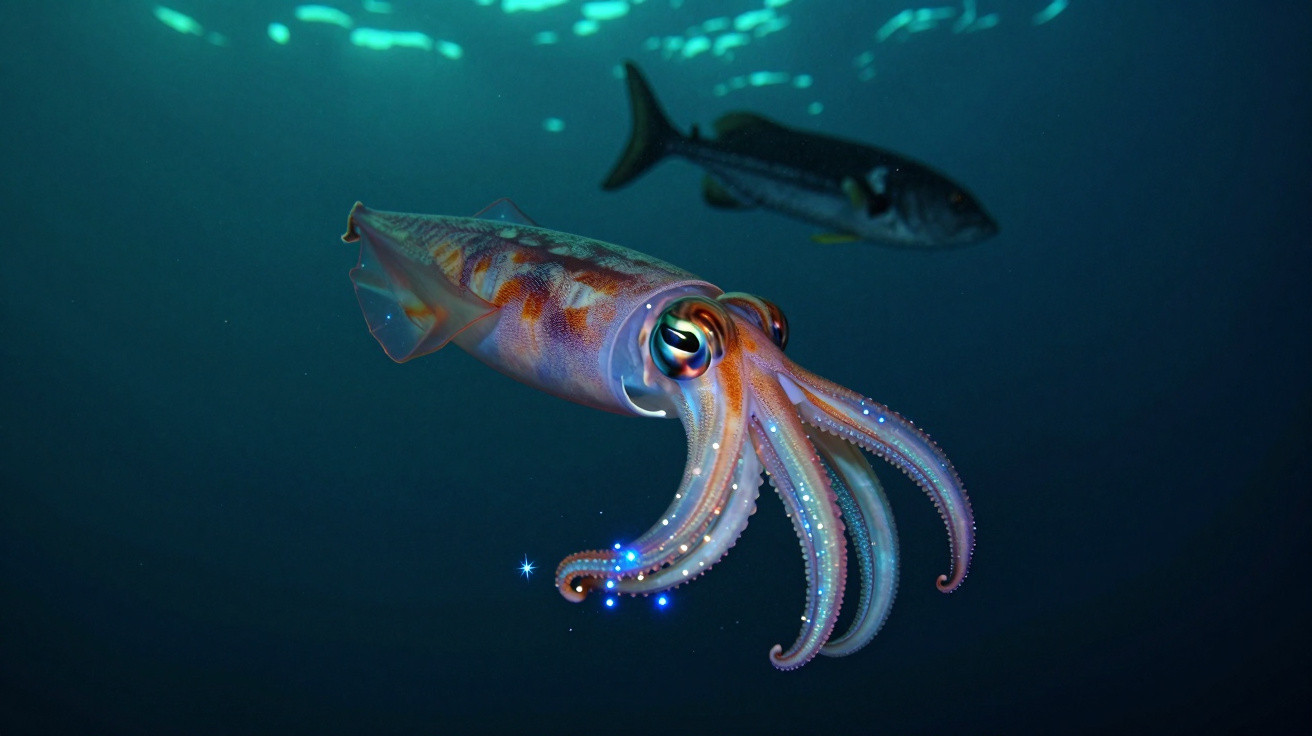
In the deep ocean, where sunlight all but vanishes, a small squid has a defence that turns darkness into a diversion. The vampire squid, *Vampyroteuthis infernalis*, relies on more than escape or camouflage: when threatened, it can release a cloud of bioluminescent mucus that glows around it.
How does the vampire squid create a luminous cloud?
This tactic begins with specialised structures at the tips of its arms. These organs can eject a sticky substance containing bioluminescent particles. Once released into the water, the mucus becomes a glowing cloud, producing bright points that remain visible for a while in the darkness.
It is a particularly effective resource in an environment where any flash of light can swiftly change how a scene is perceived. Rather than producing a simple dark discharge, as many squid do with ink, the vampire squid makes use of what appears rarest in the depths: light itself.
Why can this defence confuse a predator?
The leading hypothesis is that this luminous cloud acts as a visual distraction. An animal approaching to attack may encounter several glowing points dispersed through the water while the vampire squid attempts to slip away silently. For a few moments, telling the squid’s actual body apart from the flashes may become more difficult.
This combination makes for an unusual defence because it does not rely on harming the attacker. Its likely purpose is to buy precious seconds. Factors that make this mechanism so effective in the deep-sea environment include:
- The cloud creates several luminous points around the animal.
- The glow can draw the predator’s attention away as the squid escapes.
- The mucus stays in the water while the squid tries to put more distance between itself and the threat.
- Deep-ocean darkness heightens the contrast created by bioluminescence.
Why does the vampire squid not rely solely on dark ink?
Conventional ink is especially useful when it forms a visual curtain in illuminated surroundings. However, the vampire squid inhabits extremely deep, dark regions, where creating a black patch would have a different effect. In this setting, producing light can be a far more noticeable and disorientating alternative.
This does not mean the squid lights up its entire surroundings. The emission is localised and short-lived, enough to disrupt the approach of a potential threat. It is an adaptation shaped by the conditions of a habitat where high pressure, low oxygen levels and a lack of light demand solutions very different from those found nearer the surface.
Watch the video shared by the YouTube channel Coruj4 Curios4 showing a vampire squid on the ocean floor.
Does the glow appear elsewhere on its body?
The vampire squid’s ability to produce light is not restricted to the mucus released from its arm tips. The animal has photophores - organs able to generate light - distributed across its body. They may help alter its appearance in the darkness and are part of a sophisticated set of responses used in dangerous situations.
Taken together, these strategies make its defence seem less like an isolated reaction and more like a system adapted to the deep ocean. Light, movement and body posture can be combined to lower the chances of capture, demonstrating that bioluminescence can serve not only communication or attraction, but survival too.
What does this squid reveal about life in the depths?
The vampire squid’s glowing cloud shows that surviving in darkness does not mean staying invisible at all times. In certain moments, drawing attention to the wrong place can matter just as much as disappearing. Bioluminescence turns the absence of light into an exceptionally specialised defensive tool.
The next time the vampire squid appears as an example of a strange deep-sea creature, it is worth looking beyond its appearance. Its real surprise may lie in how it manipulates light to escape. Learning about adaptations such as this helps us recognise how much of the ocean still holds strategies that challenge our intuition.

















Comments
No comments yet. Be the first to comment!
Leave a Comment