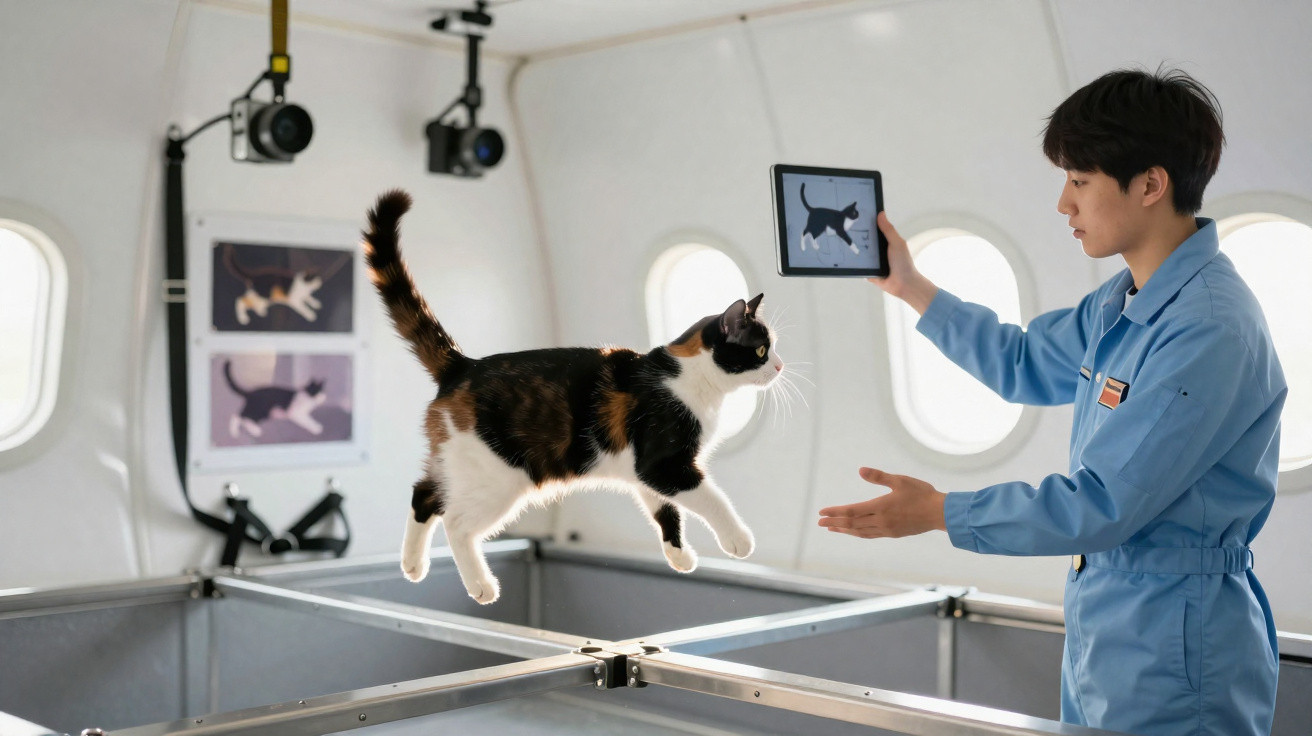
Few creatures on Earth are as agile as the ordinary domestic cat. Among their most celebrated acrobatic talents is an especially famous one: when they take a tumble, they can land safely on their soft paws.
This is more than a figure of speech, even if cats are remarkably good at getting themselves out of difficult situations. It is literal as well. Watch a cat misjudge a step and fall, and the way it contorts its furry body in mid-air can look positively uncanny.
Cats and the falling-righting reflex
Attempts to explain this feline ability properly began with the arrival of chronophotography, which enabled researchers to capture many images over a very short time.
In 1894, the French scientist Étienne-Jules Marey released a sequence of photographs shot at 12 frames per second. They showed a cat skilfully rotating while falling from a supine position, before landing flawlessly.
During the 1950s, people developed parabolic flight, a method of recreating zero-G conditions with specially designed aircraft following a carefully calculated plunging trajectory. This prompted a rather mischievous question: what would become of a cat's ability to land on its feet when it could no longer distinguish up from down?
The sharp minds at the US Air Force Aerospace Medical Research Lab therefore set out to investigate.
Parabolic flight and cats in weightlessness
Parabolic flight does not create genuine microgravity, but it offers a short-lived sensation of its effects. Much as a fast downward journey in a lift can leave you feeling lighter in your shoes, aircraft passengers become weightless as the plane descends rapidly from a higher altitude to a lower one. The experience is highly disorientating, which is why parabolic flight earned the nickname ‘vomit comet’.
The earliest tests took place aboard a Convair C-131 Samaritan and, yes, footage of the event absolutely exists. In a related experiment, pigeons were released inside the C-131 during parabolic flight. The humans involved appear to have been rather casual about protecting their eyes.
It makes for compelling viewing. The video narration states that the cats’ "automatic reflex action is almost completely lost under weightlessness". Almost – but not entirely. While the cats look confused, they can still rotate and manoeuvre their bodies as they attempt to work out where they will fall.
These trials were by no means the last. A 1957 article in The Journal of Aviation Medicine records experiments involving eight kittens in T-33 and F-94 aircraft undertaking parabolic flights – "not only to satisfy our own curiosity," wrote Siegfried Gerathewohl and Herbert Stallings of the US Air Force, "but to clarify the role of the otolith organ during weightlessness."
There are also photographs, taken in 1958, of a distinctly unhappy-looking kitten in the cockpit of a Lockheed F-94C Starfire.
What falling cats taught scientists and astronauts
All of this kitty-cat business aided scientific understanding of cats. In 1969, Stanford University mechanicians Thomas Kane and MP Scher published an analysis in the International Journal of Solids and Structures. It characterised a falling cat’s movement as two cylinders twisting relative to one another, allowing the animal to right itself swiftly during a fall.
The work also mattered for humans. That same pair of scientists produced a 1969 NASA document using mathematical models to improve understanding of human movement and orientation in freefall.
Then, in 1968, Kane enlisted a gymnast who, wearing an astronaut outfit while bouncing on a trampoline, attempted to reproduce a falling cat’s motions. Ralph Crane photographed the successful trial, and the images appeared in LIFE. Even today, astronauts learn to twist their bodies like cats so they can turn themselves around in microgravity.
That is probably fortunate. If cats had to carry out space exploration for Earth, there is no telling which cosmic abominations they might proudly bring back to show us.

















Comments
No comments yet. Be the first to comment!
Leave a Comment