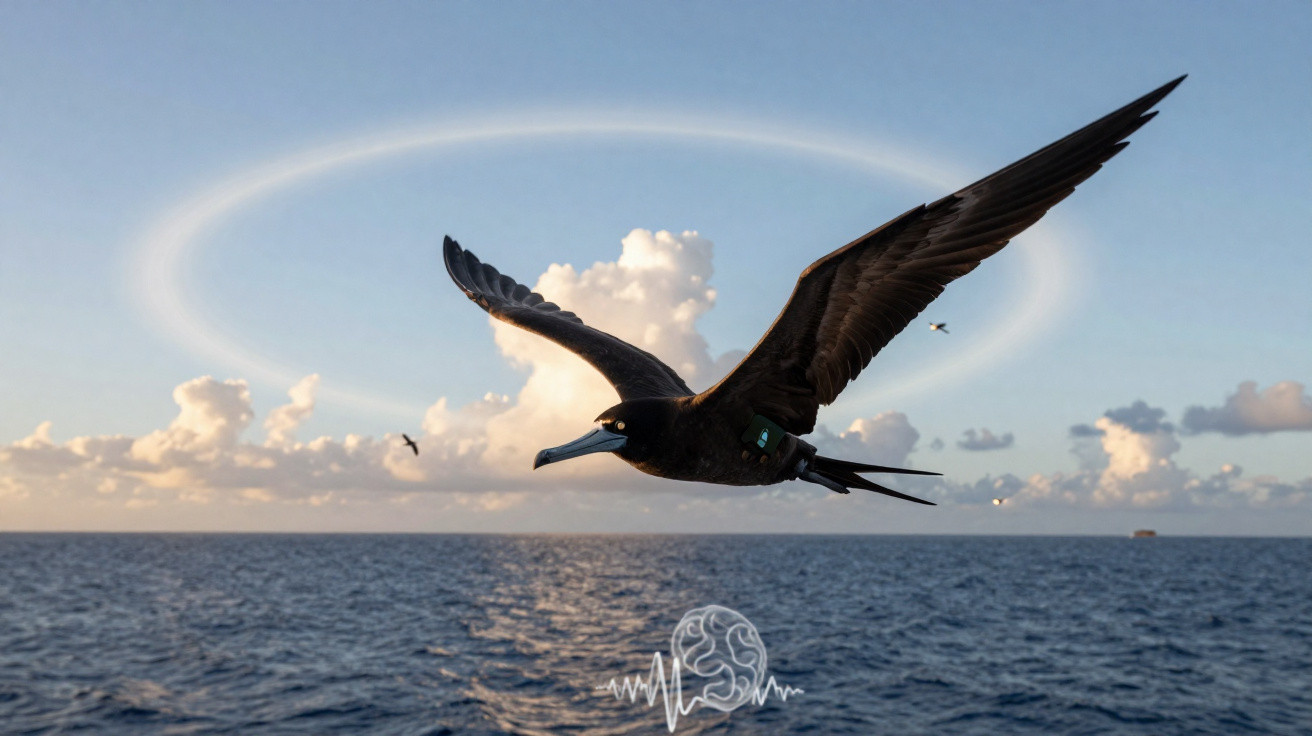
Imagine crossing the ocean for days without finding a safe place to land, yet still managing to sleep along the way. The great frigatebird can do something remarkably close to this: researchers recorded these birds’ brain activity while they were in flight and found that they take short periods of sleep while continuing to glide over the sea.
Which bird can sleep while flying?
The bird behind this ability is the great frigatebird, scientifically known as Fregata minor. This seabird spends extended periods above the ocean searching for food and can make journeys lasting several days without landing. Confirmation that it genuinely sleeps in the air came from a study published in the journal Nature Communications in 2016.
Scientists fitted the birds with small devices able to record their brain activity during their journeys. The results showed that they entered slow-wave sleep while airborne, especially when gliding. This was the first direct evidence of sleep in freely flying birds.
How can it sleep without falling?
Part of the explanation lies in what is known as unihemispheric sleep. At certain times, only one hemisphere of the brain enters a sleeping state, while the other remains more active. The bird can keep the eye linked to the awake side of the brain open, retaining some awareness of its flight direction.
- One part of the brain can rest while the other stays more alert during flight.
- The frigatebird generally sleeps while gliding, making use of rising air currents.
- Episodes of sleep in the air are brief and account for only a small part of the day.
- At certain points, researchers even recorded both hemispheres sleeping at the same time.
That final finding surprised the researchers themselves. While sleeping with only half the brain appears to be a logical way of staying alert, brief periods in which both hemispheres slept were also observed. The ability to continue gliding helps explain how this can happen without an immediate fall.
How long does the great frigatebird actually sleep in the air?
Anyone picturing a bird sleeping deeply throughout the night would be mistaken. During the long flights examined, frigatebirds slept for an average of around 42 minutes per day, divided into short episodes. This is an astonishingly small amount compared with the time these same birds can spend sleeping when on land.
The discovery indicated that sleeping in flight does not appear to restore all the rest they miss. Instead, the birds stay awake for most of the journey, possibly because they must look for feeding opportunities, monitor environmental conditions and remain in control of their movements.
Watch the video shared by the YouTube channel Planeta Animal Oficial for more information about the guardian of the skies, the great frigatebird.
Why do they prefer to sleep while gliding?
The recordings showed that sleep occurred mainly when frigatebirds were circling in rising air currents. Under these conditions, they can gain or maintain altitude by using atmospheric movement, reducing the need to flap their wings continuously and making flight more suitable for short periods of rest.
During daylight hours, however, the birds were mostly awake as they searched for food. The pattern changed after nightfall, when sleep episodes became more frequent. This suggests that even such an extraordinary adaptation must fit around the demands of feeding, navigation and survival.
What does this discovery reveal about sleep?
The great frigatebird challenges the notion that sleeping must always mean stopping all activity completely. Its brain can reorganise rest in a way that would be impossible for humans, balancing short sleep periods with the constant need to remain airborne during journeys across vast stretches of ocean.
The next time you watch a bird gliding, it is worth remembering how much remains to be discovered above our heads. The frigatebird demonstrates that apparently impossible behaviours can be highly sophisticated natural strategies, turning something as ordinary as sleeping into one of the animal kingdom’s most remarkable curiosities.

















Comments
No comments yet. Be the first to comment!
Leave a Comment