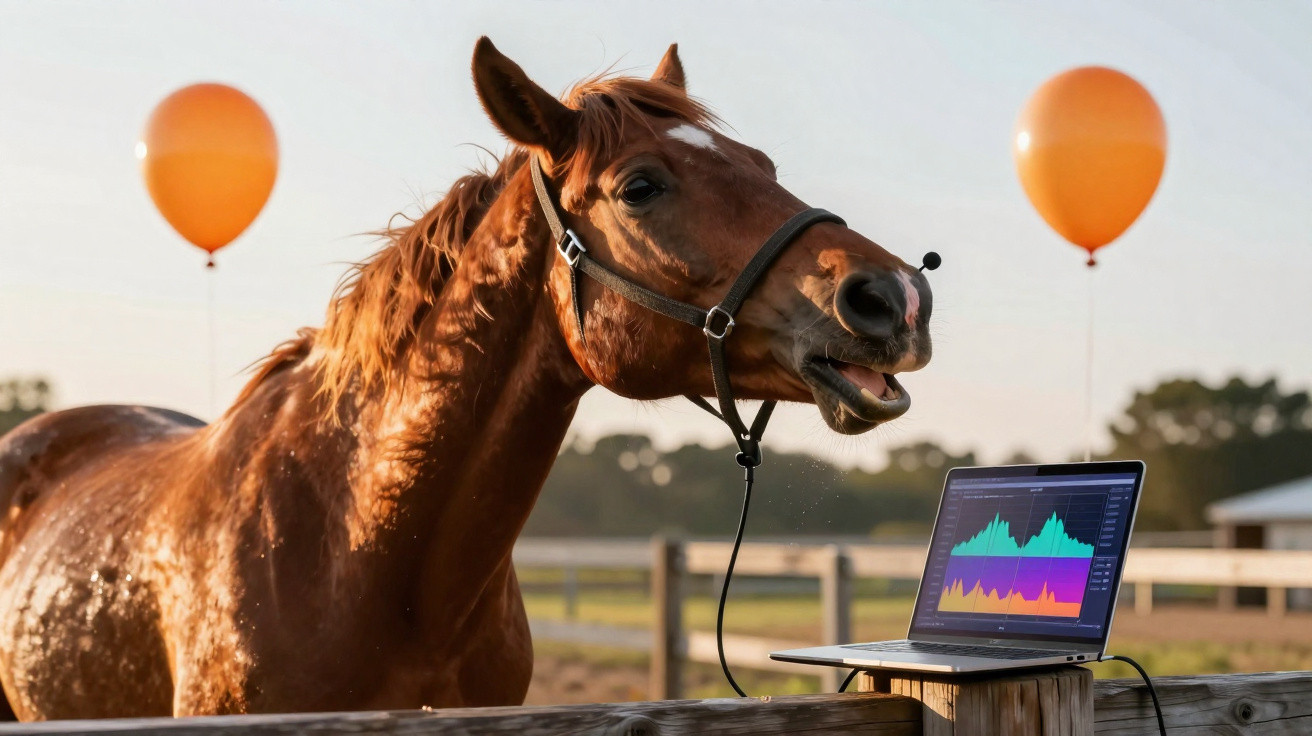
For years, scientists have recognised that a horse’s whinny contains two separate tones simultaneously: a low, rumbling sound with a crisper, high-pitched tone over it.
That is unusual in itself. Bigger animals generally make lower-pitched sounds, since larger vocal structures vibrate more slowly. On that basis, horses ought not to be capable of producing high notes. Yet they can.
Researchers have now established why. A new study reveals that, when horses whinny, they are not producing a single sound but two distinct tones at once. Each is created by an entirely different physical mechanism.
Horses sing and whistle
Horses generate the low component of a whinny in the conventional manner: their vocal folds vibrate, much as they do when humans sing.
The high component, by contrast, results from a far less common process: a whistle formed inside the larynx. Put simply, horses appear to sing and whistle simultaneously.
“We now finally know how the two fundamental frequencies that make up a whinny are produced by horses,” said study senior author Elodie Briefer of the University of Copenhagen.
“In the past, we found that these two frequencies are important for horses, as they convey different messages about the horses’ own emotions. We now have compelling evidence that they are also produced through distinct mechanisms.”
Why horse whinnies defy the size-and-sound rule
Although horses have shared their lives with humans for over 4,000 years, their vocal communication remains less well understood than might be expected.
Some of that uncertainty stems from a basic principle of biology: large mammals usually produce lower sounds because they have larger larynxes, and larger structures tend to vibrate at slower rates.
Horse whinnies, however, have always been a troublesome exception. They include a high-frequency element that appears to defy the standard relationship between body size and pitch.
The researchers refer to the whinny as an example of “biphonation”: one vocalisation containing two independent frequency components at the same time, one low and one high.
Scientists had already established that the lower component is produced by vocal-fold vibration, as in a cat’s meow or human singing. The source of the high component, however, had remained the major unknown.
Inside the horse’s larynx
To answer that question, the team brought together several lines of evidence: anatomical examinations of horse vocal structures, clinical observations and acoustic analyses of whinnies.
“Solving this biomechanical puzzle required combining approaches from veterinary medicine to acoustic physics,” said lead author Romain Lefèvre of the University of Copenhagen.
Their discovery was striking: the high-frequency component is generated by a laryngeal whistle. The principle resembles human whistling, in which turbulent airflow creates a tone, except that this occurs inside the horse’s larynx.
Small animals, including rats and mice, can make laryngeal whistles, but horses are the first large mammal known to produce them in this way.
More unusually still, horses seem to whistle while their vocal folds are also vibrating, producing the layered sound.
The helium test clinched the answer
The strongest evidence came from the way the team demonstrated that the sound was a whistle. Researchers carried out tests with larynxes taken from deceased horses, blowing air through them to recreate the sounds.
They then changed the airflow from ordinary air to helium, and back again. This is a standard test: as sound moves faster through helium, genuine whistles rise in frequency in helium. Vocal-fold vibration, which is more like “string vibration” than “tube resonance”, should remain effectively unchanged.
That is precisely what the researchers observed. In helium, the high-frequency component rose sharply, whereas the low-frequency component did not shift.
“When we blew helium through the larynges for the first time, the frequency shift was immediately obvious, and we knew we’d solved the mystery,” said co-author William Tecumseh Fitch of the University of Vienna. “We were thrilled!”
In short, the low component comes from vibrating vocal folds, while the high component is a whistle produced by turbulent airflow in the larynx. It is one call created by two distinct “instruments.”
Why horses layer a whinny
The researchers do not believe horses developed this ability merely for display. They suggest that biphonation may enable horses to communicate more than one piece of information at once, effectively layering messages.
Earlier research indicated that the two frequencies are linked to different emotional information. This study now explains the mechanism behind that finding: two signals, created by two separate physical processes, occurring simultaneously.
The researchers also say the trait appears particularly “horse-like.” Przewalski’s horses, close relatives of domestic horses, also produce biphonic whinnies.
More distantly related animals, including donkeys and zebras, seem not to have the high component. This suggests horses evolved a specialised vocal adaptation, giving them a richer call than that of many other mammals.
“Understanding how and why biphonation has evolved is an important step toward elucidating the origins of the amazing vocal diversity of mammalian vocal behavior,” said co-author David Reby of the University of Lyon/Saint-Etienne.
If a whinny has ever seemed to contain two voices, that impression was accurate. In effect, it does.
One component is the deep “voice” produced by vibrating vocal folds. The other is an internal whistle created by airflow in the larynx. Combined, they form the unmistakable sound of a horse: a call that is not only loud or emotional, but mechanically ingenious.

















Comments
No comments yet. Be the first to comment!
Leave a Comment