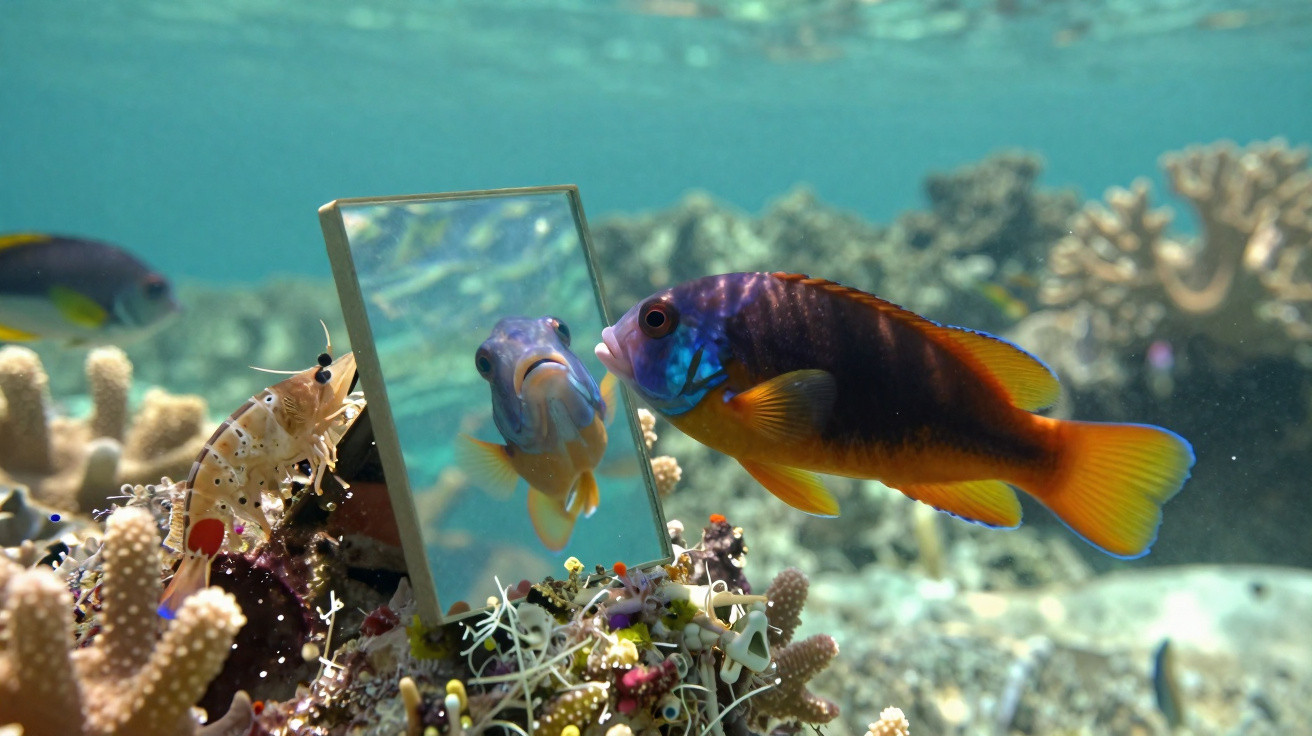
A tiny coral-reef fish has astonished scientists with its cognitive abilities. Researchers have found that the cleaner wrasse can identify itself in a mirror - and, more remarkably, can do so in a very short time.
The research was conducted by Shumpei Sogawa and Professor Masanori Kohda at Osaka Metropolitan University.
Their findings provide significant new insight into the way mirror self-recognition occurs and the point at which it emerges.
What does the mirror test involve?
Scientists rely on the mirror test to investigate self-awareness. It involves placing a small mark on a part of an animal’s body that it cannot view without assistance.
When an animal looks at, or attempts to remove, that mark using a mirror, this indicates that it may understand the reflection represents its own body.
For decades, the test was thought to be passable only by humans and great apes. Dolphins, elephants, magpies and several other animals were later found to demonstrate comparable capacities.
The cleaner wrasse - a small fish that removes parasites from other fish - can now be added to that group.
Cleaner wrasse encounter a mirror
For this study, the researchers adjusted the standard approach. Rather than allowing the fish time to become familiar with a mirror, they first applied a brown mark to each fish’s throat and then introduced the mirror.
The mark resembled a parasite, which cleaner wrasse would ordinarily remove from another fish.
The experiment involved nine cleaner wrasse with no previous experience of mirrors. Most initially responded aggressively when the mirror was introduced.
For a brief period, every fish attacked or rushed towards its reflection as though it were confronting a competitor. This aggressive response then ceased.
The fish then entered a phase known as contingency testing. They performed distinctive movements in front of the mirror, including positioning their bodies and observing the reflection as they swam.
This behaviour indicates that they were assessing whether the reflection matched their actions. The fish only began trying to scrape away the throat mark after completing these stages.
Cleaner wrasse show rapid self-recognition
The speed of this response was the most striking finding. Six of the nine fish attempted to dislodge the mark within two hours of seeing the mirror for the first time.
In certain instances, the scraping behaviour started only around 30 minutes after exposure to the mirror.
Previous research generally allowed several days before examining animals for self-recognition. This study demonstrated that cleaner wrasse need neither days nor weeks.
The fish progressed through distinct phases: aggression first, followed by contingency testing and, lastly, mark removal.
According to the researchers, such speed implies that the fish possessed a sense of self before encountering a mirror. If the outcome were explained by simple learning, recognition at this pace would be improbable.
Behaviour before and after recognition
The researchers also examined behavioural changes once the fish had attempted to remove the mark. Prior to self-recognition, they swam more rapidly, moved their fins more frequently and behaved aggressively.
Following self-recognition, their movements slowed and appeared more at ease. After recognition, the fish gently touched the mirror with their mouths and spent longer close to it.
Rather than continuing to regard the reflection as a rival, the fish seemed to investigate the mirror in a calm manner.
This marked contrast between behaviour before recognition and behaviour after recognition provided strong evidence to the researchers that the fish’s understanding had genuinely changed.
Testing the mirror using shrimp
A particularly intriguing observation was made several days afterwards. On the third and fourth days, three cleaner wrasse collected small shrimp pieces from the bottom of their tanks.
Each fish raised a piece of shrimp before releasing it beside the mirror. As the shrimp descended, the fish closely tracked its reflection across the mirror’s surface.
The team considers this to be contingency testing involving an external object. Rather than observing only their own bodies, the fish tested the way a separate moving object was displayed in the mirror.
Comparable behaviour has been documented in manta rays and dolphins. Such actions point to curiosity about the workings of reflections rather than mere confusion.
Major questions about self-awareness
Scientists have debated two principal theories for decades. One proposes that genuine self-awareness evolved a single time, in great apes. The other argues that self-awareness emerged gradually among species.
The cleaner wrasse presents a challenge to both theories. The research indicates that self-awareness may not require a large brain.
Indeed, the researchers suggest that self-awareness could have evolved as early as the first bony fish, about 450 million years ago.
“These findings in cleaner wrasse suggest that self-awareness may not have evolved only in the limited number of species that passed the mirror test but may be more widely prevalent across a broader range of taxonomic groups, including fish,” said Dr. Sogawa.
“It is highly likely that mirror self-recognition will be observed in many species where mirror tool use has been reported.”
Greater understanding of self-awareness in animals has implications across numerous disciplines. It may reshape thinking on animal welfare, neuroscience, psychology and even artificial intelligence.
The cleaner wrasse is small, yet it poses an enormous question: how many other animals already recognise themselves?

















Comments
No comments yet. Be the first to comment!
Leave a Comment