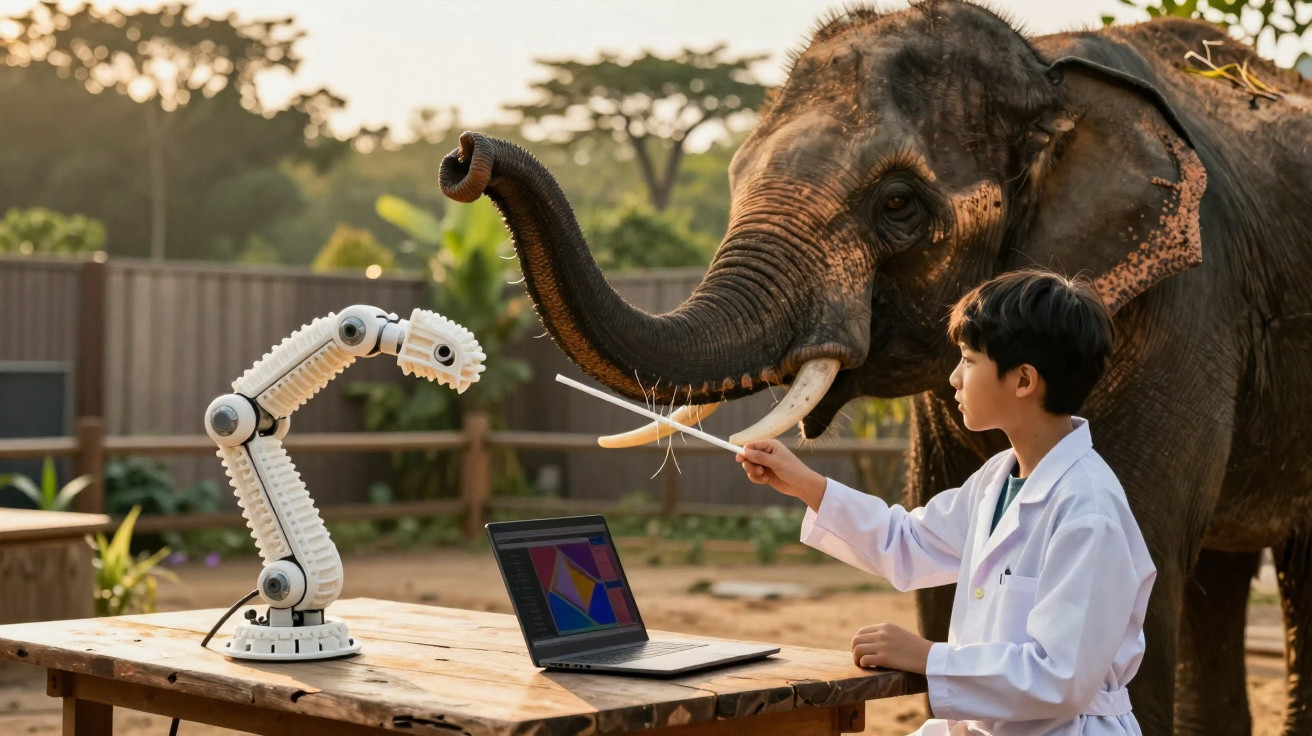
Elephants can hoist a hefty log and then, seconds later, collect something as delicate as a tortilla chip without breaking it.
New research indicates that some of this dexterity stems from an unexpected trait: minute whiskers on the trunk, designed to “tell” the animal precisely where it makes contact, despite its thick skin and relatively poor vision.
The study was conducted by an interdisciplinary German collaboration led by the Haptic Intelligence Department at the Max Planck Institute for Intelligent Systems (MPI-IS).
According to the team, approximately 1,000 whiskers distributed over an elephant’s trunk possess distinctive material characteristics. These properties help register touch along the length of each whisker, giving elephants an exceptionally detailed awareness of contact.
Stiff and soft elephant whiskers
The research centres on a structural characteristic that the scientists term a “functional gradient”. Rather than maintaining identical stiffness from root to tip, elephant whiskers are rigid at their base and gradually become softer towards their ends.
The researchers identified an equivalent gradient in domestic cat whiskers. This contrasts with the whiskers of rats and mice, which are said to have a more consistent stiffness.
This gradual shift from stiff to soft appears to deliver several benefits simultaneously. It enables whiskers to pass over objects more softly, lowers the risk of damage and – most importantly for elephants – seems to offer an inherent means of detecting where contact occurs along a whisker.
With roughly 1,000 whiskers covering the trunk, this may create a rich and precise “touch map” to direct delicate movements.
The researchers believe this helps explain how elephants can accurately pick up small objects such as peanuts or manipulate fragile food without breaking it.
The team also believes the findings could benefit robotics, a field in which engineers continually seek touch sensors that combine sensitivity with durability.
How the project started
Postdoctoral researcher Andrew K. Schulz and Katherine J. Kuchenbecker at MPI-IS led the work, working with neuroscientists at Humboldt University of Berlin and materials scientists at the University of Stuttgart.
The project emerged from a natural meeting point between robotics and biomechanics. Schulz, the study’s lead author, explained how it began.
“I came to Germany as an elephant biomechanics expert who wanted to learn about robotics and sensing,” said Schultz.
“My mentor, Professor Kuchenbecker, is an expert on haptics and tactile robotics, so a natural bridge was for us to work together on touch sensing through the lens of elephant whiskers.”
The researchers subsequently combined biological imaging, materials tests and engineering analysis. They studied elephant and cat whiskers measuring five centimetres in length at remarkably fine resolutions, reaching the nanometre scale.
Elephant whiskers made for durability
Initially, the team expected elephant whiskers to resemble the tapering whiskers of rats and mice: solid, circular in cross-section and broadly uniform in stiffness. Imaging instead exposed a far more intricate structure.
Micro-CT scans allowed the researchers to chart the whiskers’ three-dimensional form, revealing thick, blade-shaped structures with flattened cross-sections.
Their bases are hollow, with lengthy channels inside – attributes more similar to the structures found in sheep horns and horse hooves than in conventional whiskers.
This porous inner structure makes the whiskers lighter and improves their resistance to impacts, an appropriate adaptation for an animal that spends much of the day feeding, pushing and pulling.
Such resilience is important because, as the study points out, trunk whiskers do not regrow. Their structure must therefore withstand continual everyday wear.
The “stiffness gradient” question
To assess material stiffness, the researchers carried out nanoindentation using a minute diamond cube indenter – roughly the size of a single cell – to press into whisker walls at various locations. This was where the “functional gradient” became clear.
Tests at the base and the tip revealed a change from a hard, plastic-like base to a soft, rubber-like tip. The tip was also resilient, meaning it could not be permanently indented in the way that stiffer material can.
They also compared trunk whiskers with elephant body hair, anticipating that the two would behave similarly. Instead, body hair acted as the team had originally expected, remaining stiff throughout.
“The hairs on the head, body, and tail of Asian elephants are stiff from base to tip, which is what we were expecting when we found the surprising stiffness gradient of elephant trunk whiskers,” Schultz said.
This raised an obvious central question: how could varying stiffness along a whisker improve sensing?
A 3D-printed whisker wand
Schulz and his colleagues produced an enlarged prototype: a 3D-printed whisker featuring a stiff, dark base and a soft, transparent tip. The “whisker wand” enabled physical testing of how the gradient might be experienced during contact.
The key insight followed when Kuchenbecker walked through the institute carrying the wand and gently tapped railings and columns.
“I noticed that tapping the railing with different parts of the whisker wand felt distinct – soft and gentle at the tip, and sharp and strong at the base. I didn’t need to look to know where the contact was happening; I could just feel it,” she said.
This straightforward experience pointed to an important principle: differences in stiffness can generate distinctive tactile signatures, in effect indicating where along the “whisker” contact takes place.
Simulations support the principle
To examine the idea more thoroughly, the team built a computational modelling toolkit. They used it to investigate how whisker geometry, porosity and the stiffness gradient influence the way a whisker bends and conveys force when it comes into contact with an object.
The simulations backed their hypothesis. The transition from stiff to soft makes it simpler to identify where contact happens along the whisker, allowing the animal to react suitably and manipulate delicate objects without gripping too hard.
Schulz expressed clear excitement in summarising the finding: “It’s pretty amazing! The stiffness gradient provides a map to allow elephants to detect where contact occurs along each whisker.”
“This property helps them know how close or how far their trunk is from an object…all baked into the geometry, porosity, and stiffness of the whisker. Engineers call this natural phenomenon embodied intelligence.”
Importantly, domestic cats were found to have the same broad stiffness gradient, suggesting that the strategy may serve different purposes across very different animals.
From elephants to robotics
The researchers stress that the results are more than an interesting animal story. They may inform fresh approaches to robotic touch sensing, particularly designs that depend less on intensive computing and more on intelligent physical construction.
The neuroscientists involved also identify promising possibilities. Dr. Lena V. Kaufmann noted how the research links physical form with perception.
“Our findings contribute to our understanding of the tactile perception of these fascinating animals and open up exciting opportunities to further study the relation of whisker material properties and neuronal computation,” she noted.
Reflecting on the collaboration, Kuchenbecker highlighted what the team accomplished through interdisciplinary work: “I’m so proud of what we were able to figure out by working together across disciplines.”
“Andrew pulled together an amazing team of engineers, materials scientists, and neuroscientists from five different research groups and led us on an exhilarating three-year-long journey to discover the secrets behind the powerful elephant’s gentle sense of touch.”

















Comments
No comments yet. Be the first to comment!
Leave a Comment