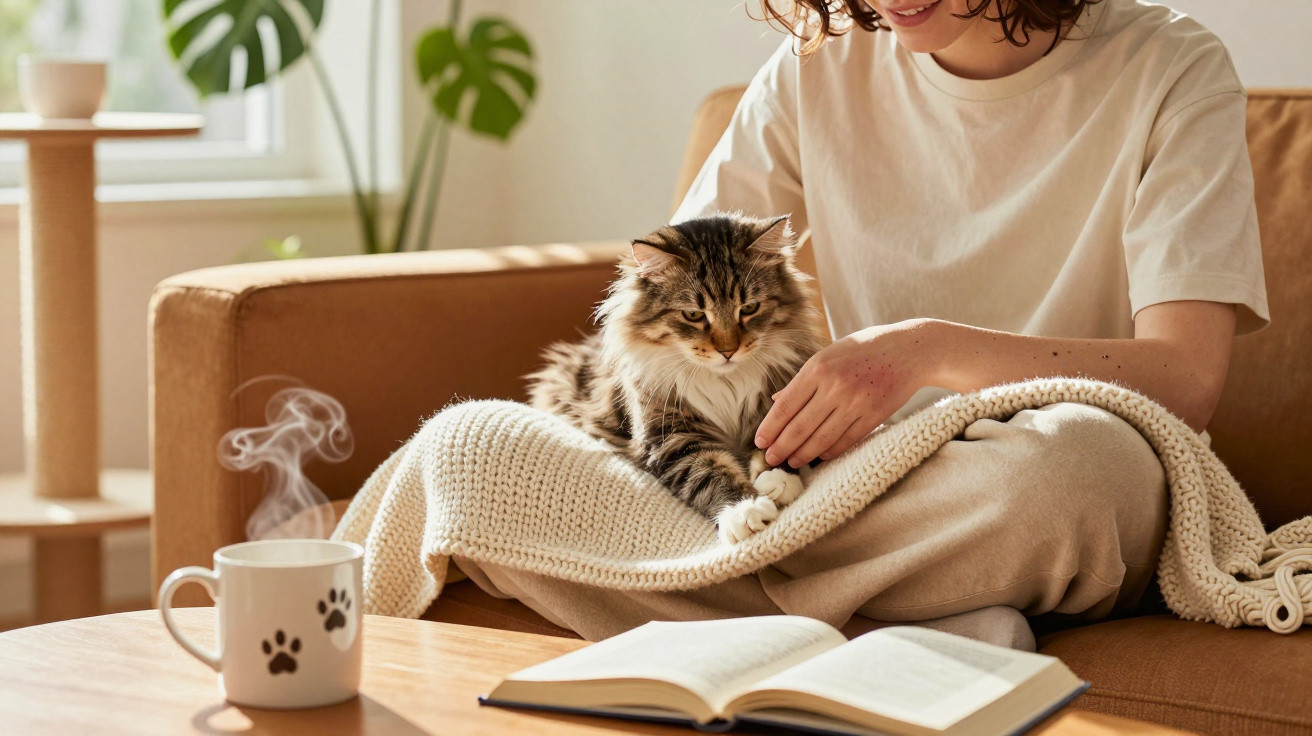
The blanket shifts before the paws come into view. There is one gentle, rhythmic press, then another, as though your cat is kneading dough you cannot see on the bed. The house is still, Netflix murmurs in the background, and this small animal gazes into space while its front legs work and its purr motor vibrates at full volume. You keep your hand perfectly still, unwilling to interrupt the ceremony: partly charmed, partly intrigued. Why that blanket, why now, and why the intensely focused expression beneath all those whiskers?
You might dismiss it as “just a cute cat thing”, alongside 3 a.m. zoomies and a passion for cardboard boxes. Yet science has begun to look beyond the surface of this peculiar feline routine.
What it reveals has more depth than you might expect.
Your cat’s blanket-kneading ritual predates your living room
The next time your cat kneads a blanket, take a closer look. Its actions follow a pattern rather than happening at random: paws push down, toes splay, paws pull back, then the other paw takes over. It is deliberate and almost hypnotic, as if your cat has mentally travelled somewhere beyond the sofa. Its features slacken, eyelids droop and ears settle into a relaxed position.
Some cats dribble, some gently nibble the fabric, and others produce a low, vibrating purr that is felt more clearly than heard. They may appear completely oblivious to your presence. In that moment, the blanket becomes an object loaded with history - a cue, or perhaps a key.
Anyone who has watched a litter of kittens feeding will recognise the striking similarity. Their little paws press against their mother’s abdomen in precisely this way, helping to encourage milk flow. Ethologists describe kneading as a “neotenic behavior”, meaning a juvenile behaviour that never entirely disappears.
So, when an adult cat kneads your favourite throw, it is not simply being odd. It is reaching for one of its earliest associations: warmth, a heartbeat, milk and security. Think of it as a sensory route back to the first days of life.
That is also why cats so often save kneading for people and possessions they trust most.
Feline-behaviour researchers suggest that kneading lies where instinct and emotion meet. It is, in one sense, strongly hardwired: press, release, alternate paws and repeat. At the same time, it seems to occur most often during moments of comfort, attachment or expectation.
Some scientists believe the action lets cats soothe themselves by engaging familiar movement patterns learned as kittens. Others focus on territory: because cats have scent glands in their paws, this light treading may leave a “soft mark” on a cherished place.
Most likely, both explanations play a part. It is an ancient, functional action that today’s indoor cats have transformed into a quiet personal wellbeing ritual.
What your cat is “saying” by kneading your blanket
When your cat jumps onto the bed and begins to knead, try observing the full moment as though it were a slow-paced nature documentary. Look at the spot it selects. Does it circle first, or give the fabric a brief exploratory sniff?
Many cats appear drawn to dense, gently yielding materials, including fleece, woollen throws and old hoodies carrying your scent. They may knead, lie down, and start kneading again a few minutes later, seemingly perfecting a nest that is not visible to us. Try quietly placing a soft blanket beneath their paws to “invite” the ritual, then see how they respond.
There is a practical origin to the habit as well. Wild ancestors of domestic cats would have flattened long grass or leaves to make a pleasant place to rest. You can see an echo of this when a cat kneads a cushion before settling down. The blanket becomes a miniature savannah, while your bed turns into a secure camp for the night.
One reader told me about Noodle, her cat, who kneads only one particular blue blanket. If it is washed, hidden or taken into another room, Noodle finds it and resumes the routine. New throws? No response whatsoever. The old, slightly tatty blue blanket? An immediate paw massage. For this cat, the item has plainly become a personal comfort relic.
Behaviourists stress that the body language accompanying kneading can be highly revealing. Loose whiskers, slow blinks and a relaxed tail suggest your cat is at maximum comfort, almost in a meditative state. A stiff tail, taut ears and shallow breaths, however, can indicate that kneading is providing relief from anxiety rather than expressing uncomplicated happiness.
Some shelter cats knead excessively when they’re overwhelmed, the way some humans bite their nails. Context matters more than the movement by itself. Pay attention to when and where kneading occurs, and it will start to seem less like a random eccentricity and more like a message about your cat’s feelings at that precise time.
How to handle cat kneading without sacrificing your skin
When needle-sharp claws dig into your thigh, your immediate reaction may be to cry out and move the cat away. That is entirely human and completely understandable. For your cat, though, it can feel rather like being pushed away in the middle of a hug.
A kinder approach is to “redirect the paws”. Ease a folded blanket, a sweatshirt or even a small cushion between your lap and those claws. Plenty of cats will immediately transfer their kneading to the new layer while remaining close to you. Your skin stays protected, the ritual carries on and everybody benefits.
Regular claw trimming is another straightforward measure. There is no need to cut them extremely short; simply take the sharpness off the ends. Realistically, hardly anyone manages it every single day. Even so, a gentle trim every couple of weeks can change painful kneading into light pressure that is barely noticeable.
The main error is to punish or shout at a cat while it is kneading. From the cat’s perspective, it is carrying out a deeply natural action during an especially trusting moment. Being told off then can make the relationship feel confusing and may leave your cat less willing to relax on you in future. Calm guidance works better than punishment every time.
You could also create a dedicated “kneading zone” at home: a particular pillow or throw kept in the same place, carrying both your scent and your cat’s. Some cats soon make it their preferred comfort stage.
“Cats don’t knead to annoy us,” explains one feline vet I spoke to. “They knead because their brain tells them: you’re safe now. You can let go. When we respect that, we’re not just avoiding scratches, we’re honoring a very old emotional code.”
- Select one or two soft, thick blankets as the “official” kneading places.
- Put them in places where your cat already enjoys resting, such as a bed corner, sofa arm or favourite chair.
- Rotate them from time to time, while retaining their scent: steer clear of strongly perfumed detergents.
- During peaceful evenings, offer your lap with a folded blanket placed over it.
- If claws are uncomfortable, calmly redirect the paws rather than grabbing abruptly or shouting.
When a cute cat habit reveals something about your bond
Once you understand the history behind it, it becomes difficult to regard kneading as “just” a meme-friendly cat habit. You realise that this small animal is repeating an infant behaviour on your blanket, hoodie or legs. Everyday belongings become part nest, part nursery and part territory.
For some people, that idea feels almost too personal. Others are quietly flattered. Many only give it thought when the pattern changes: perhaps a cat that always kneaded suddenly stops, or a previously calm cat begins kneading through the night after a house move or a breakup within the household.
Science has not yet explained every aspect of the behaviour, but one theme is apparent: kneading emerges at the point where emotion, memory and instinct overlap. That makes it a useful signal for us. It is not a code that must be perfectly deciphered, but a recurring marker within the daily life we share with cats.
The next time your blanket pulses beneath those paws, mild irritation may give way to curiosity. You may shift slightly so your cat has more space. You may silently wonder which ancient memory has stirred in that small, warm body.
And perhaps you will see that this uncomplicated, repetitive act is one of the rare visible links between their world and ours.
| Key point | Detail | Value for the reader |
|---|---|---|
| Ancient kitten reflex | Kneading recreates the action kittens use to stimulate milk flow | Helps you understand the behaviour as emotional rather than “annoying” or meaningless |
| Comfort and territory | Paw scent glands and the repetitive rhythm soothe the cat’s nervous system | Offers clues about when your cat feels secure, stressed or attached |
| Gentle management | Choose soft layers, trim claws and redirect rather than punish | Keeps your skin safe while building trust and everyday connection |

















Comments
No comments yet. Be the first to comment!
Leave a Comment