The first thing you register is the silence. Not a calm, satisfied silence, but the weighty, listless sort that settles over a small flat at 3 p.m.
A large grey tabby lies stretched across the sofa like a furry cushion, only twitching an ear while her owner scrolls on their phone. The blinds are partly drawn. There are no toys on the floor. Her food bowl is full, while the water bowl sits half-neglected in the kitchen.
She yawns, readjusts slightly, and sinks back into the same flattened patch of cushion. This is how most days pass. Nobody rings the vet about “too much lying around”, because for an indoor cat, it simply seems… normal.
But beneath that relaxed posture, something more subtle may already be counting down. Something her owner cannot see.
The quiet habit that’s slowly stealing years from indoor cats
Ask any urban vet what concerns them most about indoor cats, and one phrase comes up repeatedly: hidden lifestyle disease. It is not caused by poor food or one sudden accident, but by a persistent habit that gradually finds its way into almost every home.
That habit? Allowing a cat to spend almost its entire life inactive. Hours spent motionless on the sofa. A few unhurried steps to the food bowl and litter tray. Then a return to that same warm hollow in the blanket.
From the outside, this may appear comfortable and safe. On a medical record, it can look like the beginning of obesity, diabetes, joint problems and strain on the heart.
One vet I spoke to described Milo, a nine-year-old ginger cat who “never went outside and never caused trouble.” His owner proudly called him calm, uncomplicated and low-energy: the ideal flat companion.
Milo arrived for what should have been an ordinary check-up. He weighed more than 16 pounds. His blood tests revealed early indicators of diabetes. His heart sounded under strain, and his joints were painful when the vet carefully flexed them.
No one had taken Milo to the vet for a specific concern because there had never been an alarming symptom. He had simply slept a little longer each year, moved more slowly and played less often. Milo’s owner believed they had provided a completely safe life. The vet had to explain that this “safe” lifestyle had shortened his healthy years.
What makes this pattern especially risky is how ordinary it appears. Indoor cats that sleep for much of the day are not viewed as unwell; they are seen as simply being “cat-like”.
Yet cats are designed to be quiet athletes. Their bodies are made for brief periods of hunting, climbing, stalking and jumping, followed by rest. Without those bursts of activity, muscles lose strength, metabolism slows and fat gradually accumulates around the organs.
That is when slow-developing illnesses begin to build in the background. Arthritis. Kidney strain. Heart disease. A vet can see the warning signs in a record years before an owner notices them in the sitting room.
The difficult reality is that a life with almost no movement can gradually take years from an indoor cat’s lifespan, one drowsy day at a time.
How to turn your “couch potato” cat into a quiet athlete again
The positive news is that you do not need a feline treadmill or an elaborate obstacle course to change the outcome. The most effective approach is usually a series of small, repeatable adjustments that fit naturally into everyday life.
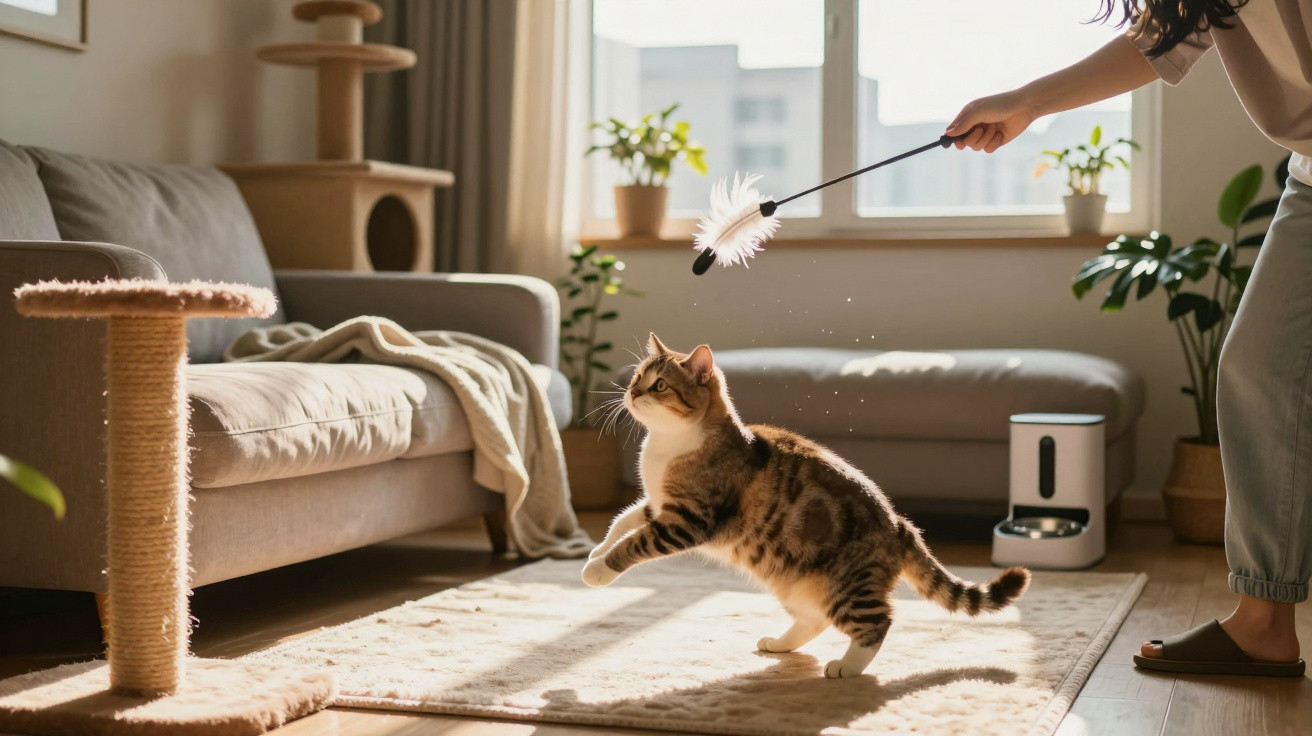
Think in terms of brief hunting sessions rather than exercise sessions. Spend five minutes before breakfast using a feather wand or laser pointer. In the evening, take three minutes to roll a crinkly ball along the hallway.
Add vertical options: a window perch, an inexpensive climbing shelf, or even a solid chair placed near a windowsill. Every jump provides a modest workout for your cat’s heart and joints. Repeated daily, these small activities provide meaningful protection.
Many people feel guilty when a vet raises the subject of inactivity. We imagine the evenings when we return home exhausted, put down our keys and reach for the remote while the cat settles beside us.
The key point is that you do not need to become a full-time entertainer for your cat. What usually helps is connecting one or two small “play anchors” to routines you already follow. As your coffee brews, pull a string toy along the hallway. While waiting for a video advert to end, roll a treat across the floor so your cat can chase it.
In truth, hardly anyone manages this every day. However, doing it consistently a few days each week can still slow weight gain, improve reflexes and clear that dull, bored expression from your cat’s eyes.
“Indoor cats live longer than outdoor cats, but only if their lifestyle is protected as much as their bodies,” says Dr. Laura Mendes, a small-animal veterinarian who’s been tracking feline obesity for more than a decade. “A cat that never moves, never climbs, never plays? That’s not a low-maintenance pet. That’s an early chronic patient in disguise.”
- Create “micro-hunts”
Place 3–5 small pieces of kibble or treats in separate locations: on a chair, behind a table leg or on a windowsill. Allow your cat to sniff them out and investigate. - Rotate toys rather than piling them up
A basket crammed with familiar toys soon becomes invisible. Leave out only two or three, then change them each week so they feel “new” again. - Make use of the environment you already have
A cardboard box with two holes, a paper bag laid on its side or a towel over a chair can each become a small hunting area. - Use puzzle feeding or scatter feeding
Distribute part of the daily food allowance around the room, or use a simple puzzle feeder, so your cat needs to bat, chase and “work” for its food. - Prioritise bursts, not marathons
Two or three 3–5 minute sessions will generally be better for both of you than one long, frustrating attempt to force play.
The habit you change today is a story your future cat can’t tell you
There is a particular kind of heartbreak vets discuss after the clinic doors have closed. It is not the emergency cases or the obvious injuries. It is the quiet regret of seeing another middle-aged indoor cat whose body has aged ten years faster than its owner expected.
We have all had that moment: looking at a cat dozing by the window and thinking, “She’s fine, she’s safe, she hardly needs anything.” The figures around feline obesity and diabetes tell a different story. They suggest that what we call “safe” is often simply “slowly declining, without making a fuss”.
The change begins when you stop interpreting stillness as “contentment” and instead see it as “a body that needs a little invitation.” That invitation could be one feather toy suspended from a doorknob, a fresh perch beside the sunniest window, or a two-minute evening “hunt” along the hallway.
You do not need to become a better owner in principle. You only need to offer your cat a few more opportunities each day to be the animal it was made to be. The years you quietly add may not appear in a striking before-and-after photograph, but they might appear in a future vet record as one simple line: “Healthy senior, active, bright, engaged.”
| Key point | Detail | Value for the reader |
|---|---|---|
| A sedentary indoor life is a hidden risk | Long-term inactivity increases the likelihood of obesity, diabetes, joint disease and heart disease over time | Helps you recognise that “lazy but safe” may actually reduce your cat’s healthy years |
| Short daily play bursts safeguard health | Brief 3–5 minute hunting-style games replicate natural behaviour and support metabolism | Offers realistic, manageable ways to lengthen your cat’s active lifespan without major effort |
| The environment matters as much as toys | Vertical areas, puzzle feeding and straightforward DIY hideaways can turn a flat into a “mini territory” | Demonstrates how to improve your cat’s life using items already available at home |
FAQ:
Question 1 How much daily activity does an indoor cat really need?
Most vets target 20–30 minutes of active play across the day, split into short sessions. Even 10–15 minutes divided into several bursts is much better than virtually none.Question 2 My cat refuses to play. Is that normal or a red flag?
Some cats are naturally more relaxed, but a cat that shows no interest in toys, movement or exploring should be checked by a vet. Pain, dental issues and early illness can all be mistaken for “laziness”.Question 3 Can food puzzles really extend a cat’s life?
They are not magical on their own, but they promote movement, slow eating and help maintain a healthier weight. Over time, reduced pressure on the joints and organs can mean a longer life with better quality.Question 4 Is free-feeding dry food part of the problem?
Continuous access to calorie-dense food combined with little activity is a risky mix. Many vets advise measured meals and, where possible, some wet food to support hydration and fullness.Question 5 What if I live in a tiny studio with no space for cat trees?
You can still provide vertical and play opportunities within the room you have: the back of the sofa, a window ledge, chairs by windows, plus rotating tunnels or cardboard boxes that can be folded away when unused.

















Comments
No comments yet. Be the first to comment!
Leave a Comment