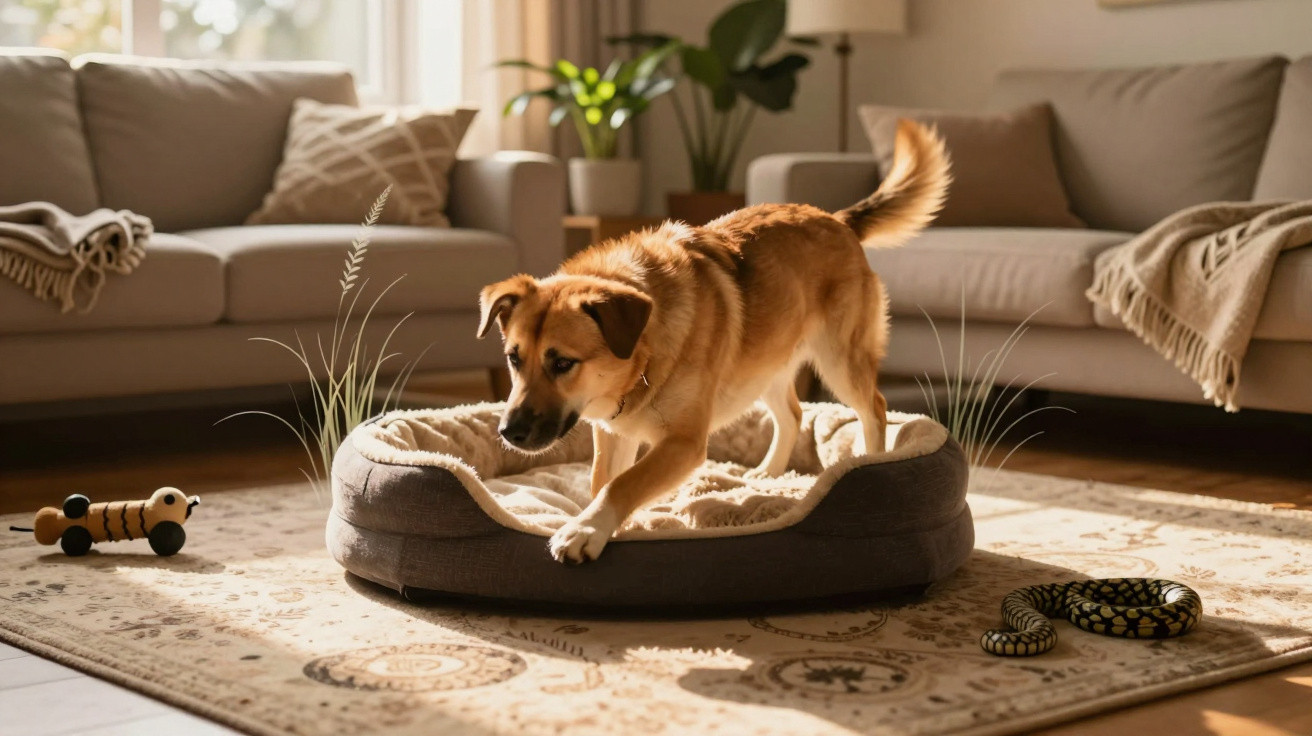
You are watching your dog get ready for sleep when it happens again.
That peculiar, almost ceremonial routine: circle, sniff, shuffle, then circle again. The bed is soft already, the floor is level and the blanket is absolutely fine. Still, your dog rotates like a furry compass searching for north.
You might laugh and perhaps record it for Instagram, yet a small question remains.
Is it merely an endearing oddity, or is a far older instinct taking over? An instinct shaped by tall grass, concealed snakes and humming insects, from a time long before memory.
At last, your dog drops down with a sigh.
You are left watching and wondering what it believes it is doing.
The answer is more untamed than it appears.
Ancient rituals on your living room rug
The next time your dog spins in circles before lying down, take a closer look.
This ordinary behaviour follows a pattern: a faint trace of life in a far more challenging world.
Dogs’ ancestors in the wild did not have orthopaedic memory-foam beds.
They dealt with rough ground, high grass, pointed twigs, lurking insects and, occasionally, a snake resting beneath the plants.
That apparently “silly” turning routine was therefore useful: it pressed down the grass, cleared a resting area and checked the surface before they exposed their bellies.
On your sofa today, the same dance is instinct running on repeat.
Your dog’s brain is still following an ancient survival instruction: circle, inspect, flatten, rest.
Consider a stray dog in a field.
If you watch for long enough, you are likely to spot the same sequence: several unhurried turns, a nose close to the earth, paws pushing vegetation down and a body positioned carefully in relation to the wind.
Researchers who study free-roaming dogs have observed just how deliberate this can be.
Dogs smell for signs of other animals, look for movement and listen for rustling that could indicate a snake, rodent or a cluster of biting insects.
Only after the “stage” seems secure does the dog curl into its recognisable spiral.
This behaviour does not vanish simply because a dog lives on a city balcony or in a compact studio flat.
Its surroundings have changed, but its neurological wiring has not.
That is why your dog may turn on a flat IKEA rug as though it were an uncertain section of savannah.
There is sound reasoning beneath the routine.
For thousands of years, dogs survived by converting possibly dangerous places into short-term safe nests.
Spinning fulfils several ancestral functions at the same time.
Firstly, it levels the surface-whether tall grass, leaves or loose soil-limiting exposure to ticks and insects while making the spot flatter and more comfortable.
Secondly, it can disturb and reveal anything concealed there, such as a spider, scorpion or snake.
Thirdly, circling lets dogs assess an area through their senses.
They rely on smell, subtle shifts in airflow and the sensation of the ground beneath their paw pads.
After that, they can relax enough to lie down, often placing their bodies so they can see or smell anything approaching.
The spinning is not random in the slightest.
It is a small security check that happens to look like a bedtime habit.
How to read your dog’s “circle language” at home
That unusual spinning can offer helpful clues about your dog’s comfort and stress.
Pay attention to the time and place it occurs, rather than simply noticing that it happens.
Does your dog make one or two easy circles before settling, with relaxed shoulders and a contented sigh afterwards?
That is the familiar ancestral routine: a brief safety inspection before sleep.
If the circling becomes forceful, repetitive or nearly frantic, however, it may point to another issue-joint pain, anxiety or difficulty getting comfortable.
One evening, try a straightforward comparison.
Provide two places to rest: a hard floor and a soft pile of slightly uneven blankets.
You will often notice more circling on the uneven option, as though your dog is quite literally “building” its own prehistoric bed.
There are practical ways to make this instinct work in your dog’s favour rather than against it.
Begin with the sleeping surface.
A supportive, non-lumpy bed with a washable cover gives your dog something it can “rearrange” through circling without causing harm.
Also consider temperature and draughts.
A dog that turns endlessly may not only be nesting-it could be trying to face away from cold air or towards a cooler area of flooring.
Allow its repeated choice of location to show you what feels best.
Then monitor any changes over time.
When a normally relaxed circler suddenly begins turning more frequently, whining or repeatedly standing and lying down, it may be a subtle warning of discomfort.
On a comfortable day, the circles should resemble a short, pleased ritual, not a job that never feels complete.
We have all watched a dog make its tenth turn and said, “Just lie down already.”
Yet this is one of the clearest glimpses we get of the way a dog’s ancient mind continues to assess safety.
A few common errors arise here.
Some people tell their dog off for circling, believing it is “neurotic” or disobedient, particularly at night when everyone is tired.
Others repeatedly move the dog’s bed without realising that every new position restarts its entire security assessment.
The opposite mistake is to dismiss obsessive circling as “just what dogs do”.
To speak plainly: when the behaviour suddenly intensifies, your dog may be communicating, in its only available language, that it is in pain.
Be kind to yourself, too.
No one monitors every turn on every night.
Let’s be honest: nobody really does that every day.
“When a dog circles before lying down, it’s not just a habit,” explains one veterinary behaviorist. “It’s a living fossil of behavior, a tiny survival story replaying itself on your living room floor.”
You can maintain a simple mental check without making it another task.
Focus on straightforward signs rather than detailed charts or apps.
- One to three relaxed circles: normal, ancestral nesting.
- Excessive circling with restlessness: possible discomfort or anxiety.
- Whining, licking joints, or struggling to lie down: talk to your vet.
By doing this, you honour the instinct instead of trying to prevent it.
Your dog can retain that connection with its wild history while you quietly notice when nature’s ritual begins to signal a problem.
The wild story hidden under the spin
Once you recognise the ancestral instinct behind the spinning, it is difficult not to see it.
Your dog is not merely “being weird”; it is bringing a fragment of prehistory into your flat.
The turn before sleep links the domestic life of pets to the outdoor existence of their ancestors.
Every circle is a remnant of long-vanished tall grass, unseen snakes and insects that might bite.
The behaviour simply never received the message that the living room is safe.
Perhaps that is part of what makes sharing life with dogs so compelling.
Their bodies and routines retain memories our own lives have lost.
As we fall onto a mattress and scroll through our phones, dogs still carry out a small but earnest safety ritual learned in a world without walls.
The next time your dog turns repeatedly before eventually curling up, you may see it in a new way.
You might notice a wild animal marking out the border of an unseen nest, pressing down tall grass that only instinct can still sense.
Or you may simply feel a sudden affection for this animal that brings its full evolutionary history onto your sofa.
It still checks for snakes in a world filled with vacuum cleaners and television noise.
It is a furry reminder that comfort once had to be spun into place, rather than purchased.
| Key point | Detail | Why it matters for you |
|---|---|---|
| Ancient nesting instinct | Circling presses down “imaginary” tall grass and clears insects or snakes. | It helps you recognise spinning as normal, deeply rooted behaviour rather than a quirk to punish. |
| Body-language signal | Short, relaxed circling differs from anxious, repeated spinning. | It provides an early warning sign of pain, stress or discomfort. |
| Environment still counts | The surface, temperature and location may increase or decrease circling. | It allows you to adjust your dog’s sleeping place for greater comfort and quieter nights. |

















Comments
No comments yet. Be the first to comment!
Leave a Comment