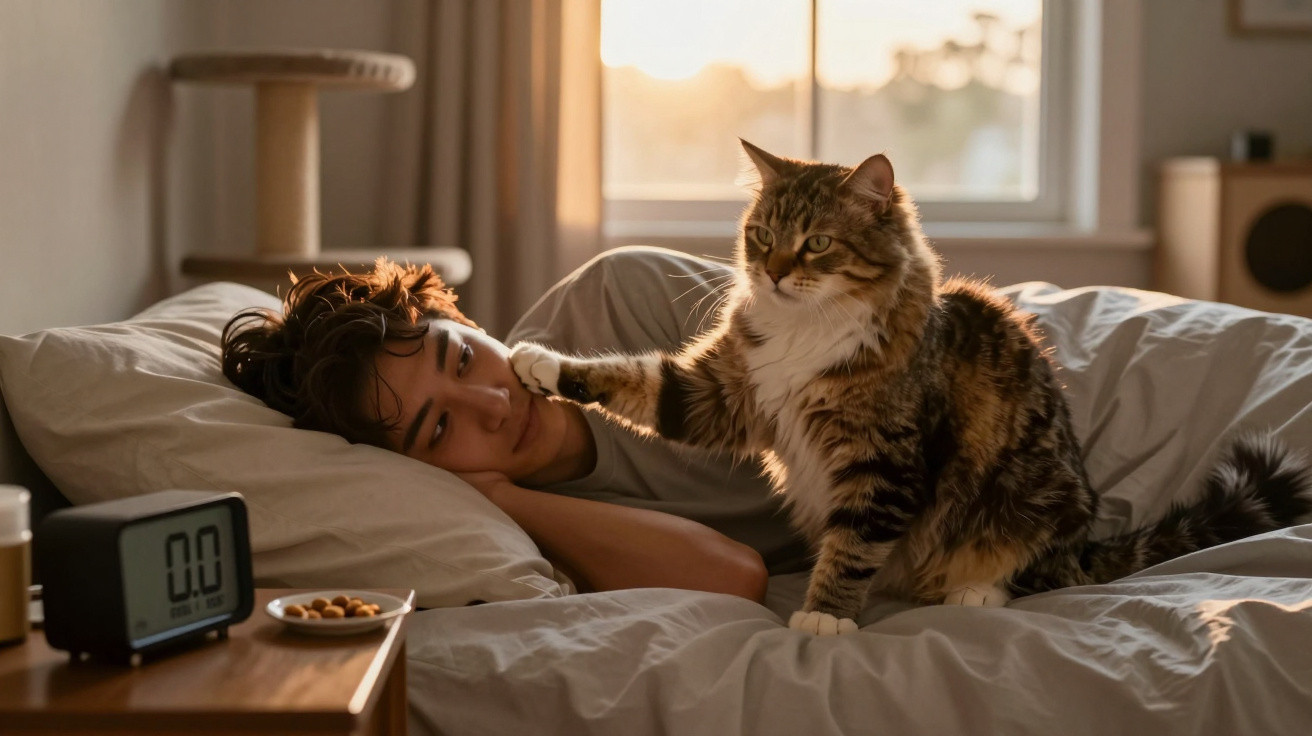
It is the middle of the night, the city is still asleep, but someone in your home has already decided that the day has begun - and will not negotiate.
The same scene plays out in many Brazilian households: exhausted humans, an alarm set for later, and a determined cat pawing at a face, meowing at the door or jumping on to a chest. Anyone looking in from outside may assume it is merely a “pet tantrum”. Yet for many people, it feels different: as though the cat controls the household routine, the arrangement of the furniture and even sleeping hours.
When the sofa, bed and wardrobe become strategic territory
Feline behaviour specialists often point out that nothing a cat does is entirely “by chance”. Where it sleeps, watches, waits or blocks a route follows its own logic, which is very different from our idea of simple comfort.
Cats are territorial animals. In the wild, this means identifying lookout points, escape routes and safe areas. Indoors, that instinct adapts rather than disappears. A section of the sofa back, the top of a bookcase or an armchair arm becomes a kind of control tower.
“The cat turns the home into a tactical map: height for watching, corridors for blocking, doors for negotiating access.”
From above, it can see everything: who comes in, who leaves, who approaches the food bowl or the front door. An elevated position offers two benefits at once: a sense of security and an overview of its “territory”, which includes you.
Lying in the middle of the corridor is not just laziness
When a cat stretches out in the centre of a corridor or takes over a doorway, it is not simply trying to get in the way. It is controlling the flow of movement. You have to step around it, jump over it, go another way or, quite often, stop to stroke it. In every case, the initiative remains with the cat.
By placing itself in these unavoidable passageways, the cat:
- controls who enters and leaves each room;
- marks the area with scent (pheromones, fur and light scratching);
- creates frequent contact points with the humans;
- tests how far its owner will give in or alter their route.
For the animal, this reinforces its feeling of control over the surroundings. For the resident, it can often seem as if the home has been “annexed” bit by bit.
It chooses the time: how a cat resets your body clock
The other aspect of this “silent power” is time. It is not only the physical space that changes, but also your schedule. Anyone living with a cat will recognise its activity periods: plenty of movement in the early morning and late afternoon, with more resting in the middle of the day.
This pattern is linked to the natural behaviour of crepuscular predators. At home, however, the cat swaps prey for dry food - and starts shaping the human routine around that goal.
The “wake me up, get food” effect
It works roughly like this: one morning, you give in. The cat meows at 5 am, climbs on the bed and nudges your face; you get up, slightly annoyed, fill its bowl with dry food and return to sleep. For you, it was a one-off solution. For the cat, it was a rewarded experiment.
“In the cat’s mind, the equation is clear: bother the human early = food arrives faster.”
After this cycle is repeated for a few days, the animal learns that persistence pays off. In psychology, this is called conditioning. The behaviour of waking its owner is reinforced by the immediate reward: the sound of dry food falling into the bowl.
The same process can appear at other times: persistent meowing when it hears the fridge door, scratching at the bedroom door or “attacking” the keyboard while you are working. All of these behaviours test and reinforce how readily your attention can be summoned on demand.
Is it domination or simply a survival strategy?
The word “domination” is tempting, particularly when you wake up exhausted after another night of meowing. From a scientific perspective, though, feline behaviour is closer to an ongoing search for predictability and security.
Cats are creatures of habit. Sudden changes to their routine, feeding times or home layout can cause genuine stress: excessive grooming, constant hiding, urinating outside the litter tray or sudden aggression.
So when a cat insists on fixed times, particular places and rigid routines, it does not mean it has a human-style plan for power. It wants to ensure that nothing goes wrong with what it considers essential: food, water, shelter, access to the litter tray and social interaction in the amount it can tolerate.
“When a cat ‘controls’ times and spaces, it is often only trying to protect its own sense of security.”
How the cat runs its own “government” at home
Three areas frequently feature in what might be called “feline governance”:
| Area of control | How the cat behaves | Impact on the human routine |
|---|---|---|
| Space | Occupies high places, corridors and doorways | Changes how people move around, furniture is repositioned, and space is surrendered on the sofa and bed |
| Resources | Demands food, fresh water, a clean litter tray and access to certain rooms | Strict feeding times, frequent litter-tray checks and doors left ajar |
| Time | Wakes people early, meows at fixed times and makes demands at “strategic” moments | A biological alarm clock set to the cat’s rhythm, with enforced breaks during work or rest |
How to regain some control without harming the cat
Veterinarians and animal behaviourists say that the answer is not to “go head-to-head” with the animal, but to adjust the environment and routine.
Strategies that reduce the feeling of feline dictatorship
- Separate waking time from feeding time: get up, do something else, and only then serve the food. This breaks the direct link between “wake the human = immediate food”.
- Use automatic feeders: this helps to shift attention away from the human as the sole source of food, reducing direct pressure on you.
- Create several elevated resting spots: shelves, cubbies and tall scratching posts distribute the territory more effectively and reduce competition for a single lookout point.
- Provide overnight environmental enrichment: treat-dispensing toys, tunnels and boxes help the cat use up energy before the night.
- Keep a predictable routine: reasonably consistent times for play, food and interaction provide security and reduce relentless demands.
“The more predictable the routine and environment are, the less need the cat has to ‘press your buttons’ to get what it needs.”
When the behaviour goes too far
Not every early-morning intrusion is simply a “tantrum”. In some cases, sudden changes in how a cat wakes its owner or occupies the home may signal pain, illness or intense stress.
Warning signs include:
- meowing that is much louder or more frequent than usual;
- sudden aggression when touched;
- prolonged isolation, with no interest in interaction or food;
- toileting outside the litter tray without any apparent environmental change.
In these situations, a veterinary appointment is recommended before interpreting the behaviour as merely an attempt to control the home.
Terms and situations that explain feline “politics”
Two concepts clearly explain the power dynamic between cats and humans in the home: conditioning and environmental enrichment.
Conditioning is the process through which a cat learns that particular actions lead to predictable outcomes. If meowing during the night always brings food, the behaviour is likely to be repeated. If jumping on to your lap while you work always results in affection, the pattern becomes established.
Environmental enrichment is the set of stimuli - toys, scratching posts, hiding places and elevated routes - that help the animal express natural behaviours such as hunting, climbing and exploring. The better designed this environment is, the less the cat needs to use its owner as a “tool” to meet those needs.
Imagine two situations. In the first, the cat lives in a flat with almost no stimulation: a sofa, bed, food bowl and litter tray. Its attempts to wake the owner and control spaces become its main mental “work”. In the second, the home has toys placed around it, high spots, evening play sessions and meals divided into fixed feeding times. The urge to “dominate” the human routine tends to weaken, because many of its needs are already being met without direct conflict.
In homes with more than one cat, the dynamic becomes even more complex. Competition for windows, shelves and even the owner’s lap can create alliances, rivalries and turns in “power”. Providing alternative routes, multiple litter trays and separate food bowls reduces tensions and prevents a single individual from concentrating all control over the environment, lessening the impression that you live under one sole “feline ruler”.

















Comments
No comments yet. Be the first to comment!
Leave a Comment