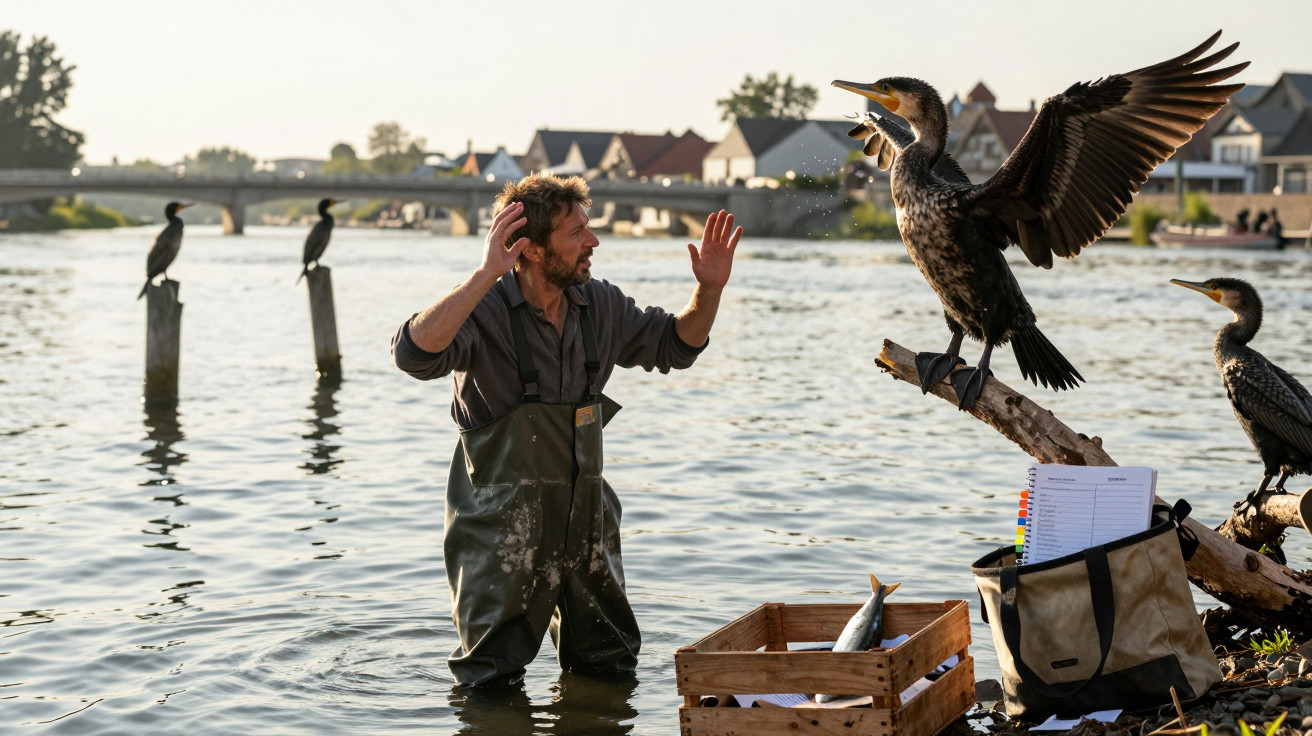
In the icy valleys of eastern France, a sleek black bird has emerged as an unexpected enemy of the winter fishing season.
Across the Jura’s rivers and lakes, anglers claim that waters they have painstakingly restored are being depleted not by poaching or pollution, but by a growing population of great cormorants - protected birds at the heart of an increasingly bitter local dispute.
A protected bird and anger on the river
The great cormorant is a common presence on Europe’s coastlines and inland waterways, recognised by its dark feathers, hooked bill and habit of holding out its wings to dry after diving for fish. In the Jura, however, it has become an emblem of mounting frustration.
The species has legal protection in France. Nevertheless, a prefectural order issued in November 2025 has permitted restricted shooting in enclosed waters, including fish farms and contained ponds. As many as 300 cormorants may be killed in these locations before 28 February, with the measure justified as a way to prevent serious harm to aquaculture.
Anglers say this arrangement overlooks what they regard as the real emergency: open rivers and natural lakes, where wild trout and grayling are meant to receive strict protection. In their view, wintering cormorants now treat these fish stocks as an unrestricted food source.
For fishing groups, public money spent restoring rivers is being swallowed up, quite literally, by a bird that enjoys stronger legal protection than many of the fish it eats.
Fifty tonnes of fish consumed?
Fishing federations in the Jura have sought to put a figure on what they observe in local waters. Their method is straightforward and intentionally stark.
They begin with an estimate from the French League for the Protection of Birds: a little more than 600 great cormorants overwinter in the Jura between October and April. Angling organisations accept this figure.
They then calculate the average daily quantity of fish required by each cormorant. Studies put this at between 400 and 600 grams, depending on the bird’s size and the conditions. Applying that consumption to several hundred birds over around seven months of wintering produces a total which anglers say is more than 50 tonnes of fish eaten in one season.
For Roland Brunet, president of the Jura departmental anglers’ federation, the figure captures the source of the anger. He questions the value of costly river-restoration schemes if, as he sees it, their main result is to feed protected predators.
“We spend thousands on habitat work and restocking,” complain local anglers, “and then watch cormorants clean out the runs where trout have just started to return.”
Enclosed waters and open rivers: a legal dividing line
A narrow but decisive legal distinction sits at the centre of the dispute: enclosed waters versus open waters.
- Enclosed waters: ponds and fish farms without a natural outlet, frequently under private management.
- Open waters: rivers, streams and connected lakes that belong to natural catchment systems.
Under current French legislation, exemptions that permit the shooting of protected species such as the cormorant are much easier to secure for enclosed waters, where economic damage to fish-farming operations can be demonstrated.
For open waters, public authorities require more compelling evidence that a protected bird population is endangering the conservation status of other protected species. Environmental organisations maintain that the available evidence is still limited or inconsistent.
Unequal protection for birds and fish
This imbalance in the law is adding to the resentment. The fish at the centre of the argument - brown trout, northern pike and grayling - are themselves protected along many sections of Jura rivers, through strict quotas or closed fishing periods.
Anglers point to what they consider an inconsistency: they face close regulation, catch-and-release requirements and increasing membership costs, while a bird protected under European and French law may consume the same fish without restriction.
| Species | Status in Jura rivers | Pressure mentioned by anglers |
|---|---|---|
| Brown trout | Protected, strict size and bag limits | Predation by cormorants on juveniles and adults |
| Grayling | Locally fragile populations, regulated fishing | Concentrated attacks on overwintering shoals |
| Northern pike | Closed seasons and minimum size | Consumption of small pike in shallow areas |
Ecologists caution against a one-sided argument
Conservation organisations challenge the anglers’ account. They see cormorants as one element of a wider ecological situation rather than an isolated cause of the problem.
They emphasise that numerous fish populations across Europe were declining well before cormorant numbers recovered. Pollution, channelled rivers, dams, agricultural run-off and increasing water temperatures all played a role. Seen this way, focusing on cormorants may be an easy diversion from more costly structural reforms.
Bird-protection groups also argue that cormorant populations in Europe are no longer expanding as rapidly as they did towards the end of the 20th century. In several areas, numbers have levelled off or even fallen where culling has been heavy or food has become less available.
Environmental NGOs argue that if rivers were healthier and more structurally diverse, fish would have more hiding places from predators, making conflict with cormorants less acute.
Science between politics and emotion
The local dispute is underpinned by a continuing scientific argument. Establishing the precise effect of cormorant predation on fish stocks in rivers, rather than fish farms, is difficult.
Researchers require long-term fish-population monitoring, detailed examination of stomach contents and a careful separation of natural variation from changes caused by predators. Such research is expensive and takes time, while lobbying pressure from both camps is immediate and vocal.
Authorities consequently often rely on “adaptive management” - limited local culls combined with monitoring - in an effort to reconcile legal duties, ecological evidence and public pressure.
What cormorant shooting actually changes
Even in places where culls are allowed, their real-world effect remains contested. Killing 300 cormorants in enclosed waters could ease pressure on particular fish farms in the short term. However, birds from nearby colonies may simply replace them, particularly where food remains plentiful.
In open rivers, selective shooting near vulnerable spawning grounds could theoretically protect key fish during critical periods. Yet this approach may drive birds to adjacent river sections, moving the issue rather than solving it.
Some fisheries scientists instead support a combination of measures:
- Creating deeper pools and woody refuges for fish.
- Restoring riverside vegetation to interrupt broad open-water surfaces.
- Altering fishing pressure so the same fish populations do not face two sources of stress.
- Deploying non-lethal deterrents around particularly vulnerable areas.
How Jura’s cormorant conflict extends across Europe
The dispute in the Jura mirrors similar arguments in the UK, Germany, the Netherlands and Scandinavia. Wherever rivers have been improved and fish populations start recovering, cormorants generally follow.
Angling communities often believe they are funding habitat reconstruction only for predators to benefit first. Bird advocates reply that this is precisely how healthy ecosystems operate: predators follow prey, and both respond to changing conditions.
On some British rivers, for example, local agreements now establish annual limits for cormorant shooting alongside strict reporting requirements and habitat restoration. These arrangements do not eliminate the disagreement, but they provide a structure in which both sides accept at least some responsibility.
Key terms behind the headlines
Two legal concepts recur in debates of this kind:
- “Protected species”: a classification in EU and national law under which a species cannot normally be killed, disturbed or have its nests harmed.
- “Derogation”: an official exception to that protection, supported by grounds such as public safety, economic harm or biodiversity conservation.
In the Jura, anglers want the derogation available for enclosed waters to cover free-flowing rivers as well. They argue that cormorants now threaten the conservation of other protected species - the fish they seek with rod and line. Bird defenders counter that such a change would make lethal control routine without demonstrating that ecosystems would genuinely benefit.
As winter returns each year, those legal concepts become practical decisions: which river stretches should take priority, which species should be favoured, and who has the authority to decide when one protected animal may be killed to save another.

















Comments
No comments yet. Be the first to comment!
Leave a Comment