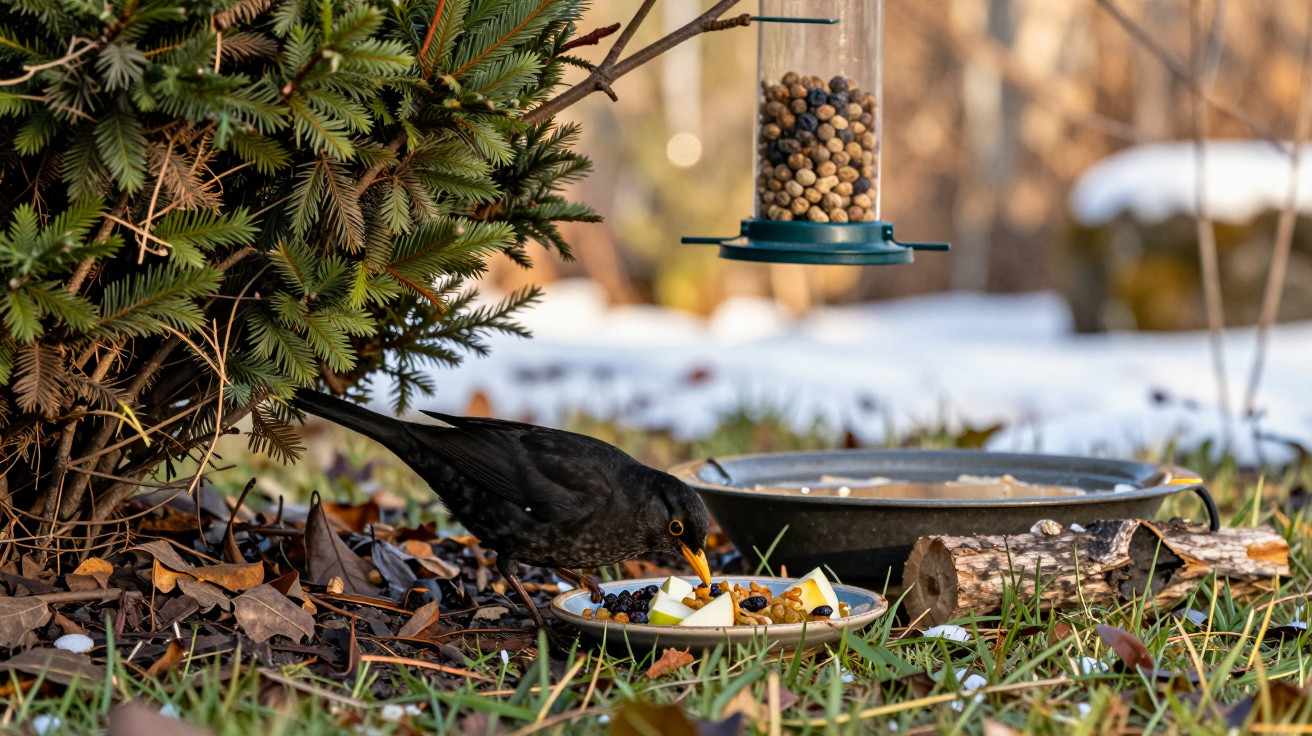
The lawn is white with frost, the thermometer is stuck close to zero, and the feeders are full… yet the blackbird is absent from the feast.
While tits and sparrows frantically compete for seeds in hanging feeders, the common blackbird stays on the ground, turning over frozen leaves. This often puzzles urban gardeners: with so much easy food within reach, why does this yellow-billed bird seem to overlook their offerings? The explanation lies in evolution, anatomy and a finely tuned survival strategy for winter.
The full-feeder paradox: why the blackbird appears to ignore your help
When the garden is alive overhead but the blackbird remains on the ground
During the coldest months, feeders are often crowded with nimble small birds, including familiar European tits, which can hang upside down with ease. The blackbird, however, remains intent on the ground even in sub-zero temperatures, when keeping warm demands considerable energy.
This is neither a sign that it is not hungry nor mere fussiness. Instead, it reflects the bird’s choice of the habitat where it has the advantage: the ground. Beneath leaves, roots and decaying vegetation lies exactly the food that its body is best adapted to use.
“The blackbird avoids aerial feeders not out of stubbornness, but because it is adapted to search for food at ground level.”
A specialist at rummaging: the digging instinct takes over
The blackbird is a ground-feeding bird. Its sturdy legs are built for walking and scratching at the earth, while its more horizontal posture is ideal for searching the ground. Its eyesight is adapted to spot the slightest movement among leaves and twigs.
Where other species balance on narrow perches, the blackbird would rather hop across the lawn, lift dry leaves with its bill and pull out hidden invertebrates. This behavioural pattern is so deeply ingrained that it persists even in lean periods, when berries on shrubs have frozen and many insects appear to have vanished.
The microclimate advantage: what happens beneath the leaf cover
Fallen leaves: garden mess or natural insulation?
Layers of leaves gathered beneath hedges, trees and flowerbeds are not simply “green waste”. They work as natural insulation, retaining some moisture, reducing direct exposure to wind and preventing the soil from freezing deeply.
While the lawn surface becomes hard as stone, the organic layer just below it still contains moisture, microbial life and small pockets of slightly higher temperatures. This is where the blackbird focuses its search.
“A layer of leaves in the garden creates a microclimate where insects, larvae and earthworms remain available, even when frost covers almost all the rest of the ground.”
Earthworms, insects and other treasures beneath the vegetation
Animal protein is essential for blackbirds in winter. Earthworms, larvae and insects concealed in humus provide energy, water and nutrients in a far better balance than many hard seed mixes placed in feeders.
When shrub berries freeze and lose nutritional quality, the soil becomes a refuge. Over generations, the bird has learned that foraging beneath dry leaves is more rewarding than competing for grains with species whose bills and abilities are much better suited to that food.
A soft bill and specialist diet: why seeds and fat balls are unsuitable
The physical issue: a delicate bill versus tough husks
European ornithologists often describe the blackbird as a “soft-billed” bird. This means its bill is less robust than that of seed-eating species such as sparrows or grosbeaks. It evolved to probe damp soil, pick up insects and peck at soft fruit, rather than crack open husks.
Faced with whole sunflower seeds in their hard shells, the blackbird simply lacks the right tool to reach the contents. It may swallow some smaller seeds, but only with effort, wasted time and little energy gained. On freezing days, that loss of energy can be costly.
Frozen berries, declining food value and a race against time
In autumn, blackbirds feed heavily on berries from ivy, elder, cotoneaster and other ornamental shrubs. As winter takes hold, many of these fruits shrivel, freeze and harden. Their texture changes, leaving the flesh almost inaccessible to a comparatively weak bill.
As the supply of good fruit declines, the most dependable food remains in the soil - provided that the ground is not completely sealed by frost. This is why small differences in garden management can have such a major effect on the species’ survival in urban areas.
How to create the ideal ground-level restaurant for blackbirds in winter
The right menu: soft, energy-rich food that is easy to peck
Anyone hoping to help blackbirds during cold spells needs to choose food suited to the bird’s bill and digestive system. Very hard fats and whole grains are of limited use.
“The best approach is to combine soft, high-energy foods with ground-level placement that reflects the blackbird’s natural feeding environment.”
- Fresh or overripe fruit: halved slightly spoiled apples and pears, placed with the cut side facing upwards.
- Raisins or dried fruit: soak them in warm water for around an hour so they become hydrated and soft.
- Porridge oats: mix with a small drizzle of vegetable oil, such as rapeseed or sunflower oil, to increase the fat content.
- Food for insect-eating birds: dry mixes containing mealworms or other dehydrated insects, available from garden centres.
Strategic positioning: place food near shelter, not in the open
Putting fruit in the middle of a patio or on an exposed lawn may deter a blackbird. The species prefers a quick escape route. If it feels vulnerable, it will avoid feeding there, however generous the offering may be.
Instead, place food directly on the ground a few centimetres from dense shrubs, hedges or piles of branches. This allows the blackbird to hop into cover within seconds if it spots a cat, crow or any other threat.
| Element | How to adapt it for blackbirds |
|---|---|
| Food type | Prioritise soft fruit, dried insects and husk-free cereals |
| Height | Always at ground level, rather than solely in hanging feeders |
| Setting | Close to shrubs, while retaining 1–2 m of clear visibility around the food |
| Distribution | Spread food into separate portions to reduce fights and direct competition |
Ground-level safety: reducing the risk from cats and other predators
Escape space, visibility and traps to avoid
Food placed on the ground makes blackbirds more vulnerable. Domestic cats, particularly in neighbourhoods with many adjoining gardens, take advantage of such opportunities. A bird distracted by an apple can become an easy target.
To reduce this risk, follow a few straightforward principles:
- Keep a 1–2 metre circle around the food free from tall objects that could conceal crouching cats.
- Ensure there is a nearby shrub or hedge, so the blackbird can reach shelter in only a few hops.
- Do not put food close to walls, steps, large pots or wood piles where a predator could hide.
- Fit bells to the collars of cats that regularly go outdoors.
Water in winter: the overlooked detail that matters
In severe cold, puddles and shallow containers freeze quickly. Without liquid water, a bird must use more energy to metabolise moisture from its food.
A small bowl of lukewarm water, refreshed several times each day, can be as helpful as food. This becomes especially important during prolonged cold snaps, when ice covers everything for several consecutive days.
Practical notes for helping blackbirds in your own garden
A garden that is too tidy can cause problems
Overly neat gardening, with every leaf cleared away, lawns cut to the millimetre and bare beds, may look attractive in photographs but offers little food. Without a layer of leaves, few accessible insects, larvae and earthworms remain during the colder months.
A balanced solution is to deliberately leave some areas wild: strips of leaves beneath shrubs, a corner with stacked branches and small patches of longer grass. These spots become natural winter supermarkets for blackbirds and other unobtrusive species.
Concepts that explain blackbird behaviour
Two scientific terms help explain many of this bird’s movements during cold weather:
- Microclimate: small changes in temperature and humidity across limited areas, created by leaves, walls, stones or terrain. It is within this more stable microclimate, just above ground level, that the blackbird finds food when the rest of the garden is frozen.
- Foraging strategy: the set of choices a species makes to maximise energy gained while minimising expenditure. For the blackbird, focusing on the ground despite full feeders is part of this logic.
People who understand these dynamics begin to see their garden differently. Rather than simply hanging another feeder in a tree, they start considering how the soil, leaves and layout of the space can help or hinder yellow-billed visitors.

















Comments
No comments yet. Be the first to comment!
Leave a Comment