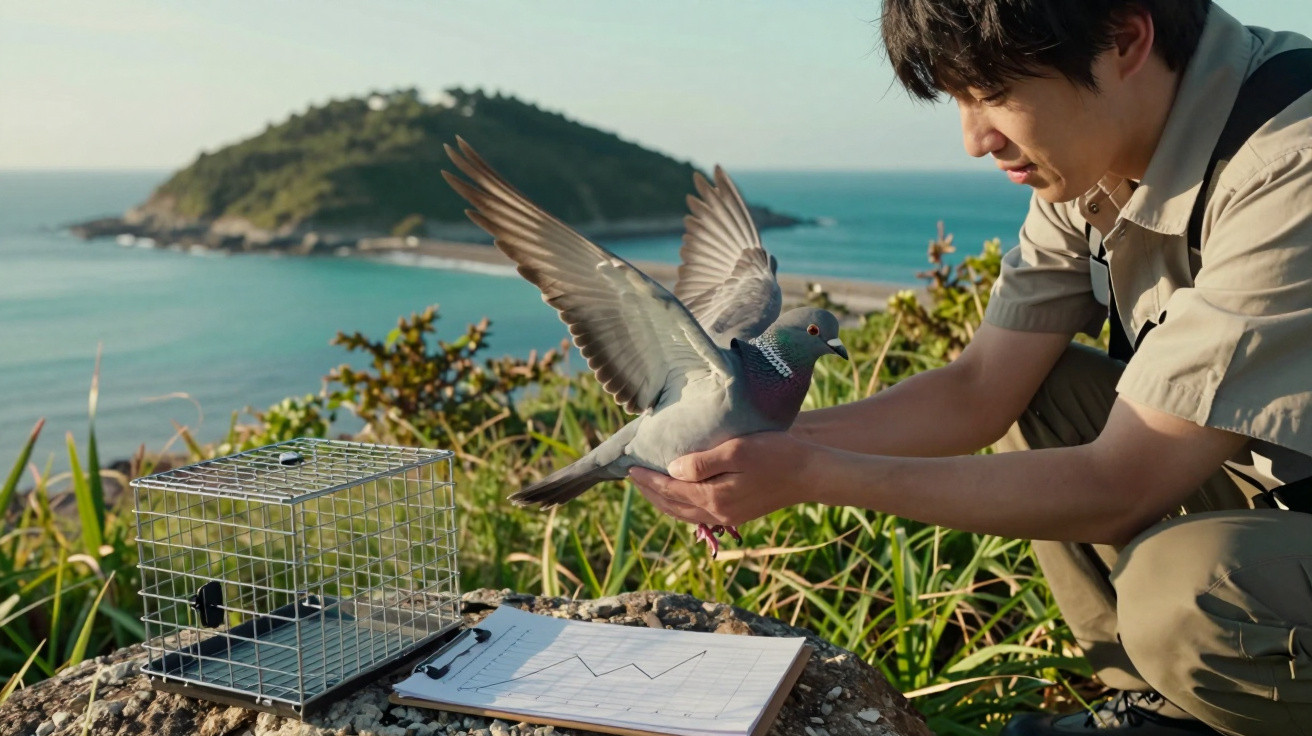
Far from Japan’s major cities, a quiet drama unfolded on the Ogasawara Islands: a pigeon found nowhere else, recognised by its striking red head, was close to disappearing. Only after the authorities took decisive action against feral domestic cats did the situation begin to reverse – and researchers uncovered a genetic puzzle that challenges many traditional conservation textbooks.
Remote islands, a vulnerable paradise
The Ogasawara Islands lie more than 1,000 kilometres south of Tokyo, in the middle of the Pacific. Their isolation has allowed numerous animal and plant species found nowhere else to evolve there. Biologists describe them as the “Galápagos of Japan” – small, fragile, yet exceptionally rich in biodiversity.
The red-headed pigeon, a rare subspecies of the Japanese pigeon, lives in these evergreen forests. For centuries, the bird had everything it needed: dense woodland, few predators and little competition. That balance gradually shifted after settlers arrived in the 19th century.
- Forests were cleared to make way for settlements and farming.
- Domestic animals arrived with people, initially dogs and cats.
- Some of these animals became feral and began hunting native species.
This nearly proved fatal for the red-headed pigeon. Feral cats in particular became lethal hunters. They climb skilfully, stalk without a sound and hunt at night – a challenge that an island bird species with no long history of predators could scarcely overcome.
From 80 birds to an apparent final chance
At the beginning of the 2000s, ornithologists sounded the alarm. On Chichijima, one of the species’ most important refuges, they counted only around 80 red-headed pigeons. For a bird species of this size, that is an exceptionally low total, concentrating many risks: one typhoon, one disease outbreak or a handful of especially successful cats could have caused the population to collapse.
The outlook appeared hopeless. Hundreds of feral cats had already spread across the islands, many well fed by rubbish, small animals and, indeed, birds. Conventional conservation measures, such as nest boxes or supplementary feeding, offered little help when the key breeding areas were controlled by predatory cats.
The turning point came only when the authorities addressed the heart of the problem: the large, skilled predators that the island bird had never encountered.
131 cats trapped – and red-headed pigeon numbers soar
In 2010, the Ogasawara Islands administration and conservation organisations launched a programme that also prompted heated debate in Japan: feral cats were to be trapped and removed from the islands. Within three years, 131 animals had been caught in traps – an enormous number for such small islands.
Importantly, these were not simply ordinary pet cats, but largely feral animals with hardly any contact with people, surviving mainly by hunting. The difference for native bird populations was noticeable – and it emerged more quickly than many specialists had expected.
By the end of 2013, researchers were already reporting remarkable figures: around 966 adult red-headed pigeons and 189 juveniles were counted. A tiny remnant population had become a stable population again in a short period. Among specialists, this recovery is regarded as one of the most striking successes in island-species conservation in recent years.
Why the population recovered so rapidly
Removing cats alone does not fully account for this dramatic increase. Other bird species often recover far more slowly after comparable action. Researchers therefore wanted to establish what made this pigeon so resilient.
Genetic puzzle: high inbreeding, but few harmful mutations
A team from Kyoto University examined the genetic material of wild and captive red-headed pigeons. Expectations were straightforward: such small populations are considered genetically depleted and are often far more vulnerable to disease or deformities.
The data did reveal an extreme characteristic: more than 80 per cent of the genome was homozygous, meaning it was genetically largely “uniform”. This indicates a long period of breeding among close relatives. Under normal circumstances, this would be seen as a major disadvantage.
But this was where the findings became intriguing. Comparison with close relatives showed that the red-headed pigeon carries surprisingly few harmful mutations. Many gene variants that would usually cause problems were simply absent.
Over generations, damaging genetic defects appear to have been gradually “filtered out” – a form of genetic housekeeping through a moderate inbreeding effect.
Specialists refer to this as “genetic purge”: where populations remain small for long periods, more robust genetic combinations are more likely to prevail, while mutations with severe consequences die out. The cost is reduced diversity, but the animals that remain can be remarkably resilient in themselves.
Tests involving captive birds supported this picture. Lifespan showed no clear negative link with the degree of inbreeding. In other words, the pigeons did not suffer from the usual inbreeding problems as severely as has been seen in many other conservation projects.
What this case means for global conservation
For a long time, conservation biology followed a simple rule of thumb: small population = high risk from inbreeding and the loss of genetic diversity. The story of the red-headed pigeon requires researchers to view that equation in a more nuanced way.
These island birds suggest that some species have developed a kind of built-in resilience over their evolutionary history. Species that have survived for millennia in small populations on remote islands can sometimes possess a genetic package that becomes an advantage in times of crisis.
Specific lessons drawn by specialists include:
- Genetic data should be incorporated into conservation programmes early, rather than treated as a late additional project.
- Small populations are not automatically doomed – a species’ history and genetic quality are decisive.
- Targeted action, such as removing particular predators, can have huge effects where a species remains genetically stable.
Other examples show a similar pattern: island species, including certain foxes and songbirds on remote island groups, have managed to persist remarkably well despite very small populations. By contrast, some apparently “healthy” populations struggle with hidden genetic burdens and suddenly decline, even though their numbers initially looked promising.
When animal welfare and species conservation collide
The example of the Ogasawara Islands also touches on an emotional debate: how far can, and should, conservation go when much-loved domestic animals are involved? Many people see cats primarily as family members rather than hunters.
On small islands, two realities collide:
| Perspective | Main focus |
|---|---|
| Cat welfare | The suffering of individual animals, trapping methods and the treatment of captured cats |
| Island bird conservation | Preventing extinction and preserving entire ecosystems |
Many current programmes aim to ease this conflict: cats are not killed indiscriminately, but trapped, neutered, rehomed or taken to the mainland. Such approaches require money, staff and time, but they can build acceptance, particularly where local residents are strongly attached to the animals.
What non-specialists can learn from this case
At first glance, the story of the red-headed pigeon may seem far removed. Yet it demonstrates very clearly how strongly individual behaviour can affect nature – usually without people realising it. Free-roaming pet cats are also a serious factor for songbirds, lizards and small mammals in Europe.
People who keep a cat can take several steps:
- Allow young cats outdoors in a controlled way only after an appropriate settling-in period.
- Restrict outdoor access during the bird breeding season or use a collar with a bell.
- Bring cats indoors earlier in the evening, as many birds are particularly active at dusk.
At the same time, another point is gaining importance: genetic research is no longer a purely academic field. Modern genetic analyses help conservation projects direct scarce resources more effectively – for example, by identifying species able to survive with relatively small but well-managed populations, while others urgently need larger refuge areas and strict protection rules.
The red-headed pigeon of the Ogasawara Islands is a reminder of how narrow the line can be between disappearance and recovery. A few dozen animals more or fewer, a trapping programme introduced at the right moment, an unusual genetic make-up – and a species that had almost been written off is once again flying through the forests of a remote archipelago.

















Comments
No comments yet. Be the first to comment!
Leave a Comment