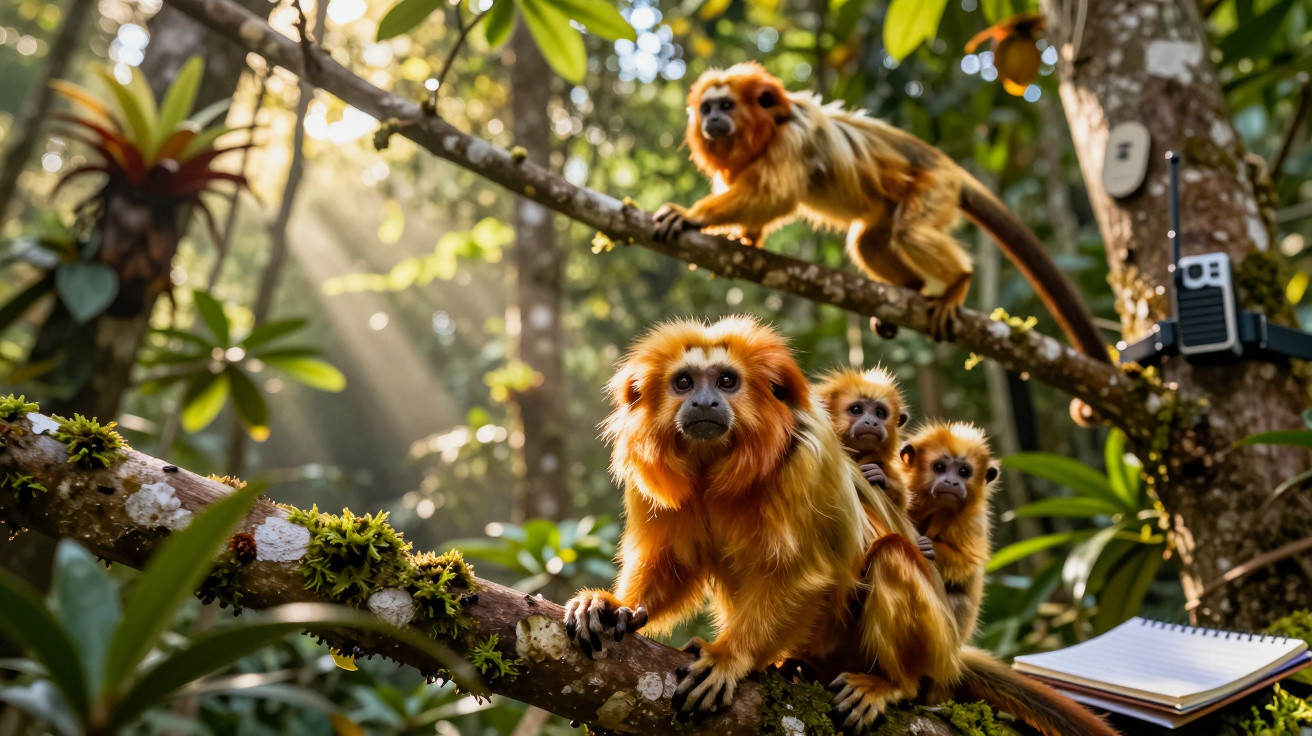
The golden lion tamarin is one of the best-known symbols of Brazil’s Atlantic Forest. Small, agile and covered in vivid orange fur, this primate draws attention not only for its appearance but also for its social behaviour. In the forest, it lives in well-organised family groups, where raising young relies on cooperation among several members.
What makes the golden lion tamarin so special?
The golden lion tamarin is distinguished by its bright coat, which creates a mane-like fringe around its head. This distinctive feature inspired its common name and has made it one of Brazil’s most recognisable animals.
Yet its importance extends far beyond its striking appearance. It is endemic to the Atlantic Forest, meaning it occurs naturally only in this biome, chiefly in forested parts of Rio de Janeiro state.
How does a golden lion tamarin family live?
These primates generally live in small groups consisting of a breeding pair, offspring and young from earlier litters. Living together supports defence, food-finding and the care of newborns.
- Breeding pair: establishes the group and maintains its territory.
- Young offspring: learn routes, food sources and warning signals by watching adults.
- Older siblings: help to carry and protect the babies.
- The group communicates through a range of vocalisations.
- Cooperation lessens the mother’s workload after birth.
What role does each member play in raising young?
Caring for offspring is among the species’ most interesting traits. As twins are commonly born, the mother does not manage every task alone. After the first few weeks, other group members carry the young and return them to their mother for feeding.
- Mother: nurses the young and maintains a direct bond with them.
- Father: usually plays a major part in transporting the babies.
- Siblings: develop parental-care skills by assisting with group duties.
- Adults protect the young from falls and predators.
- Sharing responsibilities improves the litter’s chances of survival.
Why is this primate important to the Atlantic Forest?
The golden lion tamarin feeds on fruit, insects, small animals, nectar and other forest resources. By eating fruit and moving from tree to tree, it helps disperse seeds, supporting the renewal of vegetation.
It also serves as a flagship species. When an area is protected to secure its survival, many other Atlantic Forest plants, birds, amphibians, insects and mammals benefit at the same time.
How did conservation save the species from extinction?
The golden lion tamarin became critically endangered because of Atlantic Forest destruction, the isolation of forest fragments and illegal capture. Breeding programmes, reintroductions, environmental education and the creation of protected areas helped reverse part of this situation.
The species still requires ongoing care because it depends on connected, well-preserved forests. The golden lion tamarin’s story demonstrates that conservation succeeds when science, local communities and habitat protection work together, turning a threatened animal into a symbol of hope for the Atlantic Forest.

















Comments
No comments yet. Be the first to comment!
Leave a Comment