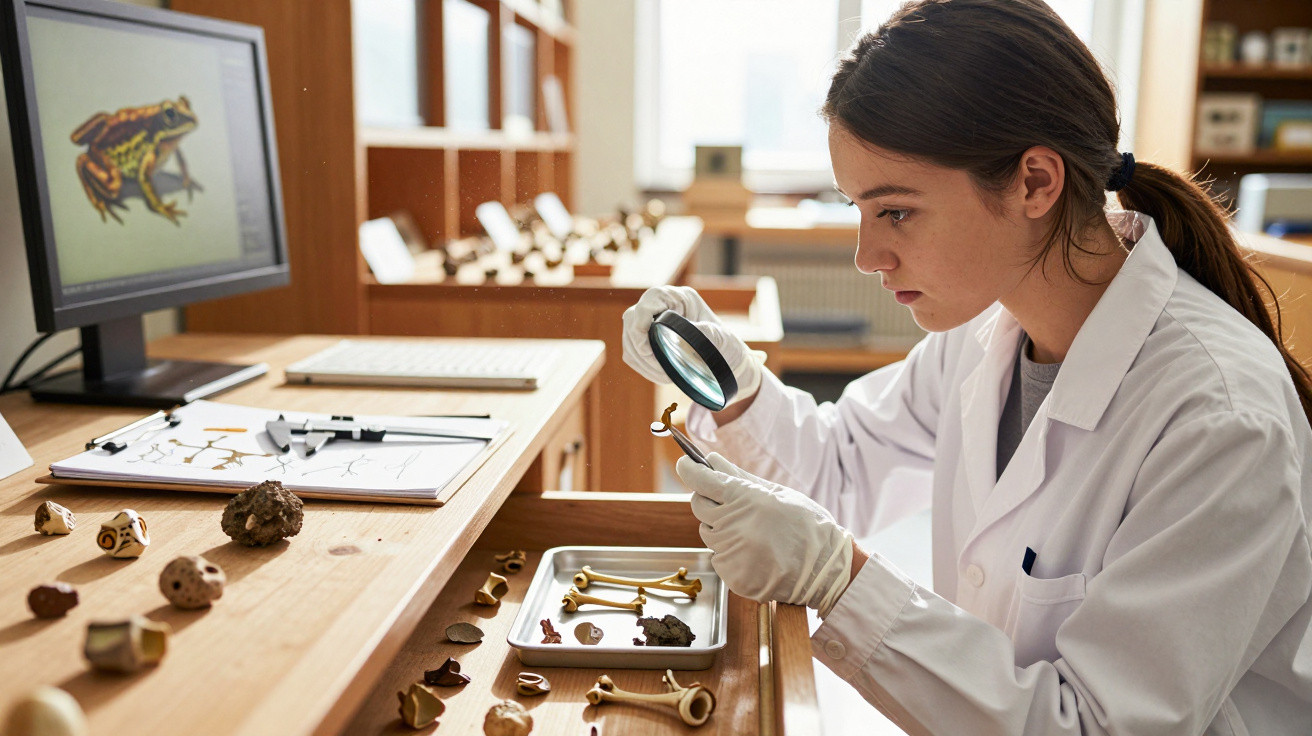
For more than 70 years, tiny bones recovered from the celebrated La Brea Tar Pits sat in a scientific collection, attracting far less attention than mammoths and sabre-toothed cats. When palaeontologist Alberto Cruz decided to reassess them, he made an unexpected find: an unknown Ice Age amphibian species, now named Spea labreae.
How did an unknown species remain hidden for decades?
Cruz was not searching for a new species when he began reviewing amphibians and reptiles held in the La Brea collections. One bone had unusual features, and he initially thought the differences might have resulted from disease or an injury suffered by the animal rather than indicating an unknown species.
However, that possibility became less convincing after repeated comparisons with known spadefoot toads. Cruz said he examined numerous specimens before becoming persuaded that he had made a discovery. The study by J. Alberto Cruz and Emily Lindsey was published in 2026 in the Journal of Vertebrate Paleontology and formally described Spea labreae.
What could a single bone reveal about Spea labreae?
The holotype, the reference specimen used to define the species, contains a fragment of the sacro-urostyle, a skeletal area close to the base of the spine. It may seem limited, but particular bone shapes enable detailed comparisons. The researchers also examined further specimens to establish whether the differences appeared consistently.
- The material remained in scientific collections for decades before being recognised as a new species.
- The species was named Spea labreae after the famous La Brea fossil site.
- The research compared the fossils with modern specimens to confirm consistent anatomical differences.
- The discovery is the first extinct amphibian species described from Rancho La Brea fossils.
The find is particularly rare because frog, toad and salamander skeletons are fragile and often do not survive fossilisation. According to the La Brea Tar Pits itself, asphalt deposits provide exceptional conditions for preserving small remains that would usually vanish from the fossil record.
Why is a small toad so important to scientists?
Large mammals may dominate Ice Age reconstructions, but amphibians offer a different kind of evidence. Since they are highly sensitive to temperature, water availability and changes in vegetation, their presence or absence helps palaeontologists explore the environments in which they lived.
Cruz explained that environmental shifts capable of altering vegetation and climate affect these animals directly. As a result, Spea labreae may help reconstruct changes that took place in southern California at the end of the Pleistocene. The study specifically examined how climatic and geographical changes influenced the distribution of these amphibians.
Watch the video shared by the 9NEWS YouTube channel announcing the discovery of the new species.
Did the same collection hold another surprise?
The review also identified fossils from the genus Rhinophrynus, the Mexican burrowing toad, at La Brea. Intriguingly, members of this group do not now live in the Los Angeles area. According to the museum, their present-day populations occur around 2,500 kilometres further south, illustrating how animal distributions have changed.
This geographical difference provides an important clue to environmental transformations after the Ice Age. The scientific paper concludes that climate changes during deglaciation, together with the geography of the south-western United States, probably helped reshape the distribution of these groups over thousands of years.
How many discoveries could still be in museum drawers?
La Brea has been studied for more than a century and contains the largest known collection of late Pleistocene asphalt fossils. Even so, Emily Lindsey, curator and director of excavations at the site's research centre, stressed that new discoveries continue to emerge. In her view, this case clearly demonstrates that much remains to be found.
The story of Spea labreae shows that a palaeontological discovery does not always begin with a new excavation. Sometimes, the next unknown animal is already catalogued inside a museum, waiting for someone to ask the right question. These old collections are worth following, because a small drawer may contain a species lost for thousands of years.

















Comments
No comments yet. Be the first to comment!
Leave a Comment