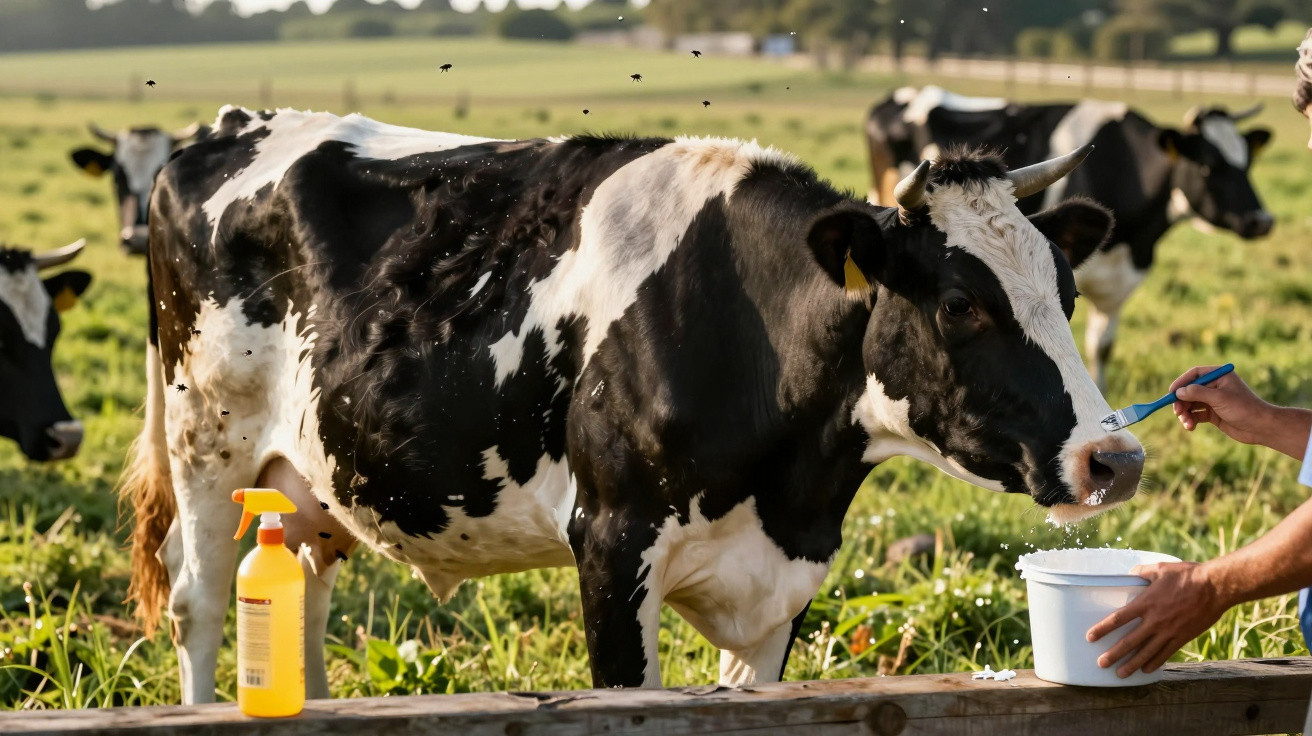
Scientists painted black cows with white stripes resembling those of a zebra and recorded a striking outcome: the animals attracted roughly 50% fewer biting flies than when their coats were entirely black. The trial supported one of the leading explanations for zebra colouring: black-and-white bands make it harder for blood-feeding insects to land on the animal’s body.
What happened when scientists painted the cows?
The study involved six naturally black Japanese Black cows, which were tested under three separate conditions. On certain days, they were given white stripes measuring approximately 4 to 5 centimetres wide. On other days, black stripes were painted onto them to assess whether the smell or physical presence of the paint itself affected the findings. There were also periods when the cows were left unpainted.
Photographs taken during the observation sessions enabled the researchers to count insects resting on the animals’ bodies and legs. On cows with the black-and-white pattern, the number of flies was almost half that seen on both the unpainted animals and those given black stripes only. As the latter two groups produced similar results, the difference could not simply be attributed to the paint used.
Which signs suggested the insects were causing less irritation?
The researchers measured more than the number of flies approaching the cattle. Over 30-minute periods, they also noted the movements cows made in an effort to drive insects away. The behaviours monitored included:
- tossing or shaking the head;
- repeatedly moving the ears;
- stamping the feet on the ground;
- twitching the skin to dislodge insects;
- swishing the tail to deter flies.
The zebra-striped cows made around 39.8 such movements in 30 minutes, compared with 53 among the unpainted animals and 54.4 among those painted with black stripes. This reduction matched the lower number of flies landing on their bodies, suggesting that the bands changed more than the cattle’s appearance: they also reduced some of the discomfort caused by the parasites.
Why do zebra stripes confuse flies?
The precise mechanism is still being studied, but available evidence suggests that the pattern chiefly disrupts the final stages of an insect’s approach. Trials involving zebras and horses have shown that horseflies can get close to both animals, yet find it much harder to slow down and make a controlled landing on striped surfaces.
The contrast between black and white may interfere with visual information the insect uses to judge its speed and distance from a surface. Rather than acting as a chemical repellent, the striped coat therefore appears to create a visual difficulty during landing. Different hypotheses still exist as to exactly how this happens.
Does the experiment help explain why zebras have stripes?
For many years, several theories have been put forward to explain this animal pattern. The bands have been linked to camouflage, recognition between individuals, predator confusion, body-temperature control and protection from parasites. As experimental research has progressed, the explanation involving biting flies has accumulated particularly strong evidence.
- striped surfaces receive fewer horsefly landings;
- horses wearing striped rugs attract fewer landings on the covered area;
- zebras experience fewer successful landings than horses with plain coats;
- painted cows reproduced the effect despite not naturally having stripes;
- visual studies have found little support for the idea that the bands mainly provide camouflage against large predators.
This does not mean that one experiment involving six cows has, by itself, settled a long-running evolutionary debate. Instead, the result adds to earlier work with zebras, horses and artificial models, building a body of evidence that avoiding ectoparasites probably placed important evolutionary pressure on the development of striped patterns.
Could zebra-like stripes help cattle rely less on insecticides?
For livestock farming, the finding is notable because blood-feeding flies cause more than irritation. Heavy infestations make cattle use energy shaking their heads, stamping their feet and swishing their tails, while also disrupting grazing and rest. The authors suggested that zebra-like patterns could be investigated as an additional way of reducing attacks without relying solely on pesticides.
The approach still has practical limitations: painting each animal took about five minutes, and the water-based paint disappeared within a few days, whereas fly seasons can last for months. Even so, temporarily turning black cows into zebra-striped animals cut landings by around 50%, offering an unusual demonstration of how a feature developed in nature could inspire new ways to protect domestic animals from biting insects.

















Comments
No comments yet. Be the first to comment!
Leave a Comment