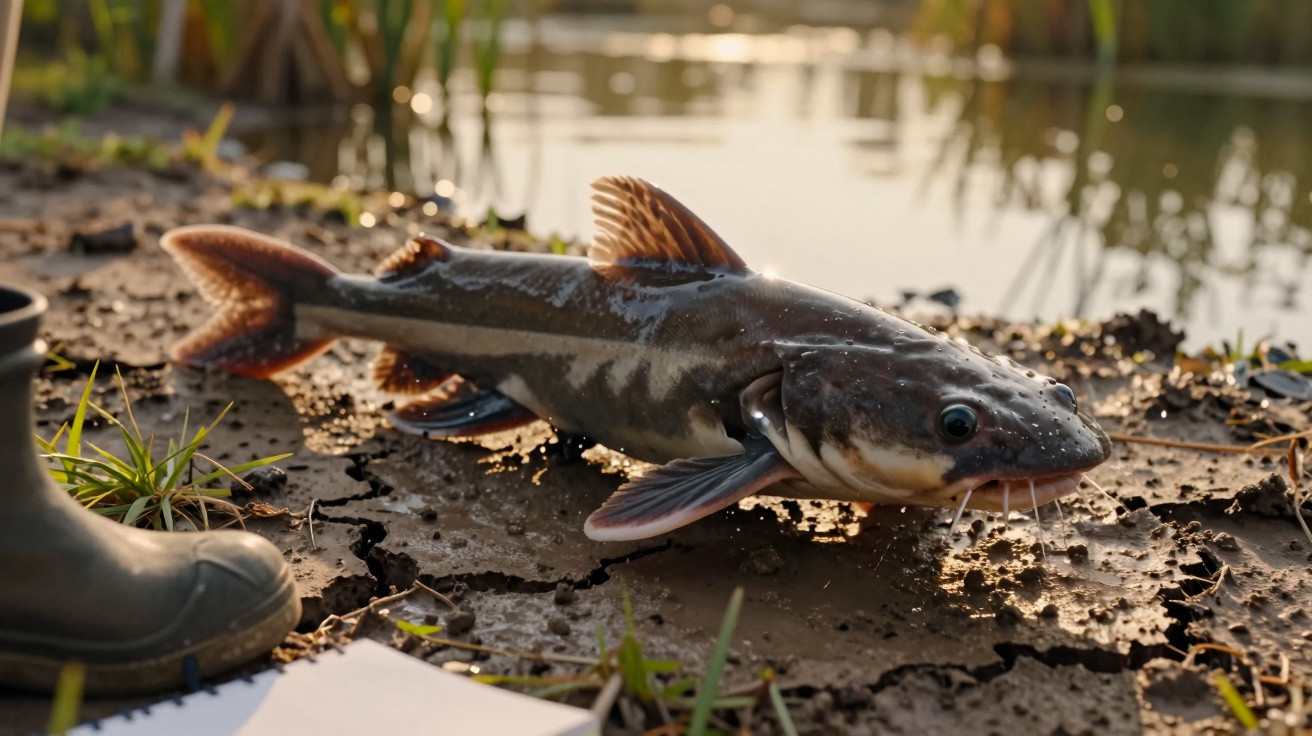
A fish out of water would ordinarily seem to have little chance of survival, yet the walking catfish defies that assumption. Scientifically known as Clarias batrachus, it can breathe air, remain on land for a while and even travel across the ground when it needs to find another aquatic habitat - behaviour that seems unlikely until it is witnessed.
How can a fish breathe outside water?
Its advantage comes from accessory respiratory structures positioned above the gills. These enable the walking catfish to take oxygen directly from the air, which is particularly valuable in ponds, marshes and other habitats with low levels of dissolved oxygen. Research published in the Journal of Experimental Biology demonstrated this respiratory ability as early as 1971.
That does not mean the fish has become a land animal. To stay out of water, it must prevent excessive moisture loss. Air breathing is a short-term solution to challenging conditions, potentially giving it enough time to seek a more suitable place.
Can the walking catfish actually cross land?
Yes. Rather than walking in the way a legged animal would, the walking catfish propels itself with undulating body movements and uses its pectoral fins for support. Together, these actions allow it to move across damp surfaces and negotiate stretches of land between channels, ponds and other bodies of water.
- It breathes air through specialised organs connected with the gills.
- It keeps its body moist with mucus while it is out of water.
- It advances over land by combining undulating movements with its pectoral fins.
- It can leave unsuitable habitats to search for another location with water.
A 2020 study in the Journal of Fish Biology specifically examined the terrestrial movement of Clarias batrachus. Its authors noted that the species is recognised both for air breathing and for moving on land, abilities that help account for its remarkable capacity to explore new environments.
Why does it leave the water voluntarily?
Leaving water may appear dangerous, but staying in it can carry risks too. Temporary pools can dry up, shallow habitats may lose oxygen, and changing water levels can leave a fish stranded. In such circumstances, crossing a patch of land can offer a chance of survival.
The Florida Museum of Natural History notes that the walking catfish can withstand difficult environmental conditions and may leave the water to find a better location, provided it can stay moist. This adaptation also enables the species to occupy areas that would be beyond the reach of many other fish.
Watch the video shared by the YouTube channel MY CLICK SUPPORT showing a walking catfish farm.
How long can it remain out of water?
There is no single period that applies in every situation, as temperature, humidity, the animal’s size and environmental conditions all matter. Specialist sources report that it can spend several hours out of water, as long as it can keep its body sufficiently moist to avoid rapid dehydration.
For that reason, the idea of a fish roaming endlessly over land is exaggerated. Its ability works best as a link between two aquatic environments. The hotter and drier the ground, the greater the challenge for an animal that still relies on moisture to survive.
The walking catfish shows that the boundary between water and land is not absolute
The walking catfish is a striking example of how evolution can produce solutions for unstable habitats. Breathing air and travelling across land have not turned this fish into a terrestrial animal, but they have given it an escape route when remaining in water is no longer the safest option.
The next time you picture a fish as completely helpless out of water, remember this small expert in defying expectations. Learning about adaptations like this changes how we view the limits of animals and shows that, in nature, survival often means being able to reach places where almost no one would expect.

















Comments
No comments yet. Be the first to comment!
Leave a Comment