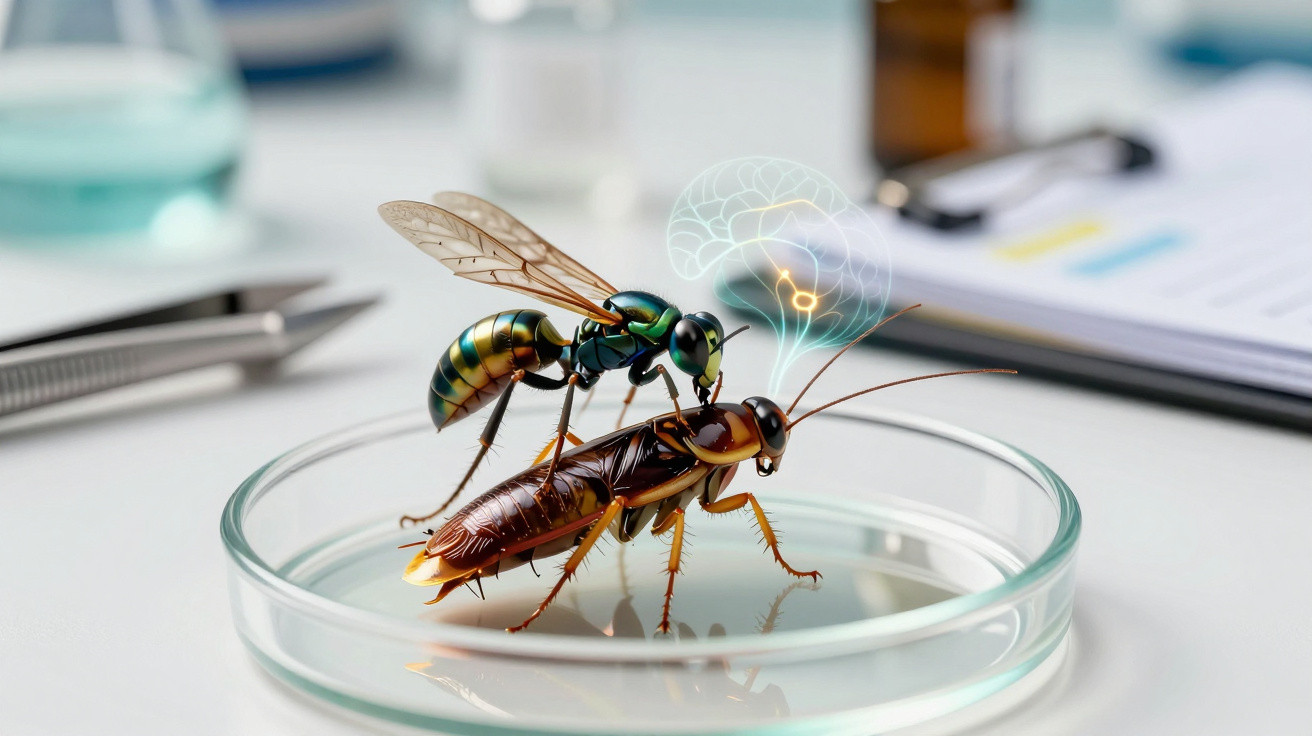
A cockroach that would normally run away can, after several precisely placed stings, simply stop attempting to flee. This is what happens when Ampulex compressa, known as the jewel wasp, attacks: its venom changes the victim’s behaviour, allowing it to be led alive to a shelter where the next generation will develop.
How does the jewel wasp control a cockroach?
The attack unfolds in stages. First, the wasp stings the cockroach in the thorax, causing temporary paralysis in its front legs. It then delivers a far more accurate second sting to the head, targeting nervous-system structures involved in movement control and escape responses.
The outcome is not total paralysis. Studies indicate that the cockroach remains physically able to walk and can even make movements when stimulated, yet its drive to escape drops dramatically. Researchers therefore refer to this condition as hypokinesia: a marked reduction in spontaneous locomotor activity.
Why is it called a “zombie cockroach”?
The nickname arose because the cockroach stays alive and functional but no longer responds to danger as it ordinarily would. After the sting to the head, it may spend a period intensely grooming itself before becoming much more passive, an effect linked to the venom’s action.
- The first sting temporarily impairs control of the front legs.
- The second sting delivers venom directly into neural regions in the head.
- The cockroach can still walk, but shows a greatly reduced urge to escape.
- The wasp can then lead its victim to the location selected for reproduction.
This is not, then, mind control in the literal sense found in fictional stories. Instead, the wasp alters neural circuits associated with locomotion and the motivation to flee. Recent research identifies the central complex in the cockroach’s brain as one of the main targets of this mechanism.
How is the cockroach led to the shelter?
Once the venom has taken effect, the wasp can take hold of one of the cockroach’s antennae and guide it as it walks. The scene is striking precisely because the victim does not need to be carried: it retains the ability to move, yet follows the wasp without displaying the escape response it would normally show.
On reaching the chosen shelter, the wasp lays an egg on the cockroach and seals the exit. Keeping the victim alive is beneficial because it becomes a supply of fresh food for the larva that will later emerge, a strategy characteristic of the parasitoid relationship developed by this species.
Watch the video shared by the YouTube channel Positivo + showing how the jewel wasp turns its prey into zombies.
What happens when the larva hatches?
After hatching, the larva begins feeding on the cockroach and continues developing by using the host as a nutrient source. Research into the species’ life cycle shows that this relationship provides the young wasp with food through its early stages, before it completes metamorphosis.
This behaviour explains why the sting must be so specific. Killing the cockroach immediately would remove the advantage of preserving fresh food. The venom therefore functions not merely as a weapon to overcome prey, but as part of a highly specialised reproductive strategy.
What does the jewel wasp reveal about how the brain works?
Ampulex compressa has become a research subject because it can modify complex behaviours without removing all of its victim’s capacity for movement. Examining its venom helps scientists explore how different areas and substances in the nervous system contribute to the urge to walk and to escape responses.
The next time the term “zombie cockroach” sounds like mere exaggeration, it is worth remembering that a biological phenomenon exists that is remarkably close to that image. The jewel wasp’s strategy demonstrates how far evolution can go when survival and reproduction depend on precisely manipulating another animal’s behaviour.

















Comments
No comments yet. Be the first to comment!
Leave a Comment