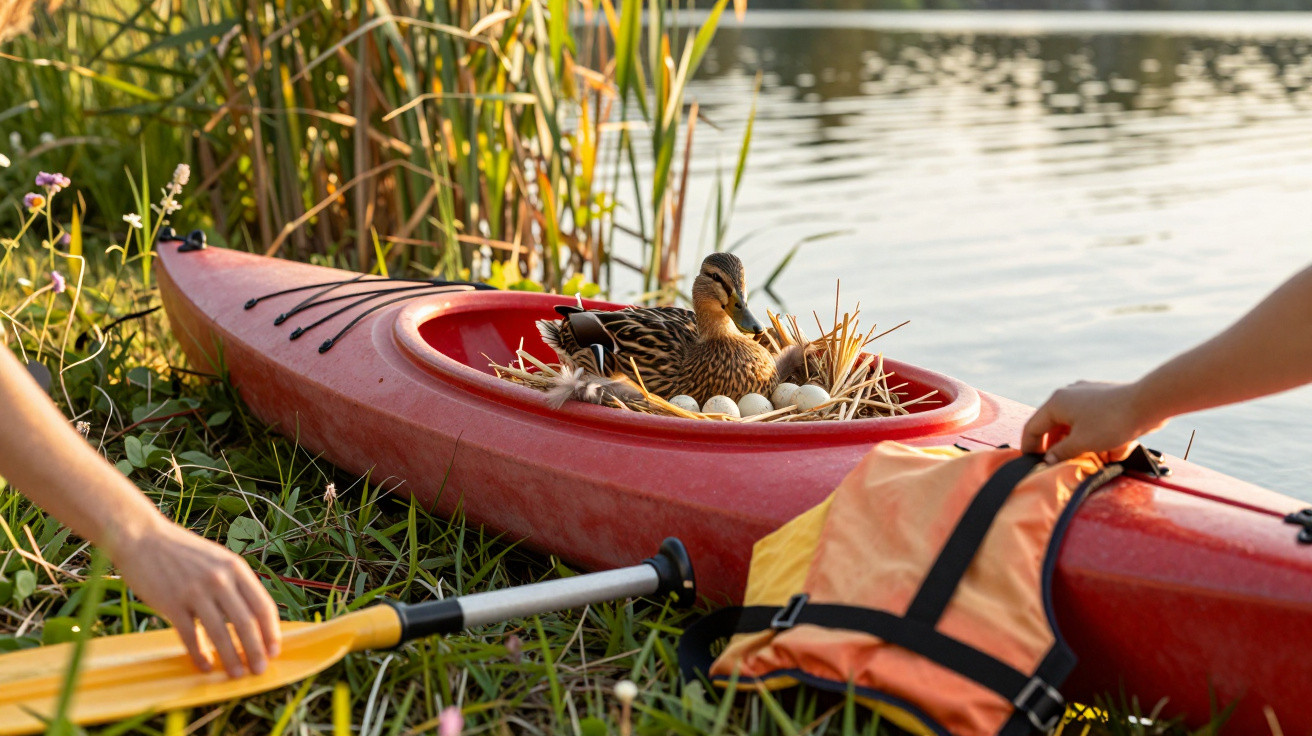
In April, the kayak had been left there almost out of habit, moored to the jetty on a small river branch where the water rarely moves much. Its owner expected to collect it again on the first fine weekends, but the weeks slipped by: work, rain and unexpected trips. Three months later, returning to see whether a heron had made a home near the hull, he stopped in his tracks. On the seat, snugly positioned between the forgotten life jacket and paddle, was a nest teeming with life. A female mallard was still incubating there, perfectly still and alert-eyed, as though the kayak had always belonged to her. It was a scene that was funny, touching and slightly bewildering. Nobody expects to find that their mooring has, in effect, been rented out to nature.
An abandoned kayak becomes an ideal refuge for a female mallard
At first glance, a kayak floating on the water hardly seems like a bird shelter. Yet, for a female mallard looking for somewhere to nest, it offers several benefits: a slightly raised surface, a spot that foxes struggle to reach and, above all, peace and quiet once people stop coming by. The hull, straps and seat can even create a kind of protective hollow. We tend to picture ducks concealed among reeds, well away from view. In developed areas, though, they are equally capable of making use of our belongings. Wildlife does not always ask permission before moving in.
The mallard is among the most familiar species found along French riverbanks, yet it can still surprise us. The female makes her nest from grass and leaves, then lines it with down pulled from her own feathers to keep the eggs warm. A clutch commonly contains between 8 and 13 eggs, which are incubated for around 28 days. In the kayak, the owner initially noticed a silent brown shape. He mistook it for a soaked bag until the duck lifted her head. Behind her, several broken shells revealed what had happened while he was away.
Once a boat has remained still for some time, this choice of nesting site is not so unlikely. Birds are less concerned with how attractive a place looks than with its practical safety: minimal disturbance, shelter from predators, food nearby and quick access to water. A quiet mooring often provides all of these things. Honestly, few people inspect their kayak every day. It is in these ordinary gaps that nature makes its presence felt. The expected heron stayed on the bank; the female mallard had claimed the best available spot.
What should you do if a nest appears in your boat?
The first rule is not to touch the nest or move the kayak while the female is incubating or before the ducklings have left. Even well-meaning interference may cause abandonment, particularly if the bird feels exposed. Watch from a distance, avoid sudden movements, and make children or curious walkers aware of the situation. If the kayak absolutely must be used, the most sensible option is to contact a wildlife rescue centre, the local bird protection organisation (LPO), or the French Office for Biodiversity. A few days of patience can prevent considerable harm.
The most common mistake is wanting to “put things right” straight away. An owner may worry about mess, mosquitoes, neighbours’ reactions or damage to their equipment; such concerns are understandable. However, removing the eggs, approaching the duck for a photograph, or moving the nest onto the bank are all poor choices. The nest was selected for a reason, even if that reason does not fit our own logic. Once the young have hatched, their mother will usually lead them to the water fairly quickly. The kayak can then return to its usual purpose, perhaps with a few feathers, some down and a story to tell.
One simple principle can help you remain calm during this unexpected encounter:
“Watching without intervening is often the best service we can offer a wild animal.”
Before taking back the kayak, a few precautions are enough:
- keep a suitable distance and minimise noise;
- do not feed the female mallard or ducklings bread;
- take photographs from afar, without flash;
- record the date and contact a specialist if there is an injury or genuine danger.
The right response is not a dramatic one. It simply requires a little restraint, which is not always easy when the surprise is so delightful.
When our belongings quietly become part of the landscape
This kayak story is a reminder that the boundaries between our routines and the living world are more fragile than we might think. A moored boat, flowerpot, old shed or planter can become a sought-after shelter for a season. The female mallard did not see an expensive piece of leisure equipment or an inconvenient object: she found a peaceful platform beside the water. Perspective changes everything. Such encounters also encourage us to look more closely at places we believe we know, especially in spring, when every nook may shelter a nest.
| Key point | Detail | Benefit for the reader |
|---|---|---|
| A kayak can become a nesting site | A stable, rarely used hull can provide temporary shelter for a female mallard. | Understand an unusual scene without dismissing it as a mere anecdote. |
| Do not move the nest | Mallard incubation lasts around 28 days. | Avoid putting the eggs or ducklings at risk. |
| Observe and seek advice | The LPO, a wildlife rescue centre or the French Office for Biodiversity can offer guidance if you are unsure. | Respond calmly, even if the boat needs to be retrieved quickly. |

















Comments
No comments yet. Be the first to comment!
Leave a Comment