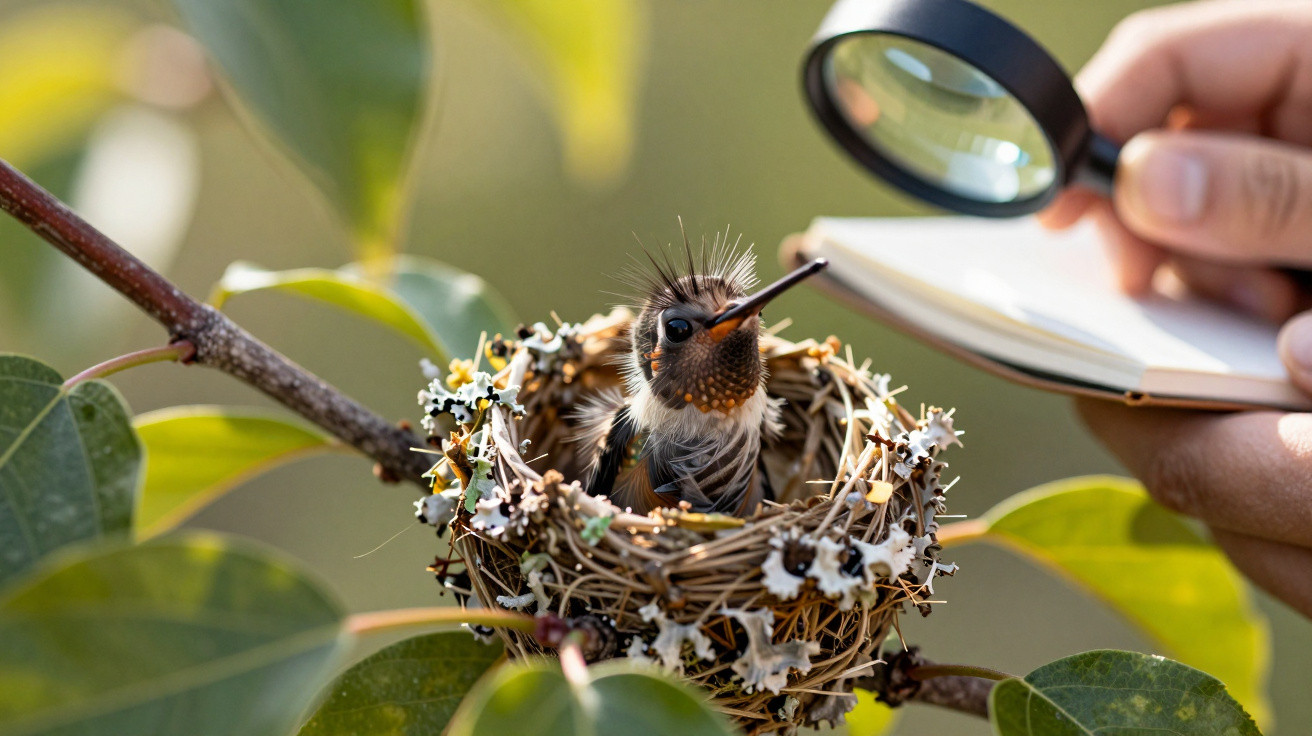
At first glance, the small creature in the nest could easily be mistaken for a hairy caterpillar. However, researchers in Panama were looking at a newly hatched hummingbird chick, whose unusually long, fluffy back feathers prompted an intriguing theory about how it might avoid predators.
Which hummingbird caught the researchers’ attention?
The chick is a white-necked jacobin, a species scientifically known as Florisuga mellivora that occurs in tropical parts of the Americas. While monitoring a nest in Panama, researchers saw something unexpected when the egg eventually hatched.
Rather than having the look usually associated with very young hummingbird chicks, the hatchling had many long, soft feathers across its back. Covering much of its dorsal area, they dramatically altered its outline and made it strikingly similar to some hairy insects.
Why does it look so much like a caterpillar?
Some caterpillars have hairs or structures that serve as protection, potentially causing predators to avoid touching them. The tiny hummingbird’s appearance recalled precisely this kind of animal, suggesting that its unusual feathers may act as a form of defensive disguise.
The idea became even more compelling because the resemblance was not limited to its appearance. Researchers also recorded movements by the chick that resembled the behaviour of certain caterpillars when disturbed, supporting the possibility that its shape and movement work together.
Does the chick really mimic a dangerous caterpillar?
It is a fascinating possibility, but it should still be regarded as a hypothesis. To claim mimicry with greater confidence, it would be necessary to show that potential predators genuinely mistake the chick for a caterpillar, or avoid attacking it because of that resemblance. A single observation cannot answer all of these questions.
For now, several features explain why scientists find the possibility noteworthy without treating it as a definite conclusion:
- The dorsal feathers are exceptionally long and fluffy for a newly hatched hummingbird chick.
- The outline created by the feathers resembles hairy caterpillars that other animals may avoid.
- The chick made body movements similar to responses seen in some caterpillars.
- Further observations of nests and encounters with predators are still needed to test the explanation.
Watch the video shared by the YouTube channel Animals Channel, showing the hummingbird that hatched covered in long feathers.
Could it simply be a form of camouflage?
Yes, and this is another explanation considered by the researchers. Long feathers may help the tiny animal blend in with materials surrounding the nest, making it harder to identify from a distance. In that case, the benefit would lie less in looking dangerous and more in simply going unnoticed.
The two explanations do not necessarily exclude one another. A feature that makes the chick less conspicuous could also resemble an organism that predators find unappealing. Establishing which effect actually occurs will require monitoring more individuals under natural conditions.
What remains to be discovered about this unusual disguise?
Future nests may prove crucial. Scientists need to find out whether other chicks of the species have the same feathers, repeat the observed movements and, above all, how predators respond to them. Only then will it be possible to determine whether this is truly mimicry, camouflage or a combination of both.
For the moment, this little hummingbird is a powerful reminder of how much remains to be discovered in nature. It is worth following future observations, because something as small as a feather may reveal a survival strategy that has gone unnoticed for a long time.

















Comments
No comments yet. Be the first to comment!
Leave a Comment