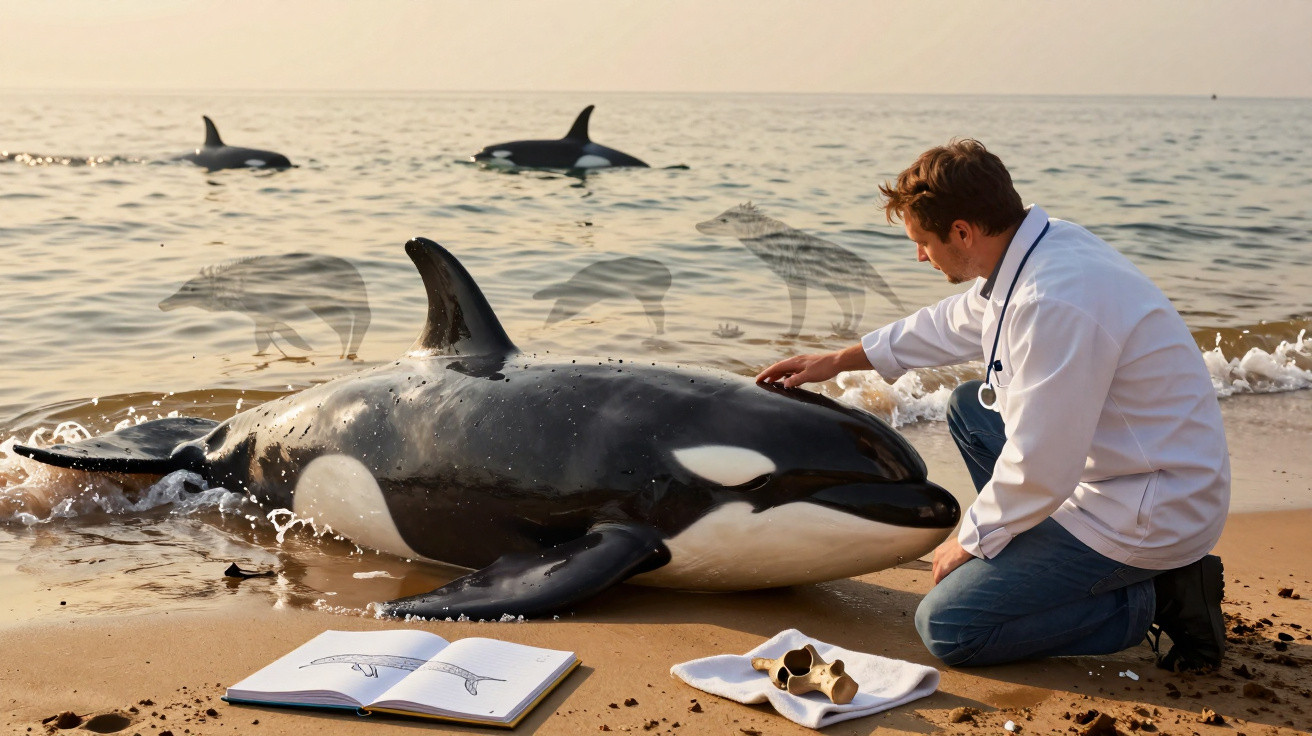
Far offshore, an orca cuts through the dark water as quietly as a breath. A few metres away, her calf stays in her wake, already learning when to breathe, how to follow the pod and how to interpret the sea’s unseen movements. From a boat, the scene can seem almost familiar: eyes, a mother, a young one, a group travelling together. Yet these animals carry the story of a permanent departure in their bodies. Their ancestors walked on four legs, long before the oceans became their sole horizon. Today, dolphins and orcas are not merely suited to water: they rely on it in their bones, skin and way of giving birth. Dry land has become a memory written into their DNA. And that history is far more astonishing than it first appears.
When orca ancestors left land behind
We all know the hesitation that comes before entering cold water, with our feet still firmly on the sand. For an orca, that hesitation disappeared a very long time ago. Its body is a remarkable marine machine: fins rather than functional arms, a horizontal tail that drives its tonnes of muscle, and smooth skin made to move through water. Hauling itself onto a beach would not be an adventure, but a physical disaster. Under its own weight, the animal could suffer crushing damage to its internal organs and rapidly become distressed. Land no longer provides it with support; it has become a hostile environment.
Fossils trace this transformation with almost unsettling clarity. Around 50 million years ago, the earliest ancestors of cetaceans still looked like small land mammals, similar to large dogs with long legs, living near waterways. Pakicetus, discovered in Pakistan, is often named as one of the oldest representatives of this transition. It was followed by animals that could both walk and swim, before their hind limbs became smaller with each generation. Modern dolphins and orcas retain tiny pelvic bones, concealed within their flesh. They are discreet remnants, like a signature from the past.
The “point of no return” was therefore not crossed overnight, nor by a single species. It developed over millions of years, as natural selection favoured those best able to thrive in water. Their lungs remained those of mammals, but everything else became specialised: underwater hearing, diving, heat regulation, nursing in water and even sleep, with one half of the brain resting at a time. Returning to live on land would mean retracing that route in reverse. In reality, such a reversal does not exist.
Why a beach is not a refuge for a dolphin or an orca
When faced with a stranded dolphin, the immediate reaction may be to pull it back out to sea as quickly as possible. The intention is admirable and deeply human. However, the best response is to contact the emergency services, maritime authorities or a local specialist stranding network immediately, then keep your distance. Avoid shouting, gathering around the animal, touching it or taking close-up photographs. A frightened cetacean may injure itself or someone else, or be returned to the water when it is ill, disorientated or too weak to swim.
A common mistake is to assume the animal “simply wants to go back”. A stranding may indicate an infection, injury, poisoning, navigational difficulty or an attempt to follow a sick member of the group. Among orcas and pilot whales, social bonds are so strong that several animals may become trapped because they are trying to remain together. Let us be honest: hardly anyone deals with this every day, so it is perfectly normal not to know what to do. The most useful approach is to keep the area around the animal calm, follow specialists’ instructions and avoid attempting an improvised heroic rescue.
Watching cetaceans without putting them at risk above all requires restraint. A successful trip at sea is not the one that gets closest, but the one that lets the animal choose the distance.
“A cetacean does not need reminding that it belongs to the sea: its entire body reminds it at every moment.”
- Choose an operator that respects viewing distances and slows down near animals.
- Never feed a dolphin, even if it approaches the boat curiously.
- Report an injured, isolated or stranded animal without pushing or moving it.
- Cut plastic waste: a modest but very practical action for the ocean.
- Share responsible images, without turning an animal into an attraction to be touched.
An irreversible evolution that changes how we see the sea
Saying that orcas and dolphins can no longer return to land does not mean they are fragile or unfinished. Quite the opposite: they are among the most highly accomplished mammals in their environment. An orca can cover exceptionally long distances, hunt cooperatively and pass on habits specific to its clan; some groups even have genuine food traditions. Dolphins, meanwhile, use echolocation with a precision we still cannot fully match. Their world is complete without us, yet it remains vulnerable to our fishing nets, underwater noise pollution, collisions and warming waters. Looking at these animals helps us understand that evolution does not draw a straight line towards humans. It opens paths, then closes them.
| Key point | Detail | Value for the reader |
|---|---|---|
| Mammals that came from land | Cetacean ancestors walked on dry land around 50 million years ago. | Understand that orcas and dolphins are heirs to a spectacular evolutionary transformation. |
| A return to terrestrial life is impossible | Their skeletons, fins, weight and physiology are entirely adapted to water. | Better understand why a stranding is an emergency, not simply a pause on the shore. |
| Observe without causing harm | Keeping a distance, staying calm and calling specialists are the right responses when a cetacean is in difficulty. | Act appropriately, without giving in to panic or the urge to intervene alone. |

















Comments
No comments yet. Be the first to comment!
Leave a Comment