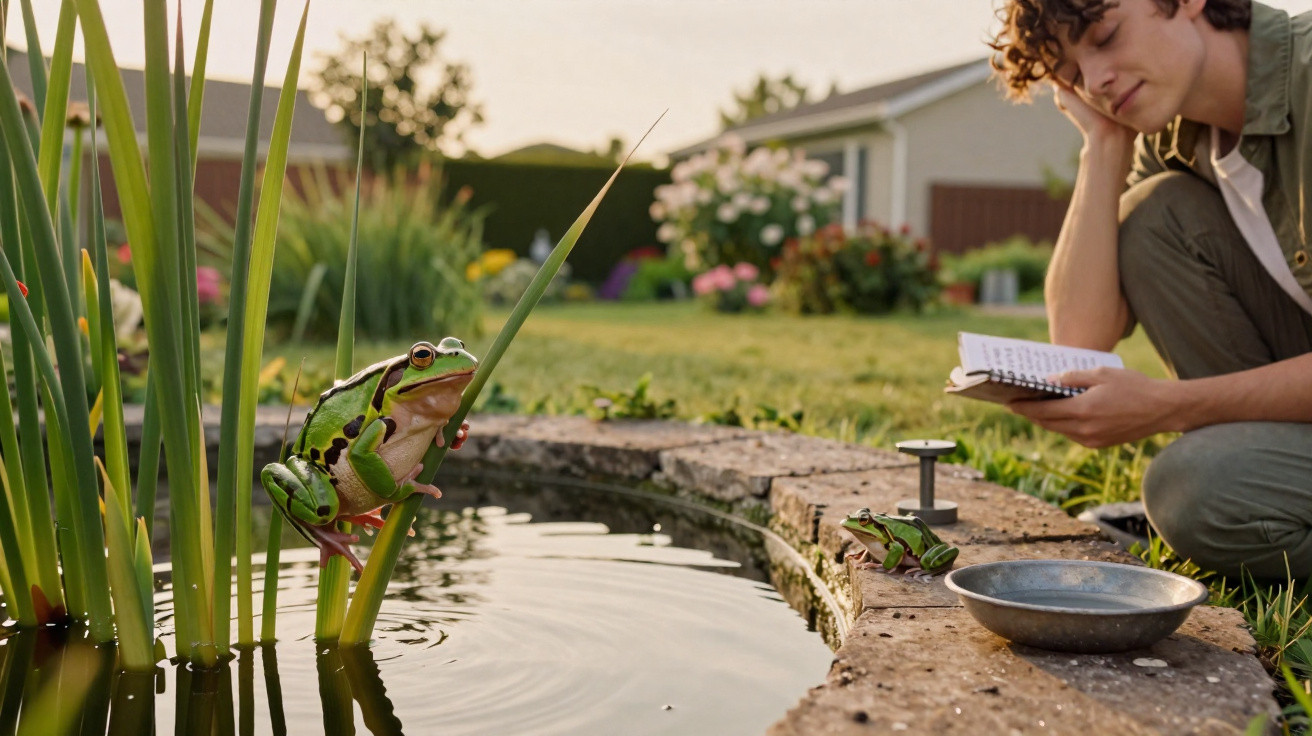
A tree frog perched on a porch rail probably did not originate in a pond. It is more likely to have begun as a tadpole in a flooded tyre track or beside a road in a ditch. Such pools may retain water for only a few weeks before disappearing.
This breeding pattern accounts for one of the greatest puzzles for people listening in their gardens. The calls can be overwhelmingly loud in one year, then almost absent in the following one.
Almost any still water works
Tree frogs require water that is still, contains no fish and remains in place long enough for tadpoles to develop. A pond is merely the version people know best.
According to the Washington Department of Fish and Wildlife, Pacific treefrog breeding habitat can be virtually any body of still or slowly flowing water.
Its examples include irrigation channels, roadside ditches, flooded puddles, deep tyre ruts and children's paddling pools.
Eastern species use similar sites. Gray treefrogs (Dryophytes versicolor) deposit eggs in tyre ruts, vernal pools and swimming pools.
When rainfall arrives, squirrel treefrogs (Dryophytes squirellus) leave upland areas for flooded ditches along roads.
Populations with dramatic swings
Running water is seldom suitable. A current disperses eggs, while streams contain sunfish and minnows that prey upon tadpoles.
Adult frogs disperse afterwards. Numerous species spend much of the year in trees and shrubs, feeding on insects around porch lights far from water.
Yet this adaptability comes at a price. Dependence on tiny, short-lived pools means tree frog numbers can fluctuate sharply between years.
Silence does not mean absence
Field biologists make a clear distinction between a survey finding and the animals actually present at a location. A silent wetland produces a non-detection, not proof of absence.
That difference led to a whole technique known as occupancy modelling.
This method relies on repeat visits to one site to calculate how frequently observers fail to detect a species that is truly there.
The adjustment is more significant than it may seem. Tree frogs call within a limited timetable, and many everyday disturbances can silence them.
Wind, strong moonlight, a passing torch beam or a nearby heron can stop a chorus within seconds.
As a result, one survey on an unsuitable night can make a healthy population appear as an empty line in the records.
Weather sets the tree frog calling schedule
As ectotherms, tree frogs have body temperatures governed by the air and water around them. Warmer water makes the muscles used for calling work faster.
The temperature cut-offs are distinct. Certain species start calling when night-time temperatures reach about 45°F (7°C), whereas others remain quiet until nights near 70°F (21°C).
Rainfall and humidity are equally important. Many species reserve their noisiest evenings for warm rain, so a dry, breezy spring may seem silent even if the population has not changed.
Temperature also affects what females hear, as call rate conveys information about breeding conditions.
For males, however, calling is costly because predators are listening as well.
A warm March, then frost
A University of Ottawa team documented this responsiveness in exceptional detail. Researchers used automated recorders at wetlands between 2022 and 2025.
An exceptionally warm March in 2024 advanced first calling dates by 11 to 18 days relative to 2022. Freezing weather subsequently returned.
In that year, calling probability declined for every species monitored by the team apart from the spring peeper (Pseudacris crucifer).
Boreal chorus frog (Pseudacris maculata) calling fell from 69 percent in typical years to 49 percent in 2024.
Although neither species spends much of its time in trees, both belong to Hylidae, the tree frog family.
When water dries up too soon
Tree frog tadpoles need standing water until metamorphosis is complete. When a breeding site dries before then, the entire cohort dies.
Ecologists refer to the period for which a wetland retains water as its hydroperiod. Cycles of booms and crashes in juvenile recruitment follow changes in this one factor.
Shallow habitats are at greatest risk. In a hot week, a ditch or tyre rut may disappear long before the tadpoles living in it are developed enough.
Drought can thus eliminate a year class without killing any adults. The chorus may sound normal that spring while producing no young, and extended dry periods make this result more likely.
Frogs face a genuine compromise. Temporary pools can dry up, but they also lack fish that would consume the tadpoles. Permanent ponds reliably retain water but are full of predators.
Groundwater extraction shifts this balance further, reducing hydroperiods in wetlands not replenished by rainfall alone.
Die-offs that leave no trace
Ranaviruses can kill tadpoles rapidly. Within only a few days, hundreds or thousands of larvae that appeared healthy can shift from normal conditions to more than 90 percent dead.
Scientists at the U.S. Geological Survey have associated ranavirus die-offs with more than 25 states and over 20 amphibian species.
Frogs in the genus Pseudacris, including peepers and chorus frogs, seem particularly susceptible.
Such outbreaks can be missed easily. Someone finding no tadpoles in July might conclude that metamorphosis ended early, rather than consider a die-off.
Bad years don’t always spell disaster
Adult tree frogs may live through several poor breeding seasons. Gray treefrogs, for instance, can survive for seven to nine years in the wild.
This lifespan provides a buffer for the population. A site may produce no froglets for two or three years yet still be filled with calling adults, since those adults hatched in earlier years.
A landmark study from 1991 illustrated this point. From 1979 to 1990, researchers surveyed four amphibian species at a breeding pond in South Carolina.
They found major variation in both the number breeding and juvenile recruitment.
Drought caused the recruitment failures. Over the study period, three of the four species had no overall trend, while the fourth increased.
Signs that tree frogs are nearby
Tree frogs reveal their presence in three ways, with sound usually being the first people notice. A chorus following warm rain answers the question more quickly than any search can.
The second clue appears on glass. The toe pads of tree frogs contain tiny column-shaped cells with mucus-tipped ends, enabling them to grip almost any surface.
This explains why they may be found pressed flat against an illuminated window at night, feeding on insects attracted by the light.
These pads also distinguish them from similar-looking frogs. Cricket frogs belong to the same family but do not have the large pads. Toads have neither these pads nor the climbing behaviour.
The third clue requires a daytime search. Regularly watered potted plants can offer dependable shelter, as can any moist, shady place close to the house.
Colour is the least useful indicator. Gray treefrogs can change between green, grey and brown, and gray treefrogs and Cope’s gray treefrogs are visually identical.
Their calls are the only way to tell them apart, as Cope’s trill is faster and higher.
Small changes help the most
The most helpful individual action costs nothing: stop spraying.
Amphibian eggs have no protective shell. They take in moisture directly from the water around them, together with anything dissolved in that water.
After rain, lawn chemicals can also run off and reach wetlands far beyond a property's boundary.
Adult skin works in the same manner. Insect repellents containing DEET are especially lethal to amphibians. Anyone considering picking one up should ensure their hands are clean, or avoid handling it altogether.
Native plants help as well. They sustain far more insects than non-native ornamental plants, and insects are the food tree frogs depend on.
Shelter is as important as food. Leaf litter, piles of brush, dense planting and uncut margins near water all give frogs places to spend the day.
Protecting tree frogs
The National Park Service also recommends keeping pets away from amphibians and covering swimming pools whenever they are not in use.
The latter advice is more important than it may first appear. Gray treefrogs can lay eggs in a pool, but chlorinated water kills the tadpoles, making an appealing breeding site a dead end.
One instruction outweighs all the others: never transfer frogs or tadpoles between sites, or introduce them to your property from a pet shop.
Either action may bring disease into areas where it was previously absent.
How to listen more carefully
One evening reveals very little to an observer. Repeated visits over a season reveal much more.
FrogWatch USA teaches volunteers to recognise frogs by their calls and to monitor one wetland throughout the February to August breeding season.
Zoos and nature centres run the chapters, while the national dataset extends back to 1998.
The protocol requires repeat visits to the same location in the same listening period after dusk, including on quiet nights. Those blank observations are important because occupancy models require them.
“That data is tracked and submitted to a national database,” said Morgan Duerksen-Balk, an East Central Illinois FrogWatch chapter coordinator.
Regularity is more valuable than intensity. The explanation for a disappearing chorus emerges only when the same listeners return to the same water year after year.
The complete study of calling phenology is published in the journal Integrative Zoology.

















Comments
No comments yet. Be the first to comment!
Leave a Comment