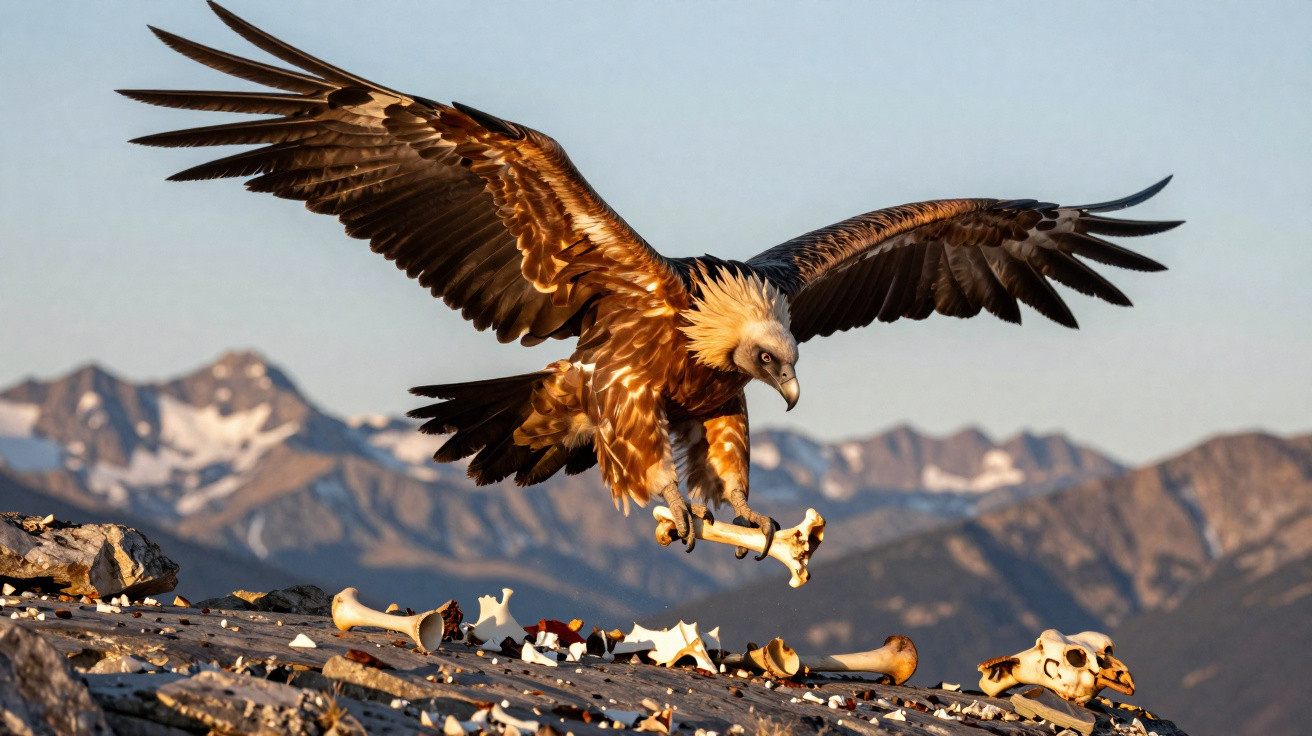
When other animals leave a carcass because little more than bones remain, the bearded vulture has found its preferred meal. Scientifically known as Gypaetus barbatus, this large bird of prey has evolved an exceptional specialism: bones can account for around 85% to 90% of its diet, a resource that almost no other vertebrate uses in this way.
How can the bearded vulture eat bones?
Its digestive system provides the first part of the answer. A study published in Scientific Reports notes that the bearded vulture’s stomach lining has a high concentration of acid-secreting cells. This produces conditions capable of breaking down the mineral structure of bones and releasing nutrients that would remain unavailable to many other animals.
This adaptation means the bird can swallow remarkably large pieces. The Vulture Conservation Foundation reports that bearded vultures can eat bones as large as sheep vertebrae. Rather than competing immediately with other scavengers for fresh flesh, they can wait and feed on what is left once their rivals have finished.
What happens when a bone is too large?
Not every piece will fit in its beak or can be swallowed whole. If a bearded vulture comes across an oversized bone, it carries it into the air before dropping it onto rocky ground. The impact can shatter the bone into smaller fragments, which the bird then retrieves and swallows.
This method requires both accuracy and learning. According to the Vulture Conservation Foundation, the bird may climb to roughly 100 metres before releasing a bone, while young birds can take years to fully master the behaviour. Its feeding strategy therefore relies on an unusual combination of anatomy, specialised digestion and learned skill.
- Most of the bearded vulture’s diet can consist of bones from dead animals.
- Smaller pieces can be swallowed almost whole and processed by its digestive system.
- Large bones may be carried through the air and dropped onto rocks to break apart.
- Marrow and the organic components within bones provide valuable energy and nutrients.
Do bones really provide enough food?
Although they look dry and lacking in nourishment, bones contain important resources. Research led by biologist Antoni Margalida found that even old bones retain considerable nutritional value. Alongside their protein matrix, fresh bones may still hold fat-rich marrow, making them an energetically useful food for a species equipped to digest them.
Bones offer another benefit: they remain available long after muscles and organs have vanished. The study points out that skeletons left in mountain environments can dry out yet stay usable for extended periods. What appears to be worthless remains can therefore become a kind of food reserve distributed across the landscape.
Watch the video shared by the YouTube channel ANIMAL TV, showing the most extreme hunting habits of a bearded vulture.
Why do almost no other animals do the same?
Making bone a primary food source requires an animal to overcome two challenges at once: breaking or swallowing a rigid structure, then digesting it. Many predators eat marrow or crush small bones, but few have adaptations that allow bone material to form the foundation of their diet as comprehensively as Gypaetus barbatus.
This specialism also lessens competition. While other scavengers fight over soft tissue shortly after an animal dies, the bearded vulture uses a part of the carcass that most of them overlook. What may seem like a dietary restriction instead becomes an ecological advantage, granting access to an abundant resource with little competition.
What does the bearded vulture reveal about adaptation?
The bearded vulture demonstrates how evolution can lead an animal to occupy a highly specific feeding niche. Its bone-breaking behaviour, combined with a digestive system designed to process bones, allows it to use an energy source that would otherwise remain scattered in the environment after other animals have gone.
The next time a skeleton seems to mark the end of a meal, it is worth remembering that, for this bird, it may only be the beginning. Learning about and protecting such specialised species means safeguarding biological solutions that took countless generations to emerge, while also preserving the vital work scavengers perform in the ecosystems they inhabit.

















Comments
No comments yet. Be the first to comment!
Leave a Comment