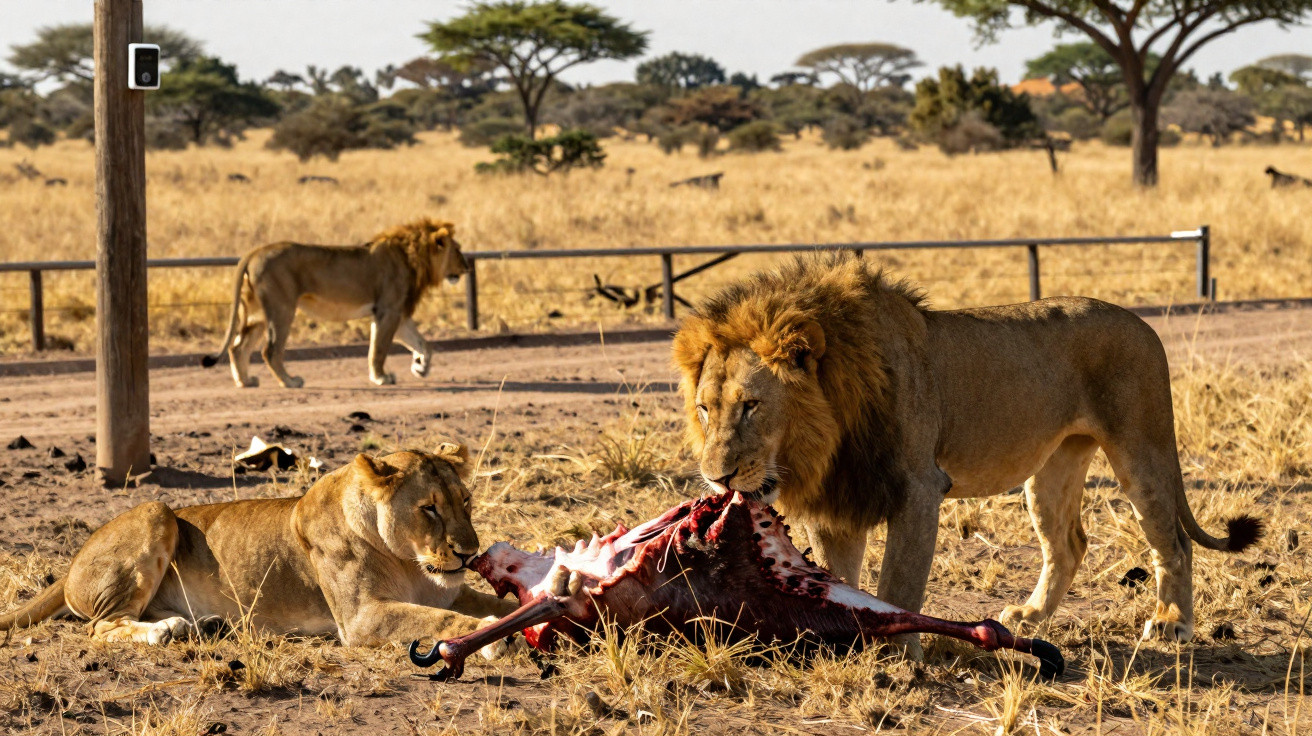
Zoo lions are commonly fed to a regular timetable, whereas wild lions face a far more uncertain supply of food.
Following a successful hunt, wild lions may consume an enormous meal before resting for extended periods; failed hunts, however, may mean going without food for days.
Feeding in zoos is usually arranged differently, with prepared meat portions delivered every day or on most days.
Although these portions can fulfil nutritional requirements, they remove much of the physical effort and the lengthy intervals without food experienced by wild lions.
A study at Monarto Safari Park in South Australia examined what occurs when zoo-feeding is timed more like the natural pattern.
Rather than considering only the period immediately after food was offered, the researchers followed behaviour through an entire feast-and-fast cycle.
Wild lions feast then fast
In the wild, lions typically eat once every 1.5 to 2.5 days, though fasting spells lasting as long as eight days have been recorded.
Their considerable size and stomach capacity enable them to consume very large meals in one sitting and then rest while the food is digested.
“Wild lions don’t eat at the same time every day. They experience natural periods of feasting and fasting depending on hunting success,” said lead author Lesia Hryhorenko of Adelaide University.
“We wanted to understand how African lions in human care respond when feeding routines more closely resemble those natural patterns.”
Carcasses changed feeding routines
Researchers observed seven African lions over three months, although the altered feeding regime was given to only three nine-year-old males.
The remaining four lions continued with their standard routine, but the two groups had already shown differences before the study started.
Across the eight-week experimental phase, the three males were given roughly 200 kilograms (440 pounds) of whole kangaroo or goat carcasses every nine days.
Carcasses were left accessible for two to three days, after which the lions had no food for six to seven days. Eight infrared cameras captured 10-second recordings every five minutes, day and night.
This approach allowed the team to monitor behaviour during daylight and darkness, post-meal rest, and the later fasting days, rather than observing only the period soon after food was supplied.
Whole carcasses made lions feed longer
On days when carcasses were provided, average daily feeding time increased from 25.7 minutes in the pre-carcass baseline period to 76.4 minutes.
Feeding episodes were also more frequent, while the interval between the first and final recorded feeding event occasionally extended to three hours and 35 minutes.
“Providing whole carcasses changes much more than the nutritional content of the diet,” Hryhorenko said.
“It gives lions the opportunity to engage in behaviors such as tearing, pulling and manipulating food over extended periods, which are important components of their natural feeding ecology.”
Lions rested after big carcass meals
Resting was the most pronounced change after food was given. During the first three days of the cycle, when the carcasses were available, the lions spent substantially more time lying down than they did during the later fasting phase.
Lying down represented 52.5 percent of observations across days one to three. This dropped to 30.4 percent on days four to six, and to 17.0 percent on days seven to nine.
Movement followed the reverse trend. Locomotion, defined as ordinary movement between places, was at its lowest soon after feeding and rose through the middle and latter fasting days.
This pattern broadly mirrors the rhythm observed among wild lions: substantial feeding, followed by rest, then increased movement as more time elapses before the next meal.
However, the study identified only a comparable pattern in this small zoo group; it did not demonstrate that the lions were in the same physical or mental condition as wild animals.
Pacing followed daily routines
The scientists also measured pacing, which is repeated movement along an identical path.
Because pacing in zoos can sometimes be associated with anticipation, the team investigated whether it would increase steadily as the lions spent longer without food.
Pacing was greater during the second month of carcass feeding than in the earlier baseline period. It did not, however, increase in a distinct step-by-step progression during individual nine-day feeding cycles.
Instead, there were two daily peaks, from nine to 10 in the morning and from three to four in the afternoon.
These periods coincided with routine keeper arrivals and enclosure transfers, indicating that consistent management activities may have had a greater influence than hunger by itself.
The researchers likewise found no rise in aggression or social instability around the carcasses. The paper notes that observations were assessed at group level, meaning the cameras could not reveal each lion's individual response.
Longer monitoring sees more
“Many zoo studies focus only on what happens immediately after food is provided,” added Associate Professor Alexandra Whittaker.
“Our results show that feeding schedules can influence behavior for days afterwards, making it essential to look at behavioral patterns across the entire feeding cycle rather than a single feeding event.”
This is significant because the cameras recorded behaviour during every hour of the day over three months.
Brief observations conducted only in daytime might have overlooked nocturnal feeding, prolonged resting after large meals, and changes that emerged several days into a fast.
Behavior changed, but welfare is unproven
Only three adult males were included in the carcass-feeding group.
The four comparison lions varied in both age and sex, and the groups displayed different behaviour at baseline; consequently, the researchers did not make direct experimental comparisons between them.
The new feeding approach also coincided with changes to enclosure use, which may have influenced both pacing and how visible the lions were to cameras.
Behaviour was scored for the group rather than by identifying individual lions, so differences between animals may not have been detected.
Crucially, the study examined behaviour rather than direct physical indicators connected with welfare.
Whole carcass feeding altered when lions fed, rested, moved and paced, yet these behavioural shifts alone cannot establish that welfare improved.
The findings indicate that feeding schedules may influence lion behaviour for several days, rather than only at the moment food is supplied.
Research involving more zoos and social groups, alongside physical health measurements, could determine whether comparable routines provide wider welfare benefits.

















Comments
No comments yet. Be the first to comment!
Leave a Comment