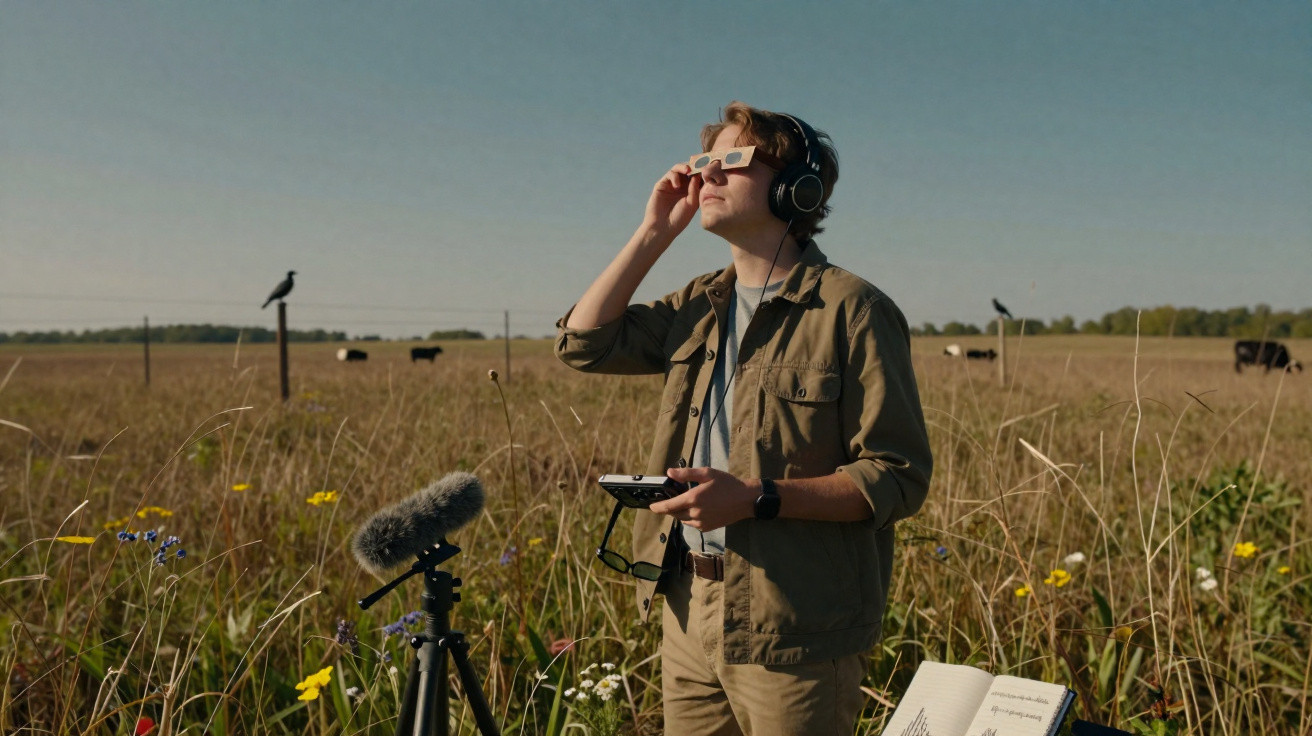
A total solar eclipse does more than darken the sky. For several uncanny minutes, it overturns the familiar patterns of daylight: illumination falls rapidly, temperatures decline and the world seems, briefly, to pause.
For scientists investigating animals’ responses to abrupt changes in light, that brief period is invaluable.
During the total solar eclipse of April 2024, a research team treated grasslands in the Midwestern United States as a natural experiment.
Rather than observing animals visually, the researchers examined what they could hear. Sound is central to life on prairies: birds vocalise, insects buzz, frogs chirp, and human-made noise comes and goes.
Together, these sounds create a “soundscape” – the combination of natural and artificial noise that gives a location its auditory character.
The researchers aimed to establish how this soundscape changes when daylight abruptly fades in the middle of the day, and what this reveals about the way animals use light signals to organise their behaviour.
Listening rather than watching
Light levels shape many biological patterns, including seasonal migration and breeding. The researchers asked whether removing sunlight without warning would make prairie communities behave as though dusk had arrived, or whether their response would be entirely different.
They investigated this using passive acoustic monitoring: specialist recording equipment that captures animal vocalisations without disrupting the animals. Recorders operated in the days preceding the eclipse, throughout the eclipse and afterwards.
The team compared soundscape diversity, complexity and intensity across three sites in Ohio: Larry R. Yoder Prairie Learning Laboratory, the Tecumseh Nature Preserve and Highbanks Metro Park.
Solar eclipses and animal behaviour
The findings revealed a more complicated picture. Although the eclipse coincided with changes in the volume of sound and the types of sounds present, it did not cause a striking change in acoustic complexity.
“Solar eclipses are wonderful events that let us experiment in natural settings what sudden losses of light could be doing to animals,” said Madison Von Deylen, the study’s lead author and a PhD student in evolution, ecology and organismal biology at The Ohio State University.
She also stressed that the significance extends beyond the day of an eclipse. “Both overexposure and underexposure to light can have negative consequences on animal physiology, and only a handful of studies have experimentally assessed how eclipses influence animal behavior.”
Detecting subtle shifts through sound
The eclipse itself is not the only notable aspect of this work; the approach also matters. Instead of depending on people to watch animals – a method that can be biased, constrained and difficult to expand – the researchers used soundscape analysis to gauge an ecosystem’s response.
Von Deylen noted that sound-based research of this type remains comparatively new in eclipse studies.
“We used a fairly novel technique to accomplish this,” she said. “Acoustic monitoring and soundscape analysis has a lot of promise for being able to track changes in ecosystem composition over time.”
This is particularly important because soundscapes record more than conspicuous events. They can reveal finer changes, such as particular birds calling less frequently, insects becoming quieter, or an entire community temporarily shifting its behaviour.
Why the timing mattered
Eclipses do not occur at times chosen for biological convenience. In this instance, however, the timing made the event especially revealing.
The April eclipse occurred during the breeding season for numerous prairie birds, a period when vocal behaviour is already intense and highly structured.
As a result, the recorders captured a soundscape that was already “busy” and contained distinctive calls associated with mating and territorial behaviour.
Initially, the researchers anticipated a straightforward outcome: the sudden darkness might make the prairie sound like it does at evening. This was a sensible expectation, since dusk is among the strongest natural transitions in light that animals encounter each day.
Yet the prairie did not simply “turn into dusk.” The findings indicated that overall sound activity was, in fact, greatest on the day of the eclipse.
Changes extending beyond the eclipse
Rather than all sounds fading as though night had begun, some animals may have reacted in ways that raised total acoustic activity.
This could reflect the eclipse’s effects beyond reduced light, including changes in temperature, shifts in wind patterns, or the unusual experience of sudden mid-day “night” alongside the wider influence of moon phase and daily rhythms.
The results offer a useful reminder that animals do not react to a single factor on its own. Light is a major influence, but it is intertwined with other signals.
An eclipse is dramatic, yet it is also messy in a distinctly real-world sense – precisely what makes field studies of this kind worthwhile.
What changed and what remained stable
The team determined that the eclipse was linked to changes in sound activity and diversity. In other words, both the species contributing to the prairie soundscape and the amount of sound they produced shifted, at least for a time.
Acoustic complexity, however – a more structural indicator of how layered or intricate the overall soundscape is – changed far less.
It is possible to picture a place where sound levels vary and certain species appear or disappear, while the overall “texture” of its soundscape stays relatively steady. This seems to be closer to what the researchers recorded.
That distinction is significant. Stable complexity suggests that the ecosystem did not merely fall silent or shift entirely into a different state.
Instead, the community may have adapted: some voices became absent, while others grew more active, but the wider organisation of the sound environment remained intact.
A future tool for ecology
The researchers took care not to exaggerate their conclusions. “The conclusions that we were able to draw from this study were extremely context-specific,” Von Deylen said. “But it lays the groundwork for more complex, larger-scale studies.”
A single eclipse in one region and one season therefore cannot show how every ecosystem will respond.
Nevertheless, the work demonstrates that soundscape monitoring can identify meaningful changes during a sudden environmental disruption without needing to film every animal or attach tags to individuals.
Future research will probably improve these quantitative methods, enabling soundscape analysis to be applied more broadly in ecology and conservation. Von Deylen also made clear that she expects the field to continue expanding.
“I’m really excited to see where soundscape work goes in the next couple of decades,” she said. “It will be of great help in answering new conservation questions.”
A total eclipse is uncommon. However, the wider principle – using sound to follow ecosystems’ responses to change – could become a routine element of monitoring the natural world, particularly as environments face climate change, habitat loss and human noise.
Seen this way, the eclipse was more than a spectacle overhead. It served as a short stress test for a living landscape and a reminder that, at times, the best way to see what animals are doing is simply to listen.
The study is published in the journal Ethology Ecology & Evolution.

















Comments
No comments yet. Be the first to comment!
Leave a Comment